Send the exact assignment or rubric from your classroom and a custom sample written to it lands in 24 to 48 hours, the first one free. BIOS-150 is Chamberlain’s Human Biology with Lab course. It centers on the normal body at introductory scale, where a simulated exercise produces numbers and the write-up has to interpret them. Searches like "bios 150 week 4 assignment example", "BIOS150 sample paper", and "BIOS-150 week samples" land on this page.
What BIOS-150 is really about
Four credits go into this course, three of them theory and one laboratory, and all of them are spent on a body with nothing wrong with it. Biological principles come first, then the major organ systems, each one presented as a build with a consequence attached: this is what the part is made of, and this is what being made that way lets it do. Roughly forty eight hours of lecture sit beside thirty two of laboratory, and the laboratory here is simulated, so an exercise still has a purpose, a procedure and numbers at the end of it. Case studies run alongside both, putting a healthy mechanism in front of a person rather than a diagram.
Two registers of writing follow from that split, and mixing them is the most common structural error in the course. An explanation of a system is prose with headings, built to answer a rubric row about form, a rubric row about job, and usually one about what a change would do. A report of a simulated exercise is a document with named sections, and it is marked as a report even though nobody touched a bench. Neither shape is an essay. The work opens weekly in the classroom inside a sixteen week semester that runs as two eight week sessions, with up to six start dates across the year, and a discussion post cannot be edited once it publishes.
What BIOS-150’s assessments ask for
Weekly work is short and there is a lot of it. Most weeks carry a structure and function explanation of whatever system the reading covered, capped at a few hundred words and marked against rows that pay separately for the build, the job and an applied consequence. A simulated exercise arrives on its own schedule and produces a report with seven jobs in it: the question asked, the physiology needed to read the answer, what was done in past tense, a table of observations with units, an analysis saying why the numbers came out that way, real limits of the exercise, and a conclusion that answers the opening question. Case studies close most units, and a discussion post opens every week for points.
Where students lose points in BIOS-150
Points leave in four familiar places. The first is an analysis section that restates the results, which is easy to spot because every sentence in it could be moved up a heading without anyone noticing; analysis says why, results say what. The second is the procedure copied out of the exercise sheet in the imperative, instructions and step numbers intact, when a report says what was done. The third is human error named as the sole limitation of a run in which no human handled anything, instead of a variable the simulation held fixed and the direction it would have pushed the value. The fourth is a beautiful anatomical description with no functional consequence attached, which leaves half the rows unanswered. Bare numbers in a table finish the job.
The BIOS-150 drawers
BIOS-150 Week 1 discussion post example
Week 1 usually opens on a system you already have an opinion about, and the post is graded. On request, free, 24-48h.
BIOS-150 Week 2 organ system explanation example
The staple weekly piece: one system described so the build and the job are joined rather than listed. On request, free, 24-48h.
BIOS-150 Week 3 virtual lab report example
The full seven part document assembled from your own run, with the analysis section doing analysis. On request, free, 24-48h.
BIOS-150 Week 4 pre-lab prediction example
The short piece filed before an exercise, stating what you expect and what would show you wrong. On request, free, 24-48h.
BIOS-150 Week 5 lab results table example
Observations laid out with units and headings, plus the one sentence telling a reader where to look. On request, free, 24-48h.
BIOS-150 Week 6 sources of error discussion example
A real constraint of the exercise named, with the direction each one would have moved your value. On request, free, 24-48h.
BIOS-150 Week 7 lab background section example
Three to five cited sentences of physiology, each of which gets used again further down. On request, free, 24-48h.
BIOS-150 Week 8 physiology case study example
A healthy mechanism put in front of a person, ending on what that person would notice. On request, free, 24-48h.
Your classroom shows something else?
Chamberlain University revises courses; week counts and deliverables shift between terms. Send what your classroom shows and the desk matches it exactly.
Using a BIOS-150 sample the right way
A finished example is most useful here as a shape. Read the report sample for where each section stops, because the whole document is shorter than students expect and the analysis is longer than they expect. Read the explanation sample for how a structural detail is fastened to a consequence inside one sentence rather than left in a neighboring one. Your own observations stay yours: send the exercise sheet with your raw values and the report is assembled around them, and where the exercise is still ahead of you the sample carries every part that your numbers are not needed for. What you submit is your own writing.
How these samples are written
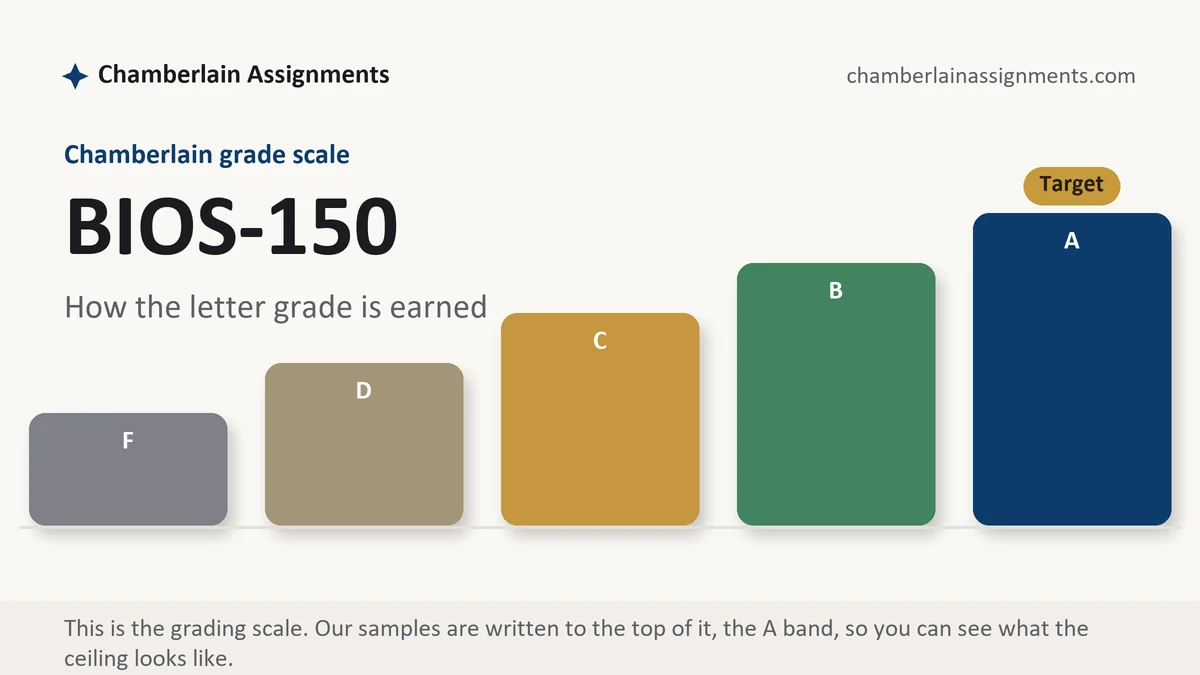
The discipline behind every paper here: the rubric is the outline, each row gets its section, one-shot discussions get the one-shot treatment, and the 76 percent floor is treated as the cliff it is. Send your week's instructions with a request and the sample matches them, revisions included.
BIOS-150 questions, answered
My simulated numbers do not match what the textbook predicts. Should the example use the textbook values?
No, and a sample built that way would cost you the heaviest row on the sheet. A result that disagrees with expectation is what an analysis section is for. Send your actual values and the example reasons from them, naming a setting in the exercise or a variable held fixed that could push a reading in the direction yours went.
Does the example cite the simulation itself?
It does, because the exercise you ran has an author and is the one source an instructor can check in a second. A sample here lists the exercise alongside the textbook and any published reference value, with mechanism claims sent to the textbook and measured figures sent to whoever measured them. Reference formatting follows whatever your section requires.
This is a prerequisite. Will the example read like a nursing paper?
It will not, and that would be the wrong register. This course is about a body that is working, so the writing stays with mechanism and normal values rather than with assessment or intervention. The clinical courses further along have their own shelves on this site. Give the week and the prompt, and the example lands at the level your own section marks.