Send the exact assignment or rubric from your classroom and a custom sample written to it lands in 24 to 48 hours, the first one free. BIOS-256 is Chamberlain’s Anatomy and Physiology IV with Lab course. It centers on the last anatomy and physiology course, where a quantity held inside a range and a probability counted from a cross carry the grade. Searches like "bios 256 week 4 assignment example", "BIOS256 sample paper", and "BIOS-256 week samples" land on this page.
What BIOS-256 is really about
Anatomy and Physiology IV is the last of the four and the broadest. Its territory runs from the gut and what crosses out of it, through energy and diet, to the kidney and the narrow windows it defends for water, salts and acid, then out again into reproduction, development and what gets passed on. Two credit hours, a portion of it laboratory time, sitting behind BIOS-255 and MATH-105N. Breadth on that scale is a hazard rather than a gift. Prompts stay narrow while the syllabus stays wide, and the answer that visits every area instead of finishing one is the commonest way a mechanism row is left unfilled.
Two kinds of writing dominate. One is the balance analysis, where something has to stay inside a window and something has moved it, and the whole answer is an accounting: what enters, what leaves, which route changed, and what the body kept or released to close the gap. The other is the inheritance answer, where the response is a worked outcome rather than a description, and the marks sit in showing the combinations and then reading a probability off them correctly. Numbers run through both. A value judged against a stated range, an amount told apart from a concentration, and a correction given a time scale are what separate a marked claim from an unmarked one.
What BIOS-256’s assessments ask for
A discussion runs every week for points and cannot be edited after it publishes, which matters in a course where a misplaced fraction is visible to the whole section. Early assignments follow the gut: what is broken down where, what crosses the wall, and what the liver does with it afterward. Nutrition and metabolism arrive next, usually as an explanation that has to cite published reference intakes rather than a popular article. Lab work turns your recorded values into a document of its own. The kidney and the balance material carry the heaviest applied pieces, where a shift in fluid, an electrolyte or acid-base status has to be traced through what gets retained and what gets excreted. The session closes on genetics, where the answer is a cross worked out and then interpreted in one careful sentence.
Where students lose points in BIOS-256
The reliable losses are numerical. Calling a value high or low without giving the range and its units leaves the judgment unsupported, and the row stays empty. Mistaking a shift in the solute for a shift in the solvent gives the right account of the wrong event, because two unrelated causes can drive the same reading, and each calls for a different correction. Writing that an organ regulates something replaces the paragraph the row wanted: regulation takes objects, and the objects are what is retained, excreted, buffered or exchanged. In genetics, a probability stretched across a whole family rather than fixed to one conception is precisely the slip the question exists to catch. Sourcing nutrition claims from popular articles and touring six topics in one answer finish the list.
The BIOS-256 drawers
BIOS-256 Week 1 discussion post example
Week 1 commonly opens on what the body holds steady and why that is harder than it sounds. On request, free, 24-48h.
BIOS-256 Week 2 digestion and absorption write-up example
Week 2 typically follows a meal through breakdown and across the wall of the gut. On request, free, 24-48h.
BIOS-256 Week 3 nutrient metabolism explanation example
Week 3 usually pairs energy use with intake figures taken from published reference sources. On request, free, 24-48h.
BIOS-256 Week 4 lab data write-up example
Week 4 in many sections turns bench readings into a table plus the interpretation it needs. On request, free, 24-48h.
BIOS-256 Week 5 urinary regulation paper example
Week 5 generally asks what the kidney keeps, what it lets go, and in exchange for what. On request, free, 24-48h.
BIOS-256 Week 6 fluid and electrolyte analysis example
Week 6 typically sets a shift in water or a single ion and wants the routes listed first. On request, free, 24-48h.
BIOS-256 Week 7 acid-base balance write-up example
Week 7 often wants the side a shift came from and which system finishes the correction. On request, free, 24-48h.
BIOS-256 Week 8 inheritance probability answer example
Week 8 ends with a cross shown in full and a probability read off it for one event. On request, free, 24-48h.
Your classroom shows something else?
Chamberlain University revises courses; week counts and deliverables shift between terms. Send what your classroom shows and the desk matches it exactly.
Using a BIOS-256 sample the right way
The value of a finished example in this course is that it shows the accounting on the page. Most students can describe the organs and still write an analysis nobody can check, because the routes were never listed before the disturbance arrived. A sample lists them first, and the difference is visible in a paragraph. Read the balance piece for how a correction gets a time scale attached, so that a fast response and a slow one stop being interchangeable. Read the genetics piece for the sentence after the grid, which is where the marks actually sit. Built against your prompt and your own recorded values, and the submission remains yours.
How these samples are written
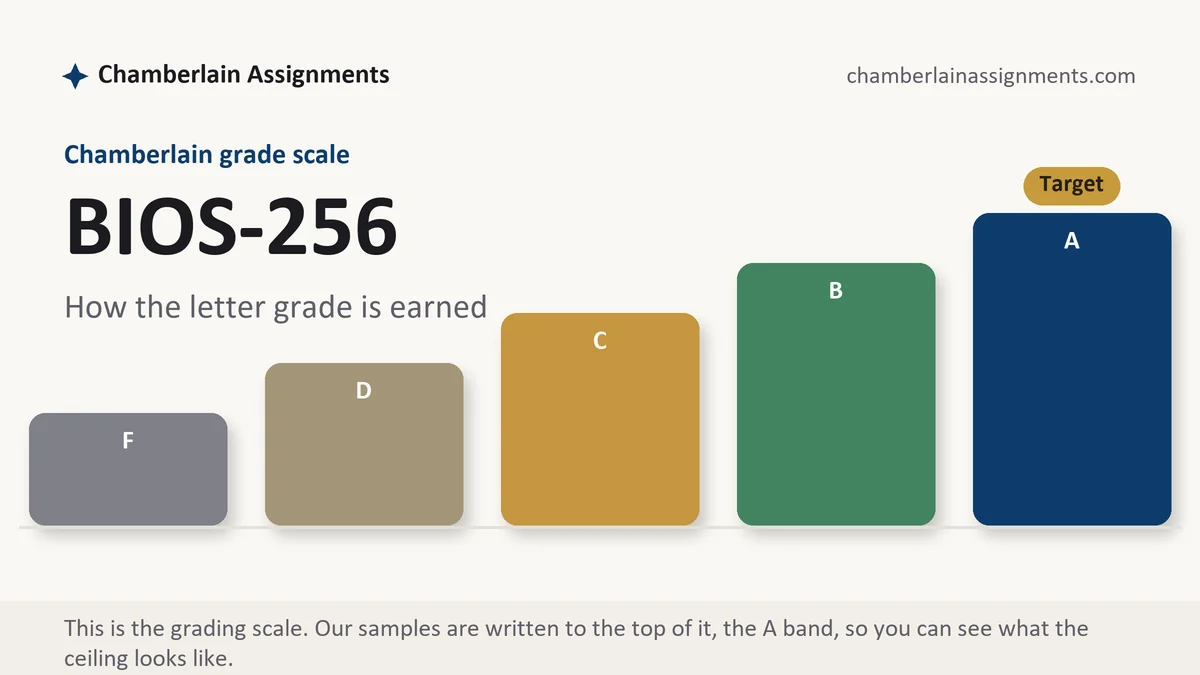
The discipline behind every paper here: the rubric is the outline, each row gets its section, one-shot discussions get the one-shot treatment, and the 76 percent floor is treated as the cliff it is. Send your week's instructions with a request and the sample matches them, revisions included.
BIOS-256 questions, answered
The prompt gives a value but no reference range. What now?
Supply the range and cite where it came from, then judge the value against it. A course textbook or a published clinical reference beats the first search result, and copying the units exactly as the source prints them keeps the comparison honest. If the number sits close to a limit, name that position; rounding it up into a tidy category hides the very thing a borderline value was put there to test.
How does a genetics cross belong in a written answer?
As a small grid or a short list of combinations, followed by prose that interprets it. State both parents in whatever notation your section uses, set out every combination they can produce, tally the ones landing in each outcome, then convert that tally into a probability for a single conception. Naming the event matters, and so does separating carrying a trait from showing it.
Six topics and one short answer. How is that not a survey?
Decide in the first five minutes which quantity or process the answer is about and write that decision at the top of the draft. Material from another area belongs in the answer when it acts on that quantity and nowhere otherwise. The phrase it is also worth mentioning is the signal that the tour has started, and depth in one chain beats coverage of six.