Send the exact assignment or rubric from your classroom and a custom sample written to it lands in 24 to 48 hours, the first one free. MPH-500 is Chamberlain’s Introduction to Public Health Systems, Organizations, & Practice course. It centers on the core functions, essential services, and agency structures that organize public health work from local health departments to federal partners. Searches like "MPH-500 week 4 assignment example", "MPH500 sample paper", and "MPH-500 week samples" land on this page.
What MPH-500 is really about
MPH-500 is the orientation course for Chamberlain's Master of Public Health, and it treats public health as a system rather than a collection of good intentions. Across eight weeks you study where the field came from, how the three core functions of assessment, policy development, and assurance divide the work, and how the ten essential services turn those functions into daily practice. You look at the layers of the system itself: local health departments, state agencies, federal bodies like the CDC, and the global organizations that sit above them. Determinants of health run through everything, because the course keeps asking why populations differ in outcomes long before anyone reaches a clinic.
The classroom rhythm is steady: discussions open the week, and written assignments close it, usually due Sunday night. Papers in many sections include an agency profile, an essay on the core functions in action, and a look at a current public health problem through the lens of the essential services. The rubric rewards specificity, so strong work names a real health department, a real program, and a real population instead of speaking in generalities. Our sample library exists for exactly that gap. Each sample paper models what specificity looks like at the graduate level, so you can see the standard before your first assignment is graded and calibrate your own writing against it.
What MPH-500’s assessments ask for
The course asks you to think in populations from the first discussion post. Early weeks typically want definitions handled cleanly: what public health is, how it differs from medical care, and which determinants shape a community's outcomes. From there the assignments often move into application, asking you to profile an agency, trace one essential service through a real organization, or examine how a health disparity persists despite programs meant to close it. Writing expectations are graduate level from the start, which means APA format, current sources, and claims tied to evidence rather than opinion. The quiet demand underneath all of it is perspective: every prompt wants you to stop reasoning about one patient and start reasoning about the conditions that produce thousands of them.
Where students lose points in MPH-500
Points in MPH-500 usually leak through vagueness dressed up as breadth. A common one: students describe a community health problem with raw counts pulled from a news article, no population denominator attached, so the claim that a problem is growing cannot actually be evaluated. Graders also mark down agency profiles that list programs without connecting any of them to a core function, which turns the paper into a brochure. Discussions lose points when replies agree politely instead of adding a source or a counterexample. And late Sunday submissions of assignments that clearly started Saturday show up in the writing: thin citations, a missing section the rubric plainly required, and a conclusion that restates the introduction instead of answering it.
The MPH-500 drawers
MPH-500 Week 1 discussion post example
Week 1 discussions often define public health against medical care; samples model a population-first opening post. On request, free, 24-48h.
MPH-500 Week 2 public health systems analysis example
Determinants of health typically anchor Week 2; a sample essay traces one determinant to one outcome. On request, free, 24-48h.
MPH-500 Week 3 agency profile example
Many sections profile a governmental agency around Week 3; samples map its work to core functions. On request, free, 24-48h.
MPH-500 Week 4 essential services analysis example
Week 4 often turns to the ten essential services; samples apply them to a real organization. On request, free, 24-48h.
MPH-500 Week 5 policy brief example
Health disparities papers tend to land midcourse; samples argue causes with rates, not raw counts. On request, free, 24-48h.
MPH-500 Week 6 stakeholder analysis example
Policy development assignments often appear in Week 6; samples connect one policy to assurance in practice. On request, free, 24-48h.
MPH-500 Week 7 program evaluation plan example
Week 7 typically builds toward the final paper; samples show a full systems argument in APA. On request, free, 24-48h.
MPH-500 Week 8 synthesis presentation example
Final submissions in many sections synthesize the whole system; samples model the closing week cleanly. On request, free, 24-48h.
Your classroom shows something else?
Chamberlain revises courses; week counts and deliverables shift between sessions. Send what your classroom shows and the desk matches it exactly.
Using a MPH-500 sample the right way
Use the samples here as calibration, not as shortcuts. Read one before you draft an agency profile and notice how it anchors every claim to a function, a service, or a named population, then hold your own draft to the same test. If the shelf does not cover the assignment in front of you, send the instructions and the rubric and we will write a custom sample to them. The first one is free and arrives in 24-48h. Students typically keep it beside their draft as a structural reference, checking section by section that nothing the rubric asks for is missing.
How these samples are written
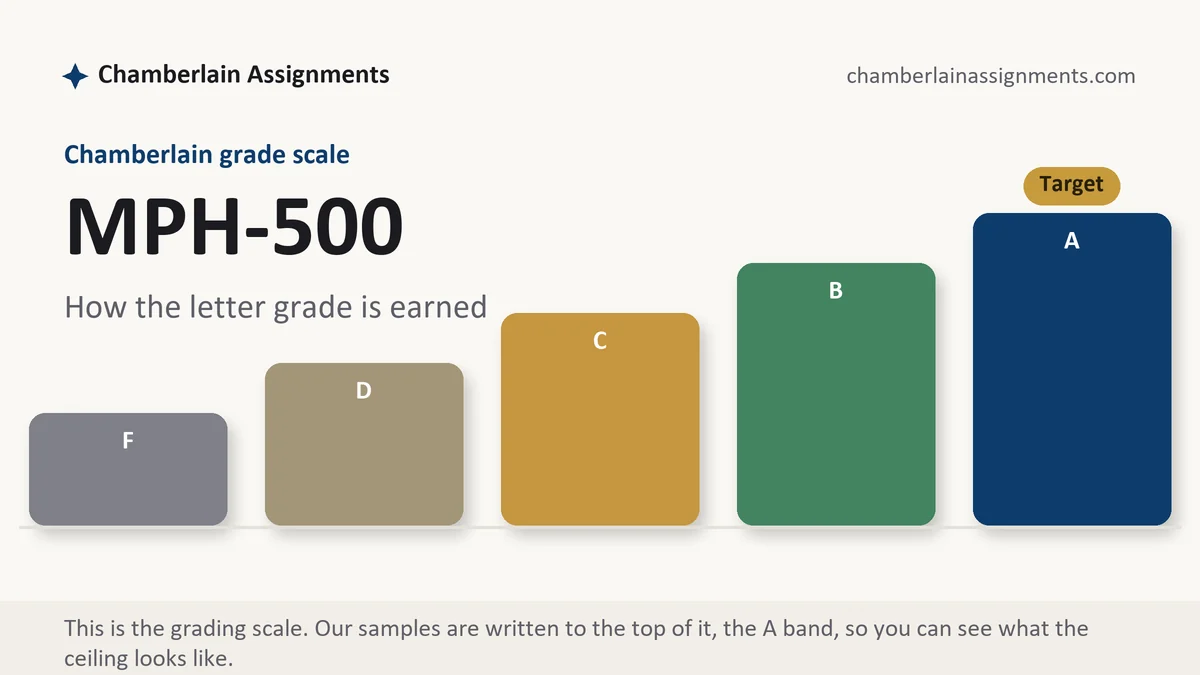
The discipline behind every paper here: the rubric is the outline, each row gets its section, one-shot discussions get the one-shot treatment, and the 76 percent floor is treated as the cliff it is. Send your week's instructions with a request and the sample matches them, revisions included.
MPH-500 questions, answered
The discussion asks me to describe a local health problem with data. What mistake should I avoid?
The usual mistake is quoting raw counts: 40 overdose deaths sounds alarming but means nothing without a population denominator and a time window. Our MPH-500 samples model the fix, stating rates per 100,000 over a defined period and naming the data source, so a reader can compare the community against the state and see whether the problem is actually rising.
If an assignment asks me to propose a response to a public health problem, how much planning detail do samples show?
Even a short proposal reads stronger with a skeleton logic model behind it. Samples for these assignments sketch inputs, activities, and intended outcomes in a paragraph, so the proposed response is something a health department could actually fund and measure. A plan that never says what changes, for whom, by how much is the pattern graders flag most, and the samples exist to break it.
My paper has to explain why a health disparity persists. Is citing a determinants framework enough?
Naming a framework is the start, not the answer. A paper that says social determinants explain the gap without tracing which determinant produces which outcome reads as decoration. The samples walk one determinant at a time, housing to asthma, transportation to missed screenings, so the explanation has a mechanism. If your prompt differs, send the instructions and rubric for a free custom sample in 24-48h.