Send the exact assignment or rubric from your classroom and a custom sample written to it lands in 24 to 48 hours, the first one free. MPH-598 is Chamberlain’s Student Success and Self-Care course. It centers on the working week of a graduate student examined as a case, with a plan specific enough to check a month later. Some program versions carry this course as MSW-500; the same drawers apply. Searches like "mph 598 week 4 assignment example", "MPH598 sample paper", and "MPH-598 week samples" land on this page.
What MPH-598 is really about
MPH-598 is the one-credit orientation every public health student takes, and Chamberlain runs the same course for the MSW as MSW-500, so the room holds two programs at once. The pairing matters, because the people sitting in it are almost always already working. Its subject is the arithmetic almost nobody does before enrolling: a graduate term placed on top of a job, a commute and a household, and what has to give when those land in the same evening. Chamberlain Care supplies the vocabulary, and the course asks you to apply that vocabulary to yourself. It is short, it carries a rubric, and what it produces is graded and recorded exactly as a core course would be.
The other half treats self-care as a competency rather than as advice. Burnout, compassion fatigue and attrition among working health and human services professionals are documented in a literature you can cite, and that literature is what separates this course from a page about balance. The deliverable is analytic rather than confessional: it runs the circuit of a case write-up, except that the subject under examination is the person writing it. First person is permitted and it has rules, carrying what you did and chose while the general claims stay with the sources. That alternation is most of what makes a graduate reflection read as graduate work rather than as a diary. Where a prompt names a reflective model, use its own vocabulary.
What MPH-598’s assessments ask for
Written work is small, weekly and cumulative rather than one long paper. Early pieces usually count the week itself: hours actually committed, the fixed points that nothing moves around, and the collisions between them. Sections then narrow to a single constraint and ask why that one was chosen ahead of the others, which is the analytic move the rubric is watching for. Middle assignments attach evidence, and the sources that transfer are about working adults, caregivers and health workers rather than general advice literature. Later pieces turn practical: a boundary stated out loud to an employer or a family, the order in which you would ask for help, and a plan carrying a date. Discussion threads run weekly for points and are personal by design.
Where students lose points in MPH-598
Marks go missing in four familiar places. The first is sincerity standing in for specificity, since a page on the importance of balance describes a feeling while hours, days and triggers describe a plan. The second is an empty evidence row, because reflective writing at this level still cites, and a strategy defended by resolve alone leaves a grader nothing to mark. The third is a plan with no failure mode, since every schedule breaks in a bad week and naming the break is often worth more than the schedule was. Fourth is ignoring the support that already exists, so program resources, workplace arrangements and family agreements go unmentioned and self-reliance reads as an incomplete answer. Treating a one-credit course as ungraded finishes the damage.
The MPH-598 drawers
MPH-598 Week 1 discussion post example
Week 1 usually opens on what the term is going to cost in hours and what you expect to give up for it. On request, free, 24-48h.
MPH-598 Week 2 workload audit example
An early piece in many sections counts the real week: committed hours, the fixed points, and where two obligations sit together. On request, free, 24-48h.
MPH-598 Week 3 constraint analysis example
Sections commonly ask for one target chosen ahead of the others, with the reason for choosing it argued rather than asserted. On request, free, 24-48h.
MPH-598 Week 4 burnout evidence brief example
Mid-term work often attaches published evidence on workload, sleep or professional burnout to the target you named. On request, free, 24-48h.
MPH-598 Week 5 boundary setting script example
Many sections want what you would actually say to an employer or a family, written out instead of described. On request, free, 24-48h.
MPH-598 Week 6 support network map example
A later assignment typically names who you would ask for help and in what order, including resources the program already provides. On request, free, 24-48h.
MPH-598 Week 7 self-care plan example
The centerpiece in most sections: strategies specific enough to schedule, with the barriers and the responses to them set alongside. On request, free, 24-48h.
MPH-598 Week 8 plan review memo example
Final week often revisits the plan against what happened, closing on a measure and a date instead of an intention. On request, free, 24-48h.
Your classroom shows something else?
Chamberlain University revises courses; week counts and deliverables shift between terms. Send what your classroom shows and the desk matches it exactly.
Using a MPH-598 sample the right way
Read an example for its proportions before anything else. Weak submissions spend three quarters of their words on the situation and one paragraph on the plan, when the rubric is paying for the plan and the evidence. A sample shows where the description is supposed to stop. Look at how one constraint gets chosen and defended, at where the citations sit and where they deliberately do not, and at the closing section, which turns a reflection into something with a date and a measure fastened to it. Your own week supplies every number, and what you submit is still written by you.
How these samples are written
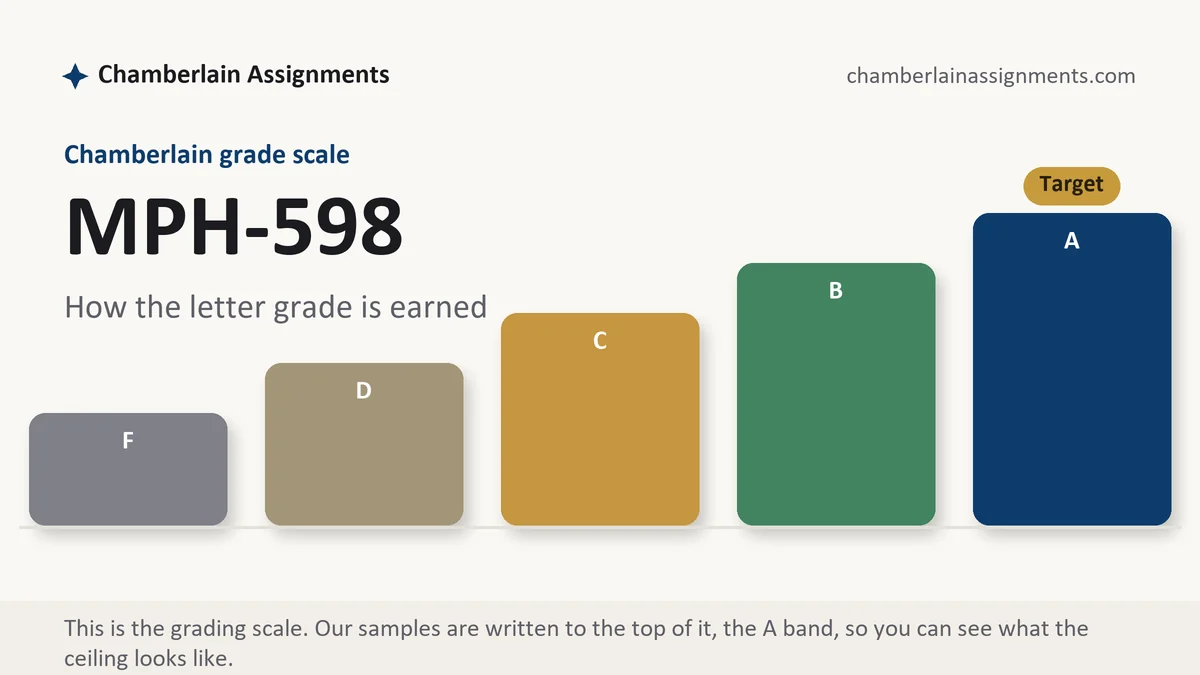
The discipline behind every paper here: the rubric is the outline, each row gets its section, one-shot discussions get the one-shot treatment, and the 76 percent floor is treated as the cliff it is. Send your week's instructions with a request and the sample matches them, revisions included.
MPH-598 questions, answered
How much of my own life has to go into this?
Enough to make the plan checkable. What the rows pay for is commitments, hours and the points where two of them collide, none of which is private history. A night shift, a commute and a Sunday deadline will carry an entire piece. If a prompt appears to reach past what you want to hand over, work at the level of the constraint and leave the cause out of it.
My code is MSW-500. Is that the same course?
Same course and the same deliverables, and an example is built for either program. Chamberlain teaches this one credit to both, so the workload problem and the evidence on professional burnout hold across public health and social work alike. What changes is the population you write about and the sources you reach for, and naming your program beside the prompt is all it takes to put the example in the right one.
The plan I wrote earlier in the term did not work. What do I submit?
The failure, treated as the material. A piece that reports what gave way, what pressure it gave way under, and what took its place will outscore one describing a schedule that held, since the marks sit on the examination and not on the outcome. Locate the break precisely, tie it to published work on why that kind of strategy fails, then attach a measure and a date to the replacement.