Send the exact assignment or rubric from your classroom and a custom sample written to it lands in 24 to 48 hours, the first one free. MSW-504 is Chamberlain’s Human Behavior in the Social Environment I course. It centers on the theories social workers use to read behavior in context, from ecological systems to the strengths perspective, applied through early life stages. Searches like "MSW-504 week 4 assignment example", "MSW504 sample paper", and "MSW-504 week samples" land on this page.
What MSW-504 is really about
MSW-504 is usually one of the first courses in the Chamberlain MSW sequence, and it does the quiet structural work of the whole program: it hands you the theories every later assessment leans on. Systems thinking, Bronfenbrenner's ecological model, attachment, learning theory, and the strengths perspective come at you quickly, and each week asks you to read a slice of human behavior through one of them. The organizing idea is person-in-environment, the claim that behavior only makes sense inside family, community, culture, and policy. Weeks move through infancy, childhood, and adolescence, so you are constantly matching a developmental stage to a theoretical lens and defending the match in writing.
The eight-week format leaves no slack. In most sections a discussion opens the week, replies follow midweek, and the written assignment closes out Sunday night, so theory you met on Tuesday shows up in an application paper five days later. The classroom threads reward specificity: a post that names a theorist, cites the text, and ties the concept to a concrete case reads very differently from one that summarizes the chapter. Grading runs on rubrics and points toward a letter grade, and the criteria usually weight application over recall. That is the real adjustment for people arriving from other fields: MSW-504 rarely asks what a theory says, it asks what the theory lets you see.
What MSW-504’s assessments ask for
Expect steady written output rather than exams. Most sections run weekly discussions with required replies, two or three theory-application papers, and a culminating biopsychosocial assessment built on a case vignette. The application papers typically hand you a scenario, a client age, or a film character and ask you to interpret the behavior through an assigned lens, with the rubric checking whether you used the theory's actual concepts or just its name. The biopsychosocial usually arrives late in the session and asks for a full picture: biological factors, psychological history, social context, strengths, and a formulation that holds them together. Some sections add a genogram or an ecomap, and nearly all of them want APA form, current sources, and clean, de-identified case detail.
Where students lose points in MSW-504
The paper that sinks letter grades here is the biopsychosocial that behaves like a diagnostic worksheet. It lists symptoms, reaches for a label, and treats the person's environment as a demographics line instead of the analysis itself. Faculty read that as a category error: this course exists to train the person-in-environment habit, so an assessment that never asks what the housing situation, the school system, or the family's migration history is doing to the behavior loses the application points even when every clinical observation is accurate. The same failure shows up small in discussions, posts that quote Bronfenbrenner and then describe only the individual. Points follow the frame. When the environment does real explanatory work in your writing, the rubric rows almost fill themselves.
The MSW-504 drawers
MSW-504 Week 1 discussion post example
Week 1 typically opens with an introductions discussion and a short paper on person-in-environment thinking. On request, free, 24-48h.
MSW-504 Week 2 theory application paper example
Systems and ecological theory often anchor Week 2, applied to a family or community case in discussion. On request, free, 24-48h.
MSW-504 Week 3 ecological systems analysis example
Many sections spend Week 3 on attachment and early childhood, with a first theory-application paper. On request, free, 24-48h.
MSW-504 Week 4 human behavior case analysis example
Week 4 often pairs learning and cognitive theories with a school-age case analysis. On request, free, 24-48h.
MSW-504 Week 5 biopsychosocial assessment example
Adolescence usually takes over Week 5, with identity theory driving the discussion thread. On request, free, 24-48h.
MSW-504 Week 6 developmental stage analysis example
In many sections Week 6 introduces the biopsychosocial format through a graded draft or outline. On request, free, 24-48h.
MSW-504 Week 7 person-in-environment analysis example
Week 7 commonly turns to strengths and resilience, refining the assessment's formulation section. On request, free, 24-48h.
MSW-504 Week 8 theory integration reflection example
The full biopsychosocial assessment typically closes Week 8, alongside a reflective final discussion. On request, free, 24-48h.
Your classroom shows something else?
Chamberlain revises courses; week counts and deliverables shift between sessions. Send what your classroom shows and the desk matches it exactly.
Using a MSW-504 sample the right way
Send the assignment instructions and the rubric from your section and our consultants write a fresh sample to them, the first one free, delivered in 24-48h. For MSW-504 that usually means a model theory-application paper or a full biopsychosocial on a vignette like yours, showing how the environment side gets analytical weight and how APA citations sit in the text. Use it as a template for structure and depth, then write your own submission in your own voice. The point is to see the person-in-environment frame executed once, correctly, before you attempt it under a Sunday deadline.
How these samples are written
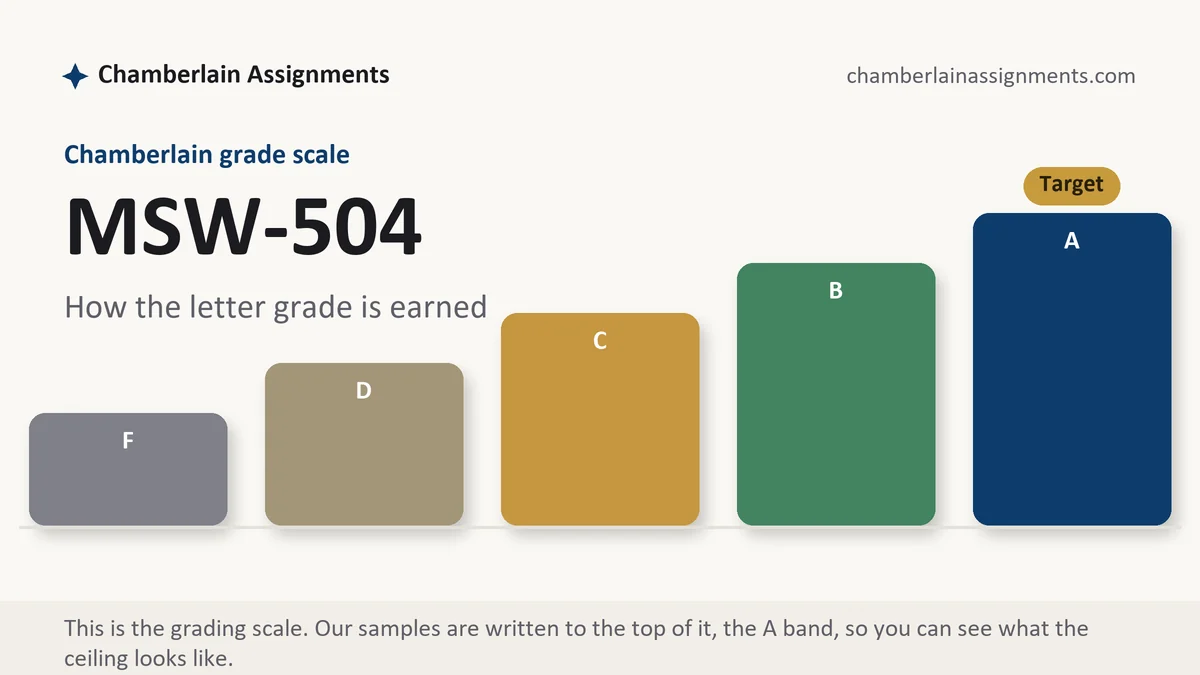
The discipline behind every paper here: the rubric is the outline, each row gets its section, one-shot discussions get the one-shot treatment, and the 76 percent floor is treated as the cliff it is. Send your week's instructions with a request and the sample matches them, revisions included.
MSW-504 questions, answered
Can a sample biopsychosocial show the person-in-environment frame without drifting into diagnosis?
Yes, and that is exactly what we build it to show. The sample keeps biological and psychological observations descriptive, then does its heaviest analysis in the social sections: family system, school or work, culture, community resources, policy pressures. You see a formulation that explains behavior through context rather than labeling it, which is the move MSW-504 rubrics reward.
My section lets us base the assessment on someone we know. What keeps that write-up safe?
De-identification, done thoroughly. Change the name, but also blur the combination of details that could point to one person: exact ages, workplaces, small-town locations, rare events. State in the paper that identifying information was altered. Our samples model this by construction, since they are written on fictional vignettes, and they show how much clinical texture survives once identifiers are gone.
How fast can I get a model paper for MSW-504?
Send the instructions and rubric from your classroom and the first custom sample is free, written to your exact prompt in 24-48h. That window fits the eight-week pace: request when the assignment posts early in the week and a reference lands well before the Sunday deadline. Treat it as a working template beside your own draft, never as something to submit.