Send the exact assignment or rubric from your classroom and a custom sample written to it lands in 24 to 48 hours, the first one free. MSW-507 is Chamberlain’s Research Methods and Applications course. It centers on how social workers read, critique, and design research, from question and sampling through measurement, ethics, and evidence-informed practice decisions. Searches like "MSW-507 week 4 assignment example", "MSW507 sample paper", and "MSW-507 week samples" land on this page.
What MSW-507 is really about
MSW-507 exists because practice decisions borrow their authority from evidence, and evidence has to be read with judgment. The course covers the full research vocabulary: quantitative and qualitative designs, sampling logic, measurement reliability and validity, single-subject thinking, and the ethics infrastructure of consent and review boards. It is less about producing statistics than about interrogating them, asking whether a study's design can support the claim its abstract makes. Qualitative traditions get equal standing, interviews, focus groups, ethnography, with their own rigor standards. By the end you are expected to move comfortably between a journal article and a practice question, and to say precisely what the one licenses you to do about the other.
The eight-week version of this course is dense by design. New methodological machinery arrives every week, and the classroom rhythm keeps it honest: a concept-application discussion opens the week in most sections, replies push on each other's reasoning midweek, and a written assignment lands Sunday. The assignments usually build cumulatively toward either a research proposal or a structured article critique, which means a weak Week 3 sampling section resurfaces in Week 7. Rubrics here are unusually literal, points mapped to named elements, so the letter grade rarely surprises anyone who reads them closely. The adjustment most people report is tonal: research writing wants hedged, precise claims, and the habits that make warm practice prose work against it until the two registers separate.
What MSW-507’s assessments ask for
Most sections mix short technical assignments with one spine project. Early weeks typically ask you to draft a researchable question, distinguish variables, and defend a design choice in discussion. Middle weeks often bring an article critique, sometimes two, one quantitative and one qualitative, where you evaluate sampling, measurement, rigor, and the fit between findings and conclusions. Ethics gets its own written moment in many sections, usually an analysis of consent, confidentiality, or vulnerable-population protections in a study scenario. The spine is frequently a proposal assembled in parts: problem statement, literature summary, method, sampling plan, and an evidence-informed practice connection. Precision is the graded skill throughout, and the rubric language tends to reward correct terminology used plainly over statistical name-dropping.
Where students lose points in MSW-507
The costliest habit in MSW-507 writing is treating qualitative methods as anecdote. Papers describe a focus group study as people sharing stories, critique it for its small sample as if it failed at being a survey, and quote a participant the way a magazine would. Faculty grade that hard because it misses the entire apparatus: purposive sampling has a logic, coding produces themes through documented steps, and trustworthiness is argued through credibility, transferability, dependability, and confirmability rather than p-values. A critique that evaluates qualitative work by quantitative standards, or presents its findings as loose impressions, loses the methods points on both sides of the divide. The fix is learnable: name the tradition, assess it by its own criteria, and let rigor mean more than numbers.
The MSW-507 drawers
MSW-507 Week 1 discussion post example
Week 1 typically frames evidence-informed practice and asks for a draft research question in discussion. On request, free, 24-48h.
MSW-507 Week 2 research article critique example
Quantitative designs and variables usually occupy Week 2, often with a short design-identification assignment. On request, free, 24-48h.
MSW-507 Week 3 literature matrix example
Week 3 commonly covers sampling logic, graded through a sampling-plan exercise or focused discussion. On request, free, 24-48h.
MSW-507 Week 4 research design memo example
Measurement, reliability, and validity often anchor Week 4, sometimes with an instrument appraisal. On request, free, 24-48h.
MSW-507 Week 5 sampling plan write-up example
Many sections give Week 5 to qualitative traditions, with a coding or theme exercise. On request, free, 24-48h.
MSW-507 Week 6 research ethics analysis example
Research ethics and consent scenarios tend to fill Week 6's discussion and written analysis. On request, free, 24-48h.
MSW-507 Week 7 qualitative study critique example
Week 7 frequently assembles the article critique or the proposal's method sections. On request, free, 24-48h.
MSW-507 Week 8 research proposal example
The finished proposal or final critique typically closes Week 8 with a practice-implications discussion. On request, free, 24-48h.
Your classroom shows something else?
Chamberlain revises courses; week counts and deliverables shift between sessions. Send what your classroom shows and the desk matches it exactly.
Using a MSW-507 sample the right way
Method writing clicks fastest when you can compare your draft against a competent one. Send your assignment instructions and rubric and the first custom sample is free, delivered in 24-48h: a model critique, an ethics analysis, or a proposal section matched to your prompt. Watch how it handles qualitative studies on their own terms, how limitations get stated without apology, and how each rubric element gets its own visible sentence. Then use it as a template while you write your own document from your own sources. Every sample cites real, checkable literature.
How these samples are written
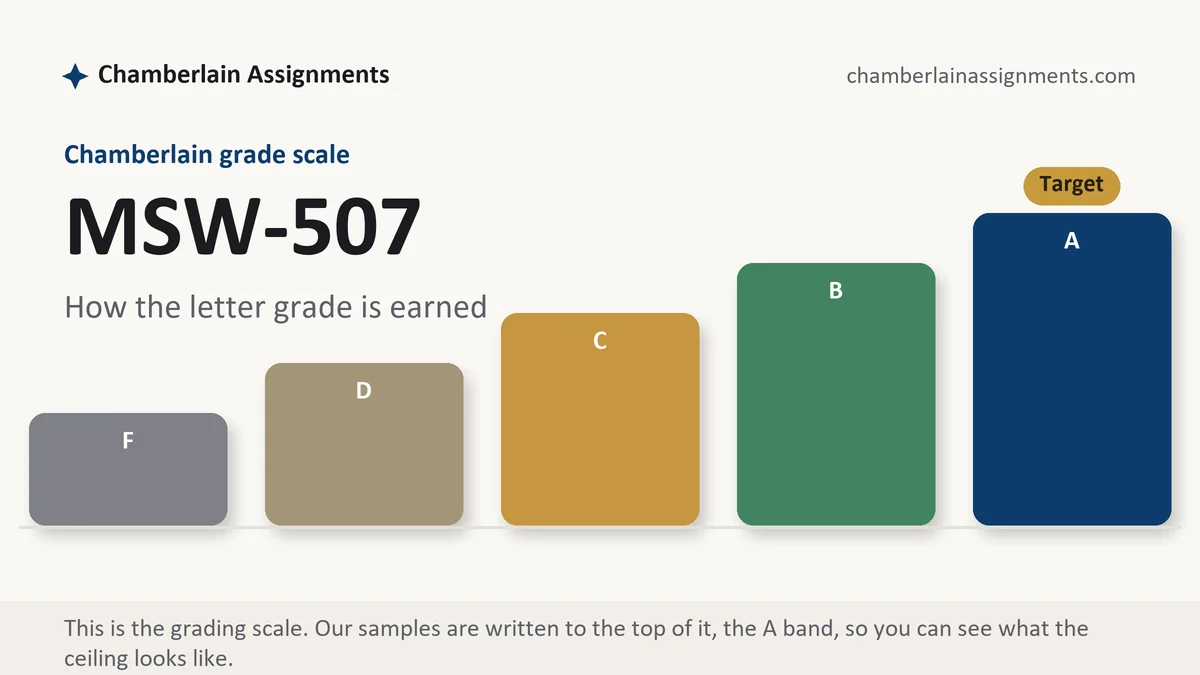
The discipline behind every paper here: the rubric is the outline, each row gets its section, one-shot discussions get the one-shot treatment, and the 76 percent floor is treated as the cliff it is. Send your week's instructions with a request and the sample matches them, revisions included.
MSW-507 questions, answered
How should an MSW-507 critique treat a qualitative study fairly?
By the standards the tradition sets for itself. Check whether the sampling was purposive with a stated rationale, whether coding and theme development are documented, whether the authors address trustworthiness, and whether quotations illustrate analyzed themes rather than replace analysis. Small samples are a design feature, not a flaw. Our sample critiques walk this checklist so the fairness is visible.
My proposal keeps drifting into stories from practice. How do I fix the register?
Separate the jobs. Practice experience can motivate the problem statement, one paragraph, cited context around it, but the method sections must run on design logic: who is sampled, what is measured, how data will be analyzed. If a sentence cannot be tied to a named methodological choice, it probably belongs in the introduction or nowhere. Seeing a model proposal usually settles this faster than feedback cycles do.
Can the free sample cover just one section of the research proposal?
Yes, and that is often the smartest use of it. Tell us which part your section grades next, sampling plan, measurement, ethics, and send the instructions and rubric rows that apply. The first custom sample is free either way and arrives in 24-48h. A tightly scoped model of the section you are stuck on beats a generic full proposal you skim.