Send the exact assignment or rubric from your classroom and a custom sample written to it lands in 24 to 48 hours, the first one free. MSW-515 is Chamberlain’s Advanced Social Work Research course. It centers on advanced research application: evaluating programs and practice, designing single-system studies, and reporting mixed findings with the rigor both traditions demand. Searches like "MSW-515 week 4 assignment example", "MSW515 sample paper", and "MSW-515 week samples" land on this page.
What MSW-515 is really about
MSW-515 answers the question MSW-507 leaves open: now that you can read research, can you build some? The center of gravity is evaluation, of programs, and of your own practice. Logic models connect an intervention's resources to its intended outcomes; process and outcome evaluation designs test whether the connection holds; single-system designs bring the same discipline down to one client's progress line. Measurement gets practical, choosing instruments, defining indicators, deciding what counts as change, and analysis stays applied: enough statistics to interpret honestly, enough qualitative method to treat interviews and open-ended responses as data. Stakeholders, ethics, and feasibility run through everything, because agency evaluation happens in real organizations with real constraints.
The course typically runs as a build. Week by week, sections assemble an evaluation proposal in graded pieces, program description and logic model, evaluation questions, design, sampling and measurement, analysis plan, dissemination, with discussions doing the argumentative testing early in the week and the assignment landing Sunday. Rubrics stay granular, points tied to named components, so weak joints show up in the letter grade. What sets strong submissions apart is symmetry of rigor: the quantitative parts specify instruments and analysis honestly, and the qualitative parts arrive with sampling logic, coding plans, and trustworthiness criteria instead of a vague promise to gather feedback. The classroom rewards proposals an agency director could actually run, which is precisely what the program wants this course to produce.
What MSW-515’s assessments ask for
Most sections stage the deliverables as proposal components with a few standalone exercises. Expect a logic model early, often visual plus narrative, then evaluation questions and a design defense that names comparison logic and threats to validity. A measurement assignment usually follows, selecting instruments and defining outcomes for the program at hand. Many sections add a single-system design exercise, baseline, intervention phase, graphing, and interpretation for one practice case, and some include a mock findings write-up or data interpretation. The finished evaluation plan, frequently with an executive summary for stakeholders, tends to close the session. Discussions run parallel critique work on published evaluations. Rubric weight concentrates on alignment, questions matching design matching measures matching analysis, plus APA form and current methodological sources.
Where students lose points in MSW-515
The advanced version of the qualitative-as-anecdote failure is what costs points in MSW-515. Evaluation plans promise interviews and focus groups, then treat the resulting material as decoration: a quote dropped in to humanize the numbers, themes announced with no account of how they were derived, stakeholder voices summarized as if summarizing were analysis. Graders read that as a design with one rigorous half. A qualitative strand earns its place the same way the survey does, stated sampling rationale, a coding procedure someone else could repeat, criteria for trustworthiness, and findings tied back to the evaluation questions. The mirror error, dismissing single-system and small-N work as too small to mean anything, loses points just as reliably. Method is method at every scale; write it that way and the rubric follows.
The MSW-515 drawers
MSW-515 Week 1 discussion post example
Week 1 usually reintroduces evaluation's purpose and selects a program to carry through the session. On request, free, 24-48h.
MSW-515 Week 2 research question write-up example
Logic models typically get built in Week 2, submitted as diagram plus narrative. On request, free, 24-48h.
MSW-515 Week 3 literature matrix example
Week 3 often drafts evaluation questions and design choices, defended against validity threats. On request, free, 24-48h.
MSW-515 Week 4 evaluation design plan example
Measurement and instrument selection commonly fill Week 4's assignment and discussion. On request, free, 24-48h.
MSW-515 Week 5 single-system design write-up example
Many sections run the single-system design exercise in Week 5, graphs included. On request, free, 24-48h.
MSW-515 Week 6 data analysis write-up example
Week 6 frequently covers qualitative strands and analysis planning for both data types. On request, free, 24-48h.
MSW-515 Week 7 program evaluation plan example
Findings interpretation and stakeholder reporting often occupy Week 7, sometimes as a mock write-up. On request, free, 24-48h.
MSW-515 Week 8 findings presentation example
The complete evaluation plan with executive summary typically concludes Week 8. On request, free, 24-48h.
Your classroom shows something else?
Chamberlain revises courses; week counts and deliverables shift between sessions. Send what your classroom shows and the desk matches it exactly.
Using a MSW-515 sample the right way
Evaluation writing rewards people who have seen the whole machine assembled once. Provide your assignment instructions and rubric and the first custom sample is free, returned in 24-48h: a logic model with narrative, a design section, a single-system exercise, or the complete plan if that is what your section grades. The model shows alignment holding from question to analysis and shows qualitative components specified to the same standard as the quantitative ones. Keep it beside your draft as a template, then submit work built on your own program, reasoning, and sources.
How these samples are written
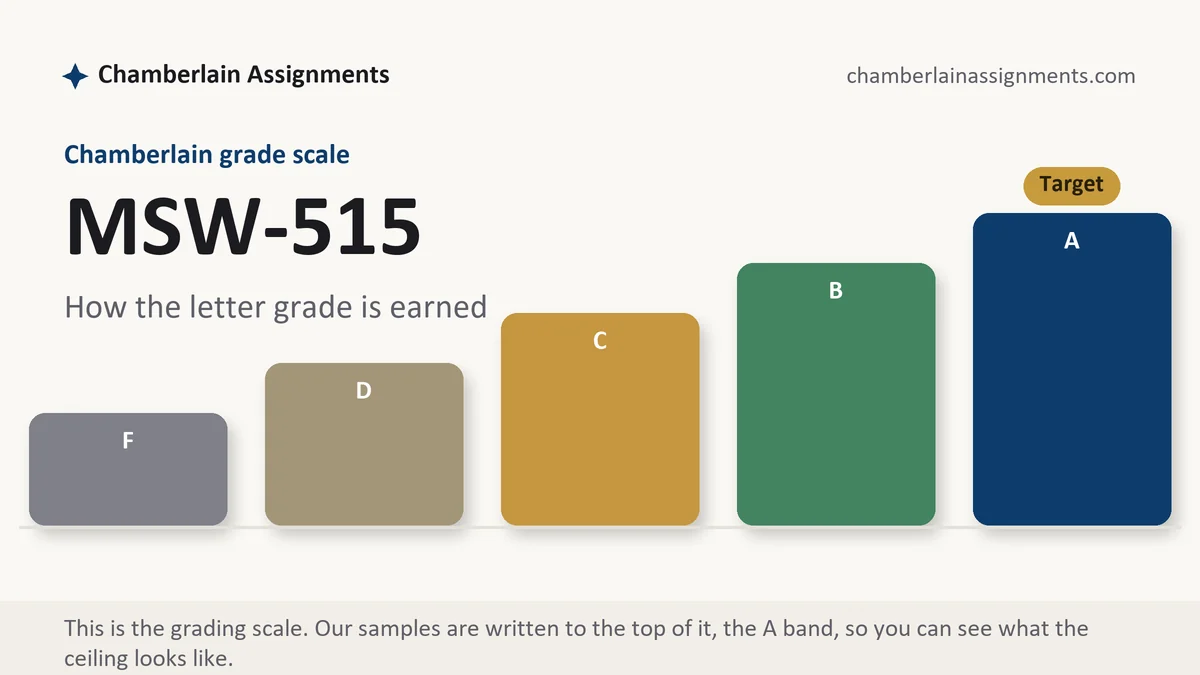
The discipline behind every paper here: the rubric is the outline, each row gets its section, one-shot discussions get the one-shot treatment, and the 76 percent floor is treated as the cliff it is. Send your week's instructions with a request and the sample matches them, revisions included.
MSW-515 questions, answered
How much qualitative detail does an evaluation plan actually need?
Enough that a stranger could run the strand without calling you. Name who will be sampled and why, roughly how many, what the interview or focus group protocol covers, how transcripts become codes and codes become themes, and which trustworthiness criteria you will apply. Two disciplined paragraphs usually satisfy every rubric row; a promise to collect feedback satisfies none of them.
Is a single-system design paper defensible with just one case?
That is the entire point of the design, and papers get marked down for apologizing rather than specifying. Rigor at N of one means a stable baseline, a defined intervention phase, a measured outcome graphed over time, and interpretation rules stated in advance. Write those four elements cleanly and one case supports real inference about your practice; hand-wave them and no sample size would save the paper.
What should I attach to request the free MSW-515 sample?
The assignment instructions, the rubric, and anything defining your program: the agency scenario your classroom uses, the intervention being evaluated, any required components. The first custom sample returns free in 24-48h, built to those documents with methodological sources you can check. The tighter your attachments, the closer the model tracks what your grader will read against the rubric.