Send the exact assignment or rubric from your classroom and a custom sample written to it lands in 24 to 48 hours, the first one free. MSW-553 is Chamberlain’s Advanced Theory Across Systems course. It centers on setting two or more explanations of the same case against each other and defending the one that survives the evidence. Searches like "msw 553 week 4 assignment example", "MSW553 sample paper", and "MSW-553 week samples" land on this page.
What MSW-553 is really about
The title of MSW-553 sits close to other theory courses in the program, and the difference is in what you are asked to produce. Here the case is fixed and the explanations compete. Two frameworks get pointed at the same history, each one accounts for the same events, and both accounts sound reasonable when read on their own. The work of the term is establishing what would have to be true for each to hold, then going back to the record to see which claim the case actually supports. Faculty are marking that adjudication, not the two summaries that came before it. Both summaries are only the setup, and the ruling is the assignment.
What makes this harder than it sounds is that a well-built theory rarely fails outright. It bends, absorbs the awkward detail, and comes back looking intact, which is why strong papers press on predictions instead of on plausibility. If one explanation is right, something specific should be present in the case and something else should be absent. Naming both in advance is what turns a comparison into a test. Do it afterward and you have written a justification. Sections vary in how many frameworks they put in play and whether the case is assigned or brought in, but the demand does not move: two accounts, one body of evidence, a decision with reasons attached.
What MSW-553’s assessments ask for
Weekly work tends to alternate between building the accounts and judging between them. Early assignments usually ask for each explanation written out in its own terms, fairly enough that a reader could not tell which one you favor. A comparison table or matrix often follows, lining the frameworks up on shared rows so that the differences stop being rhetorical. Later weeks commonly ask what evidence would cut against your preferred account and whether the case in front of you contains it. Most sections close with a defended choice, sometimes a paper and sometimes a presentation to the classroom, and nearly all of them want the rejected explanation still standing rather than caricatured. Most sections also grade sources and APA form as rows of their own.
Where students lose points in MSW-553
The paper that loses points sets up an opponent nobody holds. A theory gets described thinly, given the weakest version of its argument, and dismissed in a sentence, which tells faculty that no real contest took place. Second is the tie: two accounts laid out at length, a closing paragraph saying both offer valuable insight, and no decision anywhere on the page. Third is the choice made on grounds outside the case, because one framework was covered more recently or because it sounds more humane. Papers also slip when the same detail is quoted under both explanations without anyone noticing it cannot support each of them equally. A comparison that risks nothing is the safest thing to write and the least rewarded.
The MSW-553 drawers
MSW-553 Week 1 discussion post example
Week 1 typically asks which explanation of an opening case you reached for first, and why. On request, free, 24-48h.
MSW-553 Week 2 rival explanation brief example
Week 2 often wants each account written out in its own terms before any judgment. On request, free, 24-48h.
MSW-553 Week 3 theory comparison matrix example
Week 3 commonly lines the frameworks up on shared rows until the differences become visible. On request, free, 24-48h.
MSW-553 Week 4 two theory case reading example
Week 4 in many sections runs one history through both explanations end to end. On request, free, 24-48h.
MSW-553 Week 5 explanatory power write-up example
Week 5 usually asks what each account covers, what it leaves over, and at what cost. On request, free, 24-48h.
MSW-553 Week 6 disconfirming evidence memo example
Week 6 frequently asks what would have to appear in the record for your favored account to be wrong. On request, free, 24-48h.
MSW-553 Week 7 theory choice defense example
Week 7 often takes up the decision itself and the reasons standing behind it. On request, free, 24-48h.
MSW-553 Week 8 competing theories paper example
Week 8 closes the term with one argued contest and a verdict at the end. On request, free, 24-48h.
Your classroom shows something else?
Chamberlain University revises courses; week counts and deliverables shift between terms. Send what your classroom shows and the desk matches it exactly.
Using a MSW-553 sample the right way
An example is most useful for the pivot. Find the paragraph where the description stops and the ruling begins, and see what it rests on: a detail present in the record, an event neither account predicted, a claim one framework has to explain away. Look at how the losing explanation gets treated afterward, since keeping it credible while ruling it out is the move that separates grades here. Notice too how short the descriptive half is kept, since a contest needs both accounts on the table early. Your case and your assigned frameworks will differ, so what transfers is the structure of the contest.
How these samples are written
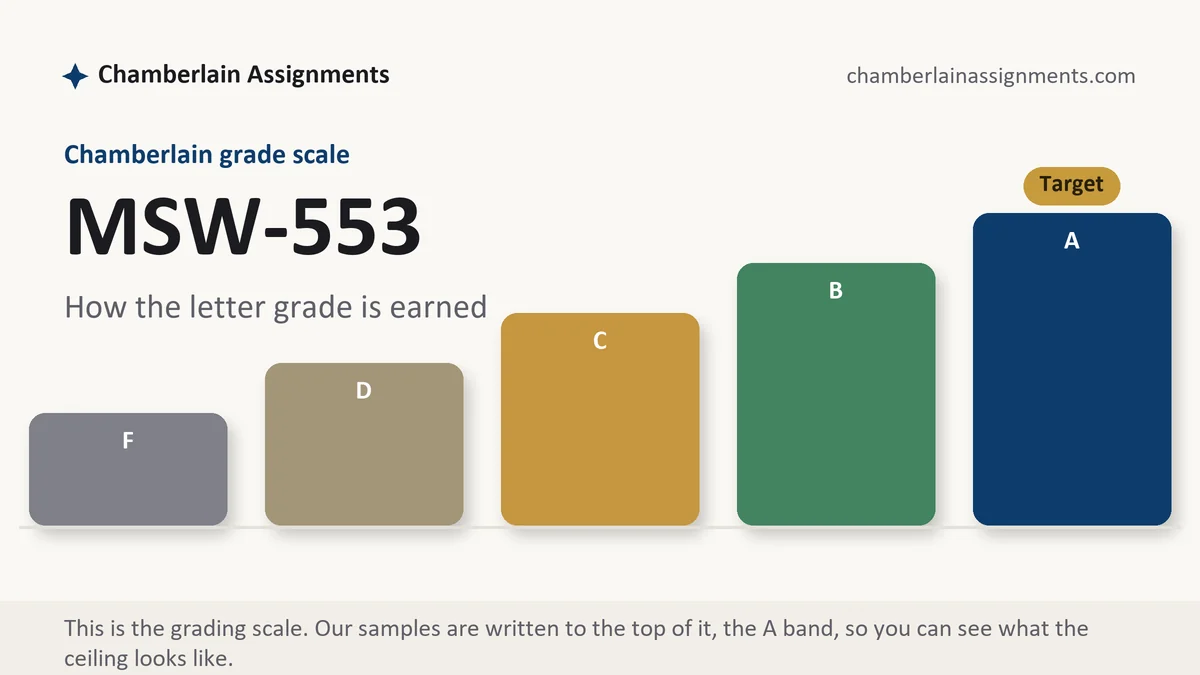
The discipline behind every paper here: the rubric is the outline, each row gets its section, one-shot discussions get the one-shot treatment, and the 76 percent floor is treated as the cliff it is. Send your week's instructions with a request and the sample matches them, revisions included.
MSW-553 questions, answered
How is this different from the theory course that walks one framework across system levels?
That one keeps the theory fixed and changes the system. This one keeps the case fixed and changes the theory. The question here is which of two explanations the evidence supports, so a submission that climbs from an individual up to a community without ever ranking anything has answered the neighboring course instead of this one.
Do I have to pick one, or can I argue that both apply?
You can argue that both hold, but only if you say what each is doing that the other is not, and what the case would look like if only one were true. An undefended draw reads as avoidance. Rubrics here award the reasoning behind the decision, so the reasons matter a good deal more than which framework you land on.
My section assigned the case. Can a sample still help?
Yes. Send the assignment and a de-identified outline of the case you were handed, and the sample gets built on a comparable situation with comparable frameworks. What comes back models how two accounts are set against each other and how the decision is carried through to the end, which is the part the rubric weights.