Send the exact assignment or rubric from your classroom and a custom sample written to it lands in 24 to 48 hours, the first one free. MSW-555 is Chamberlain’s Capstone/Integrative Seminar course. It centers on pulling the whole program together by showing that practice decisions in your field placement rest on theory, research, policy and ethics. Searches like "msw 555 week 4 assignment example", "MSW555 sample paper", and "MSW-555 week samples" land on this page.
What MSW-555 is really about
An integrative seminar has a reputation for being the easy one, which catches people out. Nothing new is taught, so students expect a term of summarizing. What is actually being assessed is whether the separate strands of the program have become one way of working: whether a decision you made with a client system last week can be traced to a theory of behavior, a body of research, a policy that set the limits, and a value that made one option unacceptable. Writing that trace is harder than writing any single course paper, because a weak link shows immediately and cannot be hidden behind fluency.
The second half of the seminar is about evidence of your own competence, which is a different kind of writing again. Claiming that you practice with cultural humility earns nothing; describing the moment you realized an assumption was doing the work, and what you changed afterward, earns a good deal. Faculty are reading for specificity and for the willingness to name what you got wrong, since a portfolio in which everything went smoothly reads as a document written for an audience rather than about a placement. Field hours, process recordings and the evaluations your field instructor completes stay yours throughout, because they are the record of what you actually did.
What MSW-555’s assessments ask for
Weekly work in many sections alternates between integration and evidence. Integration pieces typically take one situation from placement, de-identified, and ask you to account for it from several directions at once: what theory explains the behavior, what the research says about the intervention, which policy governed what was possible, and where the Code of Ethics narrowed the options. Evidence pieces ask you to argue that you hold a competency and to attach something concrete to the claim. Most sections also want a professional development plan aimed at licensure and early practice, plus a presentation. The seminar discussion usually tests a position before it reaches a paper. Assignments close the week in the usual rhythm.
Where students lose points in MSW-555
The capstone that loses points is the one that summarizes the program instead of using it. A paper listing the courses taken and the competencies covered has described a transcript, not a practitioner. Second is the trace with a missing link, most often the policy one: a decision explained by theory and research, with no acknowledgment that a funding rule or an eligibility criterion decided what was actually available. Third is the ethics section that names a principle and stops, when the assignment asked what happened when two principles pulled against each other. Identifying details left in, competence asserted with no example behind it, and a development plan made of intentions also cost points.
The MSW-555 drawers
MSW-555 Week 1 discussion post example
Week 1 typically opens on what integration is supposed to mean in practice. On request, free, 24-48h.
MSW-555 Week 2 competency evidence write-up example
Week 2 often asks you to attach something concrete to a claim. On request, free, 24-48h.
MSW-555 Week 3 integrative case analysis example
Week 3 in many sections wants one field situation explained from several directions. On request, free, 24-48h.
MSW-555 Week 4 theory to practice write-up example
Week 4 commonly asks which theory actually informed a decision you made. On request, free, 24-48h.
MSW-555 Week 5 policy and practice brief example
Week 5 typically asks what a rule or funding limit made possible. On request, free, 24-48h.
MSW-555 Week 6 ethics analysis example
Week 6 often takes up two principles that will not both be satisfied. On request, free, 24-48h.
MSW-555 Week 7 licensure and development plan example
Week 7 in many sections looks ahead to early practice and supervision. On request, free, 24-48h.
MSW-555 Week 8 capstone integrative paper example
Week 8 usually gathers the term into one finished argument. On request, free, 24-48h.
Your classroom shows something else?
Chamberlain University revises courses; week counts and deliverables shift between terms. Send what your classroom shows and the desk matches it exactly.
Using a MSW-555 sample the right way
Follow one decision through an example and watch every link in the chain. See whether each part of the explanation is actually load-bearing, or whether the theory paragraph could be lifted out without the argument noticing. Look at how the writer handles a moment that went badly, since the register there is difficult to guess at. The situations have to come from your own placement, because a capstone is an account of your practice and nothing else will substitute. What an example supplies is the structure of a trace and the level of candor that reads as professional rather than confessional.
How these samples are written
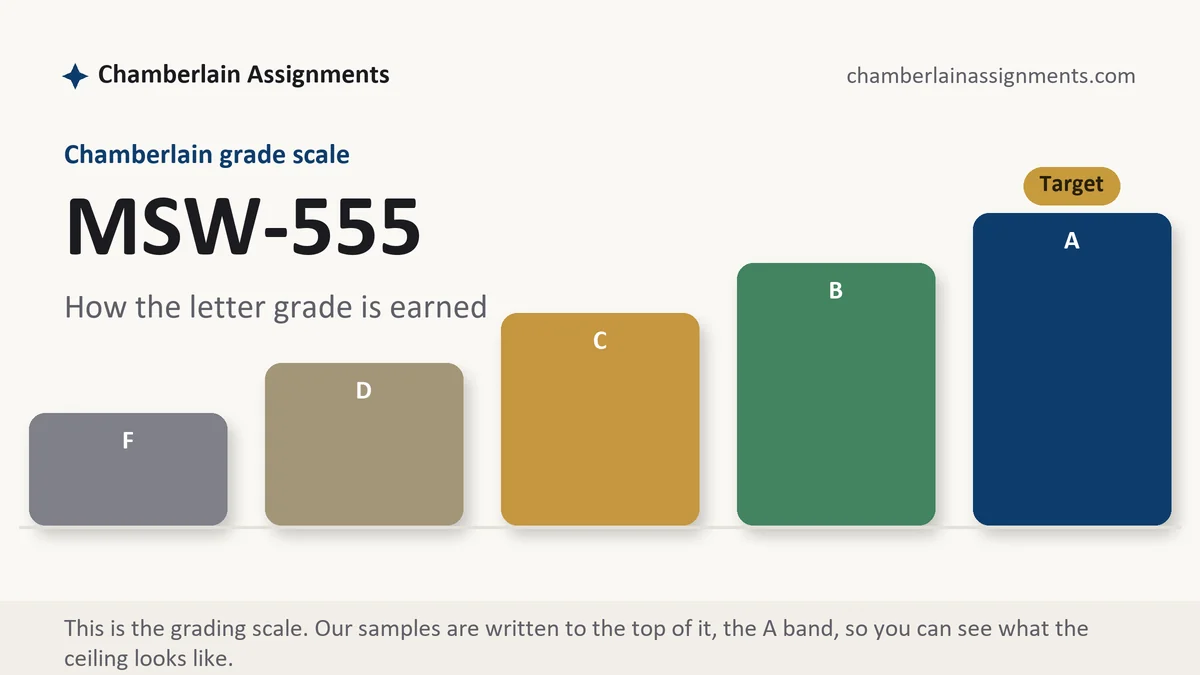
The discipline behind every paper here: the rubric is the outline, each row gets its section, one-shot discussions get the one-shot treatment, and the 76 percent floor is treated as the cliff it is. Send your week's instructions with a request and the sample matches them, revisions included.
MSW-555 questions, answered
How much of my placement can appear in a sample?
None of it directly. Send a de-identified description of the kind of situation you are writing about and the sample is built around a comparable scenario, so what you get is a model of the argument rather than a version of your case. Process recordings, supervision notes and field evaluations are documents only you and your field instructor produce.
Does the capstone have to use the competency framework my program follows?
Follow whatever your section issues, since programs organize the evidence differently and the headings decide where each claim belongs. Send the framework along with the assignment and the sample is written into it. The underlying move stays the same in every version: a claim about your practice, then something specific that shows it happened.
Is a capstone paper different from the presentation my section also requires?
Yes, and treating them as the same document is a common way to lose points on both. The paper can afford the full trace; the presentation has to choose one line of argument and make it land in the time allowed. Send both assignments and the samples are built as a pair rather than as one text cut down.