Send the exact assignment or rubric from your classroom and a custom sample written to it lands in 24 to 48 hours, the first one free. NR 283 is Chamberlain’s Pathophysiology course. It centers on what a disease actually does to the body, followed as far as the findings a nurse would notice and report. Searches like "nr 283 week 4 assignment example", "NR283 sample paper", and "NR 283 week samples" land on this page.
What NR 283 is really about
Pathophysiology is the first course where the science you already passed stops being enough on its own. Anatomy asked what a structure is and physiology asked what it does when everything works. This one asks what happens when it does not, and then asks the question the earlier courses never did, which is what any of that means for the person it is happening to. Most people write their first paper as a very good reference entry. It is accurate, it is organized, it may well be more detailed than the assignment needed, and it earns a middling mark because nothing in it reaches a patient.
What a strong answer adds is short and specific. The process is explained at the level your own course materials teach it, and then the writing says what shows up: the finding on a set of vital signs, the thing the patient says out loud, the laboratory value that moves, the change that would make you call somebody. Nobody at this stage is asking you to diagnose or to pick a treatment, and answers that reach for either usually get there by stepping over the observation in between. The move being marked is smaller and harder than it looks. It is the sentence saying that because this is happening inside, this is what you would see, and this is the part you would not sit on.
What NR 283’s assessments ask for
Weekly work generally follows the body system the week covers. Case assignments give you a patient with a story attached and ask what is going on and how the presentation follows from it, expecting your explanation to reach the findings rather than stopping at the name of the condition. Concept maps and diagrams appear in many sections because relationships are easier to mark when they are drawn than when they are buried in prose. Some weeks ask for laboratory values interpreted, which means saying what a result indicates and what a nurse then does about it. Discussions open on a condition or on one risk factor, and a good reply adds the finding a classmate's explanation would predict but never mentioned.
Where students lose points in NR 283
The reliable loss is the textbook paragraph, correct and complete and inert, ending exactly where the reading ended. A grader marking application has nothing there to reward. Second is the answer that names the condition and then describes its usual presentation as though describing it explained anything, which steps around the part being assessed. Third is detail chosen for its own sake, where three paragraphs of cellular biology arrive before a single clinical finding does. Beyond those, findings listed with no reason they occur, risk factors copied without saying which ones this patient has, values reported without their meaning, and verbs vague enough to hide which way anything moved all cost points across a session.
The NR 283 drawers
NR 283 Week 1 discussion post example
Week 1 often begins with what happens to a cell under stress. On request, free, 24-48h.
NR 283 Week 2 inflammation write-up example
Week 2 in many sections asks what inflammation is actually doing to the patient. On request, free, 24-48h.
NR 283 Week 3 system case study example
Week 3 typically takes one body system and asks what its failure looks like. On request, free, 24-48h.
NR 283 Week 4 concept map example
Week 4 commonly wants a diagram where risk, process and finding sit together. On request, free, 24-48h.
NR 283 Week 5 laboratory value interpretation example
Week 5 usually asks what a set of results indicates and what follows from it. On request, free, 24-48h.
NR 283 Week 6 case study analysis example
Week 6 generally presents a patient with two conditions working on each other. On request, free, 24-48h.
NR 283 Week 7 patient scenario write-up example
Week 7 frequently asks which changes you would report, to whom, and how quickly. On request, free, 24-48h.
NR 283 Week 8 final case paper example
Week 8 usually finishes on a single patient explained from risk to bedside finding. On request, free, 24-48h.
Your classroom shows something else?
Chamberlain University revises courses; week counts and deliverables shift between terms. Send what your classroom shows and the desk matches it exactly.
Using a NR 283 sample the right way
Read a sample backwards. Start in the last third, where the writing turns into what would be observed and reported, then look at how much explanation was actually needed to get there, which is usually less than people expect. That ratio is the thing worth copying, since most first drafts invert it. Then rebuild the explanation in your own words for the system your week covers, because this is the course whose habits every later course assumes you already built. What a sample offers is the point where the writing stops explaining and starts pointing at a patient.
How these samples are written
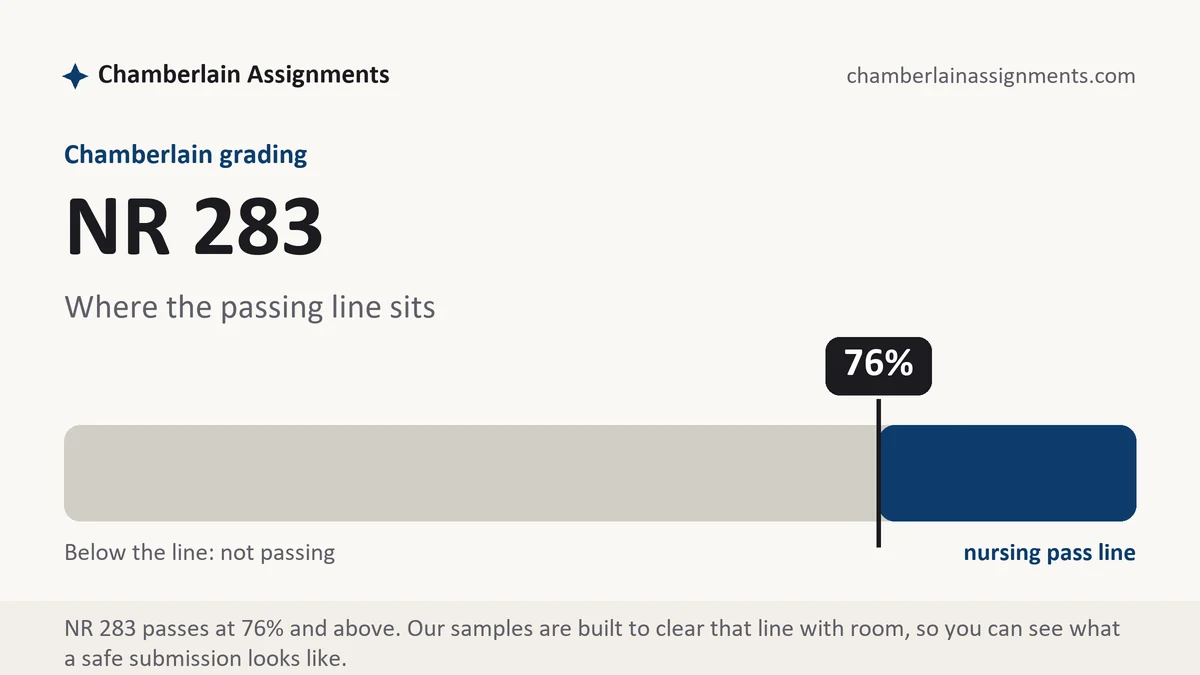
The discipline behind every paper here: the rubric is the outline, each row gets its section, one-shot discussions get the one-shot treatment, and the 76 percent floor is treated as the cliff it is. Send your week's instructions with a request and the sample matches them, revisions included.
NR 283 questions, answered
How much detail is enough?
Enough to explain what the patient shows, and then stop. Undergraduate work is marked on whether the process reaches the presentation, not on how far down into the biology you can go, so an extra paragraph with no finding attached to it adds length rather than points. When in doubt, match the depth your own course materials use.
Do I need outside sources, or is the textbook enough?
For most assignments the course text and the materials your week supplies are what the marking expects, cited at the claim they support. Reach further only where the prompt asks you to. Volume of references earns nothing here. Whether the source sits beside the sentence it backs up is the part that does.
Is this the same as the graduate pathophysiology course?
No, and writing it as though it were is a way to lose points. The graduate course argues at prescriber level and expects that depth. Here the expectation is that you can explain the process and say what it produces in a patient you would be watching, which is a different finish line and a different amount of detail.