Send the exact assignment or rubric from your classroom and a custom sample written to it lands in 24 to 48 hours, the first one free. NR 328 is Chamberlain’s Pediatric Nursing course. It centers on a patient whose expected values move with every year of age, and whose history arrives through the adult sitting beside them. Searches like "nr 328 week 4 assignment example", "NR328 sample paper", and "NR 328 week samples" land on this page.
What NR 328 is really about
Two things make this course harder than its content suggests. The first is that there is no fixed normal to memorize. A breathing rate that would be unremarkable in an infant is an emergency in a nine year old and boredom in an adult, so every figure has to be read against an age before it means anything, and answers that quote a range without saying whose range it is cannot be marked correct. The second is that children hold their ground and then stop holding it suddenly. A child who compensates well looks reassuring right up until the point where they do not, and much of the assessment work in this course aims at the early, unglamorous signs.
The third difference is who you are talking to. Most of the history comes from an adult who is worried, tired and reporting what they noticed rather than what happened, so the assessment includes their account, the gap between their account and what you observe, and their own capacity to carry out whatever you decide. Teaching runs in two registers at once, one for a child at whatever stage of understanding they have reached and one for the person who will be measuring a dose at midnight. Weight sits underneath all of it. Doses, fluids and equipment are calculated rather than looked up, and a calculation with no working shown is not an answer this course accepts.
What NR 328’s assessments ask for
Weekly work usually moves up through the ages and asks the same questions differently at each one. Growth and development assignments ask what a child of a given age should be doing and what your assessment would look like at that stage, which changes the approach as much as the findings. Illness weeks supply a case and ask what you would assess first, with age-appropriate values named rather than assumed. Calculation work runs across the term and the working is what gets marked, because a safe dose starts from a weight. Family teaching assignments want instructions that survive a bad night at home. Discussions often open on a child whose caregiver noticed something first, and good replies say what that observation was worth.
Where students lose points in NR 328
The dependable loss is the adult answer with a smaller patient in it, where the ranges, the approach and the teaching would all have suited somebody thirty years older. Second is the age left out, since a figure without the age beside it cannot be judged and a grader will not supply the missing half. Third is the caregiver treated as background, so their report never becomes data and the plan never checks whether they can actually do it. Beyond those, a dose calculated with no working, development mentioned as a heading and then ignored, teaching aimed only at the child or only at the parent, and a compensating child described as stable because the blood pressure was still holding all cost points.
The NR 328 drawers
NR 328 Week 1 discussion post example
Week 1 in many sections begins with the adult who answers for the patient. On request, free, 24-48h.
NR 328 Week 2 growth and development write-up example
Week 2 usually asks what a given age should be doing and how you check. On request, free, 24-48h.
NR 328 Week 3 well-child visit write-up example
Week 3 often records a routine visit where nothing is wrong and everything gets measured. On request, free, 24-48h.
NR 328 Week 4 weight-based dosage set example
Week 4 typically works doses from a weight and marks the route to the answer. On request, free, 24-48h.
NR 328 Week 5 respiratory case response example
Week 5 commonly follows a child working hard to breathe before numbers say so. On request, free, 24-48h.
NR 328 Week 6 chronic illness care plan example
Week 6 generally plans for a family managing a long condition at home. On request, free, 24-48h.
NR 328 Week 7 family teaching handout example
Week 7 frequently asks for instructions written for a parent and a child together. On request, free, 24-48h.
NR 328 Week 8 case study analysis example
Week 8 tends to close on one child followed from arrival to the instructions home. On request, free, 24-48h.
Your classroom shows something else?
Chamberlain University revises courses; week counts and deliverables shift between terms. Send what your classroom shows and the desk matches it exactly.
Using a NR 328 sample the right way
Read a sample with the age in mind the whole way down. Notice that the writer names it early and then uses it, so each finding is judged against what that year of life expects rather than against a general adult figure. Notice too where the caregiver enters: their report treated as evidence, their question answered, their ability to do the thing checked before the plan relies on it. Then rebuild it around the child in your own prompt, since a case moved by two years is a different case and the values you quote have to move with it.
How these samples are written
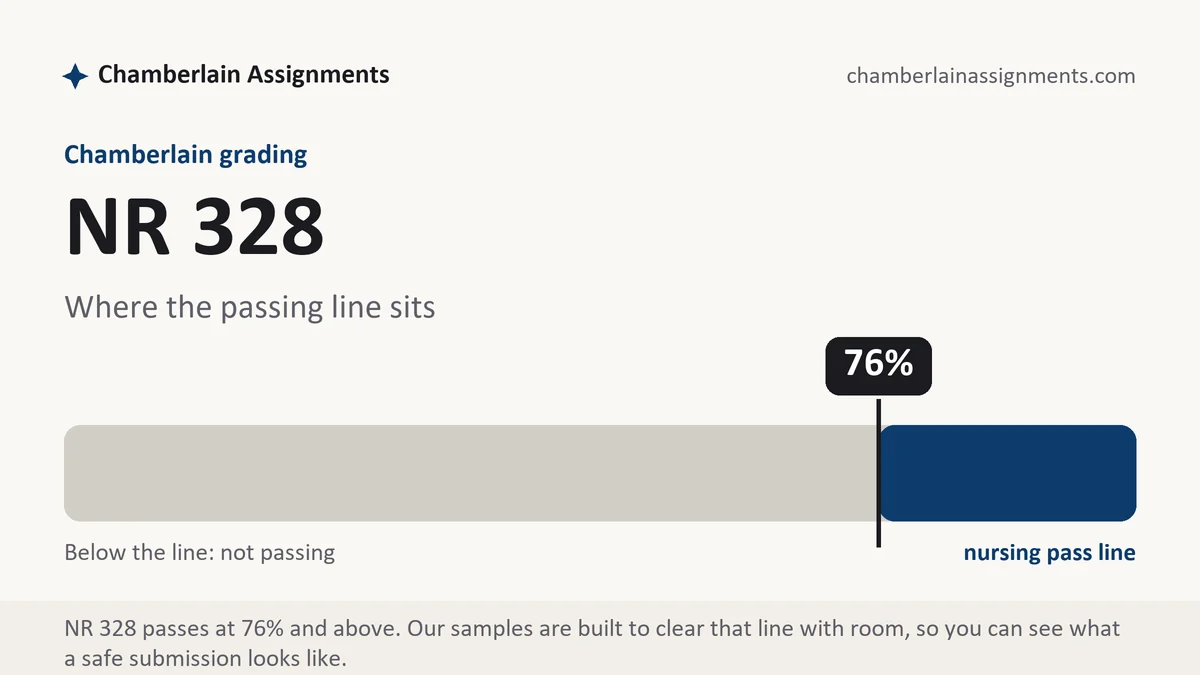
The discipline behind every paper here: the rubric is the outline, each row gets its section, one-shot discussions get the one-shot treatment, and the 76 percent floor is treated as the cliff it is. Send your week's instructions with a request and the sample matches them, revisions included.
NR 328 questions, answered
Do I have to memorize vital sign ranges for every age?
You have to know which direction they move and where the boundaries sit, then look the rest up and cite what you used. What gets marked is whether the figure you quote belongs to the age in the case and whether you did something with it, not whether you carried the whole table in your head.
How do I handle a history that comes from a parent?
Record it as their account and keep it labeled that way. Say what they report, in their words where it matters, then say what you observed, and treat any distance between the two as information rather than as an error. A parent who says the child is not themselves has given you a finding worth writing down.
How much developmental theory belongs in an assignment?
Only as much as changes what you would do. Naming a stage earns nothing on its own. Saying that a child at this stage will cooperate with an examination if it starts at the feet, or needs an explanation immediately before a procedure rather than the day before, puts the theory to work where a grader can see it.