Send the exact assignment or rubric from your classroom and a custom sample written to it lands in 24 to 48 hours, the first one free. NR 442 is Chamberlain’s Community Health Nursing course. It centers on community assessment, population level planning, and the public health roles nurses carry beyond a single patient's room. Some program versions carry this course as NR 444; the same drawers apply. Searches like "NR 442 week 4 assignment example", "NR442 sample paper", and "NR 442 week samples" land on this page.
What NR 442 is really about
NR 442 asks a bedside question at a different altitude: not how is this patient, but how is this population. The course covers epidemiology basics, health disparities, vulnerable groups, environmental and communicable disease concerns, disaster readiness, and the community health nurse's roles across settings. Weekly reading connects those concepts to data sources, county health rankings, national health objectives in the Healthy People tradition, local statistics, because population claims are expected to carry numbers. For working RNs the adjustment is scope. Interventions get planned for aggregates, outcomes get measured in rates, and the writing has to hold that altitude without drifting back to the single memorable patient who usually anchors nursing prose.
The graded spine in many sections is a staged community project: assess a community you can actually observe, often through a structured drive through or walk through survey plus published data, identify a priority health problem, and propose a nursing intervention aimed at the population level. Discussions continue the usual rhythm, opening early in the week with replies expected before it closes, and written assignments collecting on Sundays. Rubrics grade the pairing of observation with evidence, a noticed pattern is only a finding once data supports it, and the intervention rows want measurable, realistic plans rather than good intentions. Points assemble into the letter grade with the project stages typically carrying the largest slices.
What NR 442’s assessments ask for
Expect data work wrapped in nursing judgment. The assessment stage asks you to describe a community systematically, demographics, resources, hazards, health indicators, and defend a priority problem by comparing local numbers to benchmarks. The planning stage wants an intervention matched to that problem: who it reaches, what changes, how change would be measured, which existing agencies participate. Discussions typically run scenario style, an outbreak, a school health concern, a home visit safety question, and expect cited responses plus engagement with classmates. Some sections add a vulnerable population paper or a disaster preparedness exercise. Throughout, sources shift from clinical literature toward public health data, and the graded skill is keeping claims at population scale with the numbers visible.
Where students lose points in NR 442
Community papers lose their points where impressions replace method. Writing that a neighborhood is underserved or that residents do not prioritize prevention, without data or an assessment framework underneath, is generalization wearing a public health coat, and the rubric responds accordingly: description rows partly credited, analysis rows empty. Graders in NR 442 want the unlovely machinery showing, indicators compared, sources named, the priority problem earning its place over alternatives. The second leak is familiar but sharper here because project weeks are heavy: discussions slip to Saturday, the reply window closes, and participation points fall out of an otherwise strong week. Guard the early week post even when a project stage is due.
The NR 442 drawers
NR 442 Week 1 discussion post example
Course openings typically contrast bedside nursing with population focus and the settings where each lives. On request, free, 24-48h.
NR 442 Week 2 windshield survey example
Epidemiology and health indicator basics often arrive early, teaching rates before anyone assesses anything. On request, free, 24-48h.
NR 442 Week 3 community assessment example
In many sections the community assessment stage begins, structured observation plus published local data. On request, free, 24-48h.
NR 442 Week 4 population health analysis example
Vulnerable populations and disparities typically drive midcourse discussions with data expected in posts. On request, free, 24-48h.
NR 442 Week 5 epidemiology write-up example
The priority problem and intervention proposal stage often lands here, measurable outcomes required. On request, free, 24-48h.
NR 442 Week 6 health promotion plan example
Communicable disease and environmental health scenarios typically fill this week's prompts. On request, free, 24-48h.
NR 442 Week 7 community teaching plan example
Disaster preparedness and the nurse's public health roles often close the discussion sequence. On request, free, 24-48h.
NR 442 Week 8 reflection example
Final submissions typically package the community project with a reflection on population level practice. On request, free, 24-48h.
Your classroom shows something else?
Chamberlain revises courses; week counts and deliverables shift between sessions. Send what your classroom shows and the desk matches it exactly.
Using a NR 442 sample the right way
An NR 442 sample is best read as a data handling demonstration: where the numbers enter, how a benchmark comparison is phrased, how the priority problem is argued, how the intervention stays measurable. Map those moves onto your own community, which will produce a different paper by necessity since your survey and your county's data cannot match the model's. Project stages vary noticeably between sections, so if yours is structured differently, send the stage instructions and rubric and we will draft a custom sample to that structure. First one free, normally within 24-48h, timed so a stage due Sunday can still benefit.
How these samples are written
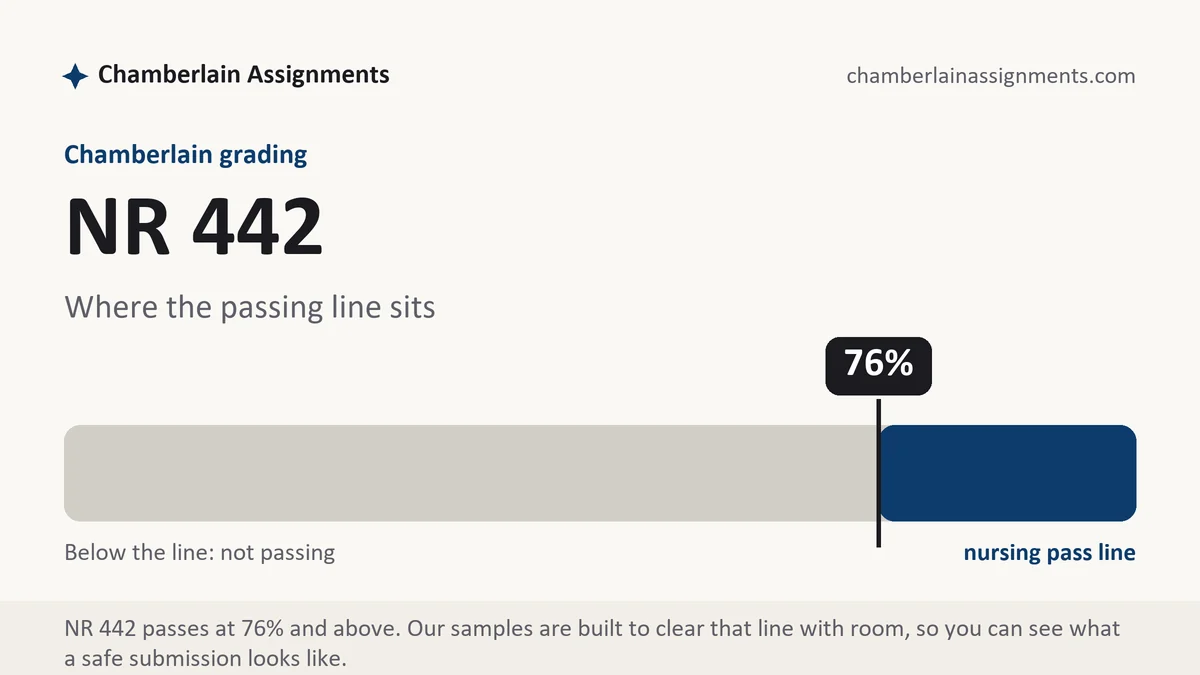
The discipline behind every paper here: the rubric is the outline, each row gets its section, one-shot discussions get the one-shot treatment, and the 76 percent floor is treated as the cliff it is. Send your week's instructions with a request and the sample matches them, revisions included.
NR 442 questions, answered
My community assessment described everything I saw. Why were the analysis points low?
Observation alone is the first half of the assignment. NR 442 rubrics credit analysis when what you saw gets tested against data: local rates beside state or national benchmarks, a framework organizing the findings, a priority justified over alternatives. A vivid walk through with no numbers reads as impression. Our samples show the observation to data handoff paragraph by paragraph, which is the part most drafts miss.
Which community should I pick for the project?
Pick the one you can physically revisit and research in public data, usually where you live or work. The project rewards repeat observation and verifiable numbers, and both get difficult at a distance. Resist choosing a dramatic community you barely know; thin familiarity produces exactly the sweeping statements this course grades down. Send your stage instructions and rubric and the free first sample can model scoping it, in 24-48h.
Project stages and discussions collide in the heavy weeks. What gives first?
Usually the discussion, and that is the wrong sacrifice. A project stage can absorb a mediocre draft and recover next stage; discussion replies expire with the week and their points are gone permanently. In collision weeks, post the initial discussion early even if brief, bank the replies midweek, then give the project the weekend. Students who run that order report calmer Sundays and steadier letter grades.