Send the exact assignment or rubric from your classroom and a custom sample written to it lands in 24 to 48 hours, the first one free. NR 504 is Chamberlain’s Leadership and Nursing Practice: Role Development course. It centers on acquiring a leadership role while still expert at the job you are leaving and new at the one ahead. Searches like "nr 504 week 4 assignment example", "NR504 sample paper", and "NR 504 week samples" land on this page.
What NR 504 is really about
Nurses entering this course are usually very good at something. That is the difficulty. Role development means walking away from work you had long since made routine and starting again as a beginner in a role with no procedures, no checklist and no shift report, and the discomfort of that is a subject the course takes seriously rather than a feeling to be pushed through. It also has a vocabulary worth using precisely. Role ambiguity is not knowing what the job includes. Role conflict is being pulled by two sets of expectations that cannot both be met. Role strain is what those produce in a person. Naming which one you are describing is the difference between a complaint and an analysis.
The second half is leadership examined in the small units the role is actually made of. Not the transformation of an organization, but a meeting you have to run, a team that has stopped bringing problems forward, a colleague you agreed to mentor, and a decision that is now yours to make and defend. That scale is deliberate. Leadership at the level this course marks is visible in what you do on a Tuesday, and the writing is expected to reach that level of detail. Mentorship gets the same treatment, examined as an arrangement with a person, a purpose and a way of ending, rather than as a value everybody endorses.
What NR 504’s assessments ask for
Assignments in many sections build a picture of you moving into a role. Early work asks for the role described as it will actually be lived, including what it takes away, since a paper listing only what is gained has not read the material. Middle weeks commonly stage the ordinary situations, a team that is underperforming, a task that must be handed to somebody else with the accountability that cannot be handed with it, a conversation you would rather not start, and ask what you would do and on what grounds. Later work typically produces a development plan with evidence attached: what you will learn, from whom, by when, and what would show it happened. Discussions early in the week put their points behind a post that commits to a position and takes the disagreement.
Where students lose points in NR 504
The reliable loss is the role written as a job description, a list of duties copied from a posting with nothing in it about what learning the role will cost. Second is the strain paragraph that stays a feeling, where difficulty is described at length and never sorted into ambiguity, conflict or plain overload, which is the analysis the rubric was asking for. Third is the mentorship section with no mentor, an endorsement of the idea with no person, purpose or arrangement behind it. Papers also slip when management and leadership are used as the same word, when delegation is written as handing over a task with no mention of what stayed with you, and when a development plan sets goals nobody could ever tell you had failed.
The NR 504 drawers
NR 504 Week 1 discussion post example
Week 1 often asks what leadership looks like from a position with no authority. On request, free, 24-48h.
NR 504 Week 2 role theory write-up example
Week 2 typically sorts role strain into ambiguity, conflict and plain overload. On request, free, 24-48h.
NR 504 Week 3 leadership philosophy statement example
Week 3 in many sections asks what kind of leader you intend to be. On request, free, 24-48h.
NR 504 Week 4 team development analysis example
Week 4 commonly examines a team that has stopped raising problems early. On request, free, 24-48h.
NR 504 Week 5 mentorship plan example
Week 5 often arranges the learning with a named person and a purpose. On request, free, 24-48h.
NR 504 Week 6 delegation and accountability case example
Week 6 usually asks what was handed over and what stayed with you. On request, free, 24-48h.
NR 504 Week 7 leadership development plan example
Week 7 generally sets goals that somebody else could watch you fail. On request, free, 24-48h.
NR 504 Week 8 role synthesis paper example
Week 8 generally assembles the session around the role you are entering. On request, free, 24-48h.
Your classroom shows something else?
Chamberlain University revises courses; week counts and deliverables shift between terms. Send what your classroom shows and the desk matches it exactly.
Using a NR 504 sample the right way
The part of a sample worth studying is the honesty about cost. Find where the writer says what the new role takes away, and notice that the paper gets stronger rather than weaker at that point, because a role described only as an improvement tells a reader nothing was examined. Look next at the development plan and check whether each goal has something observable attached to it. Then rebuild all of it around the role you are actually moving into and the people who would have to teach you, since a plan aimed at nobody in particular cannot be held to anything.
How these samples are written
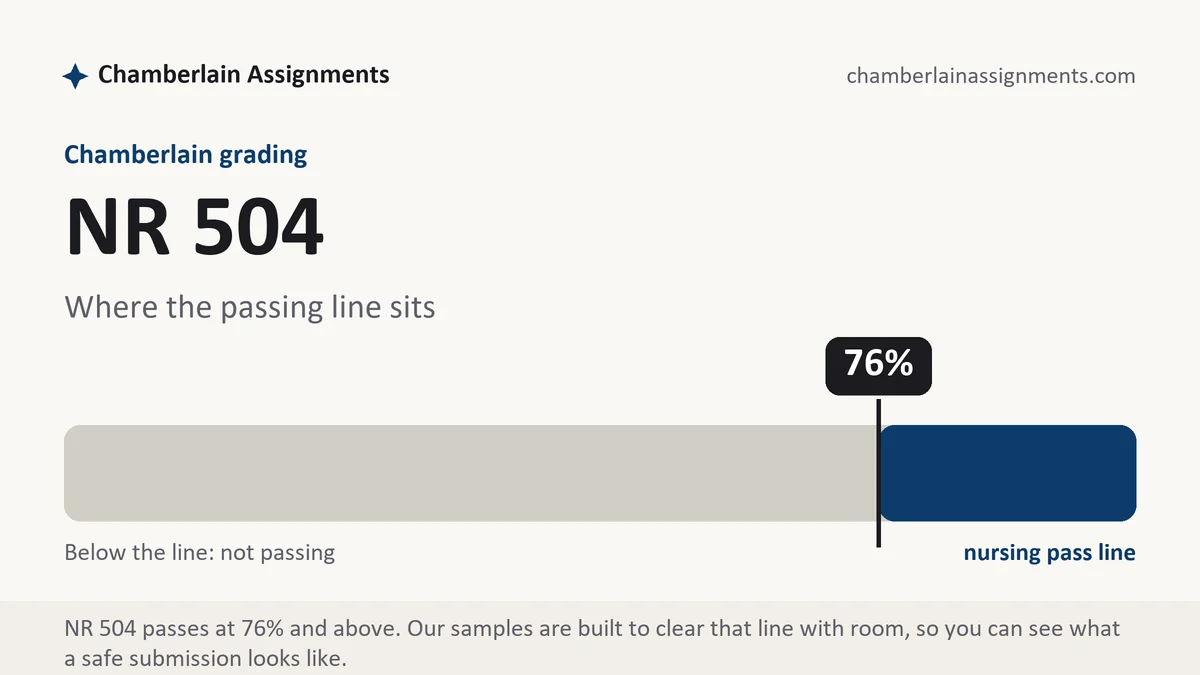
The discipline behind every paper here: the rubric is the outline, each row gets its section, one-shot discussions get the one-shot treatment, and the 76 percent floor is treated as the cliff it is. Send your week's instructions with a request and the sample matches them, revisions included.
NR 504 questions, answered
I already lead a shift. Does that count for these assignments?
It counts as material and not as a conclusion. Running a shift is real leadership, and the course still wants to know what the role you are preparing for asks that a shift never did: sustained responsibility for people you rarely see, decisions with no immediate feedback, and accountability for work you did not personally do. Write from the shift, then say what does not transfer.
How do I write a development plan that is not just a list of good intentions?
Attach evidence to every line. A goal becomes gradable when it names what you will do, who is involved, roughly when, and what somebody else would be able to observe if it worked. Learning more about conflict is not a goal. Chairing three team meetings and asking a named mentor for feedback after each one is, because it can fail visibly.
The assignment asks me to interview a nurse leader.
The interview is yours to arrange and yours to record, since it is primary material you were asked to collect. What a sample can show is the part after the conversation: how a quotation earns its space, how the answers get set against the reading, and how much of the write-up should be analysis rather than record. Send what your leader said, with the classroom instructions and any template attached.