Send the exact assignment or rubric from your classroom and a custom sample written to it lands in 24 to 48 hours, the first one free. NR 510F is Chamberlain’s Leadership and Role Development of the Advanced Practice Nurse course. It centers on the personal side of taking on advanced practice, where a competent nurse becomes a beginner again and has to plan for it. Searches like "nr 510f week 4 assignment example", "NR510F sample paper", and "NR 510F week samples" land on this page.
What NR 510F is really about
Chamberlain teaches this subject twice, and the suffix on your course code matters more than it looks. The other version stays with the organization: credentialing, employment, the money behind a position. This one stays with the person moving into it, which is harder to write about honestly. Most people entering advanced practice are experienced clinicians who are about to be beginners again, and the course is built on that reversal. Assignments ask what you can already do, what you cannot yet do, who is going to teach you the difference, and how you will know once it has been learned. None of it is answered by enthusiasm, which is why the opening weeks feel unusually blunt to people used to being competent.
Written work about yourself fails in predictable ways and the rubric is aimed at those. A development plan made of intentions holds nothing anyone could check, so the course wants targets attached to dates, sources and proof: this competency, by this point, through this arrangement, demonstrated by this. Mentoring is treated the same way, as a working relationship with an agreed subject rather than a name you admire. The transition itself is fair material as long as it stays analytic. Saying that a first independent decision frightened you is only useful once you say what you did about it and what you would want in place next time.
What NR 510F’s assessments ask for
The weekly rhythm alternates between measuring yourself and planning around the measurement. Self-assessment assignments typically ask you to score your own readiness against a published set of competencies and then defend the score with something you have actually done or failed to do. Planning assignments turn low scores into a schedule with a named mentor, a resource and a way of telling whether the gap closed. Some weeks look outward at certification, licensure and the professional documents you will need, which is dull work carrying real points because every detail is checkable. Reflective weeks ask what the shift has already cost you and what you did about it. Discussions run alongside, and the useful reply asks whether a classmate's plan could survive one full clinical week.
Where students lose points in NR 510F
Points go first to the development plan that could belong to anybody: improve communication, stay current, seek mentorship, none of it dated, sourced or measurable. Second is the strength inventory with no admitted gap, which reads as unwillingness to be assessed rather than as readiness. Third is the transition narrative that never gets past feeling, so a grader finishes the paragraph knowing you were anxious and nothing about what you changed. Competency language quoted without ever being applied to your own record, mentors listed with no subject attached, and a certification section repeating published requirements without saying where you personally stand in the sequence each thin the grade. So does the plan that answers every gap with more reading, since a knowledge problem and a practice problem rarely close the same way.
The NR 510F drawers
NR 510F Week 1 discussion post example
Week 1 often asks what you expect to lose when the new role starts. On request, free, 24-48h.
NR 510F Week 2 competency self-assessment example
Week 2 typically scores your readiness against published expectations and asks for proof. On request, free, 24-48h.
NR 510F Week 3 gap analysis example
Week 3 commonly turns the lowest scores into a list somebody could work through. On request, free, 24-48h.
NR 510F Week 4 mentorship plan example
Week 4 often asks who will teach the gap and what they get from it. On request, free, 24-48h.
NR 510F Week 5 professional development plan example
Week 5 generally attaches dates and sources to everything the earlier weeks admitted. On request, free, 24-48h.
NR 510F Week 6 credentialing checklist example
Week 6 usually walks the certification and licensure sequence in the order it happens. On request, free, 24-48h.
NR 510F Week 7 professional portfolio piece example
Week 7 in many sections assembles the documents an employer or credentialing body reads. On request, free, 24-48h.
NR 510F Week 8 role transition reflection example
Week 8 typically closes on what your first year is now planned to look like. On request, free, 24-48h.
Your classroom shows something else?
Chamberlain University revises courses; week counts and deliverables shift between terms. Send what your classroom shows and the desk matches it exactly.
Using a NR 510F sample the right way
What is worth studying in a worked example is how it handles specifics about a person: a real gap named without apology, a mentor with a subject attached, a date somebody could check. Notice that nothing in the strong version is a promise, and that the writer names an arrangement already made rather than one they intend to make. Then write your own, because a development plan only works in this course if the gaps in it are ones a grader could believe you have, and your competency scores, clinical hours and any preceptor arrangement stay your own record to gather and submit.
How these samples are written
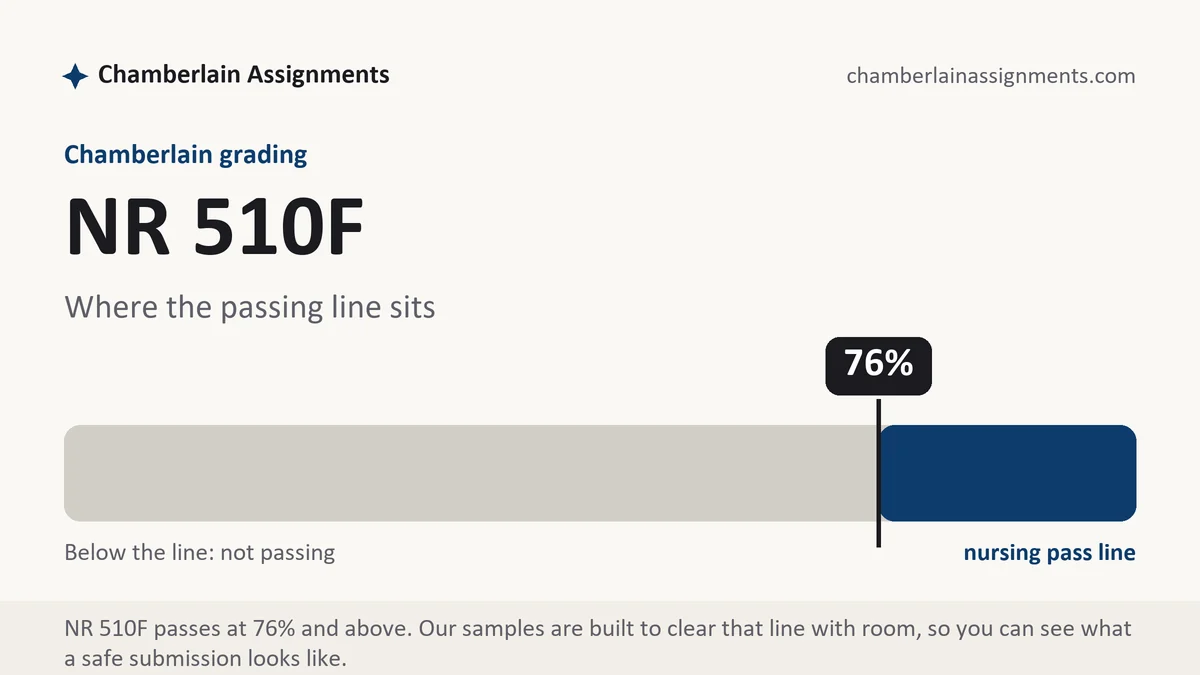
The discipline behind every paper here: the rubric is the outline, each row gets its section, one-shot discussions get the one-shot treatment, and the 76 percent floor is treated as the cliff it is. Send your week's instructions with a request and the sample matches them, revisions included.
NR 510F questions, answered
Which version am I in, and does it change the assignments?
Your classroom listing settles it, and yes, the emphasis changes. The version without the suffix argues the role as an organizational position, with credentialing and cost attached. This one spends its weeks on your own transition, so the same subject arrives as a self-assessment and a plan rather than as an analysis of an employer. Read the assignment instructions before reusing anything.
Can a sample include my competency scores?
It can be built around them once you send them, and it cannot invent them. The same holds for clinical hours, preceptor signatures and anything a site records on your behalf, which stay yours to collect. What a worked example shows is how a low score becomes an argument instead of an embarrassment, and how a plan is written so somebody could check it later.
How honest should the weaknesses be?
Honest enough to be specific, and chosen with some judgment. A gap you can describe, explain and plan around is the whole point of an assignment built on self-assessment. Something you claim you cannot do at all, with no plan behind it, only raises a question you then have to answer somewhere else in the paper. The middle is where the points are.