Send the exact assignment or rubric from your classroom and a custom sample written to it lands in 24 to 48 hours, the first one free. NR 512 is Chamberlain’s Fundamentals of Nursing Informatics course. It centers on what counts as data in a health record, who defined it that way, and where the definition breaks. Searches like "nr 512 week 4 assignment example", "NR512 sample paper", and "NR 512 week samples" land on this page.
What NR 512 is really about
Most nurses arrive here expecting an introduction to systems and find instead an argument about vocabulary. Before a screen can show anything, somebody decided that a fall is this and not that, that pain is captured on this scale, and that a field is required rather than optional. Those decisions are invisible during a shift and they govern everything that happens afterwards. The course spends its first weeks making them visible, which is why the early writing feels less like technology and more like definition work. A submission that opens by naming a system has usually skipped the part being marked, because the assignment wanted the item, the standard behind it, and the person who chose it.
The second half of the argument is what happens to the item once it exists. A recorded value moves out of the chart into a report, a registry, a bill and sometimes a study, and each of those readers assumes it means what its label says. Fundamentals work asks you to follow one item through that chain and say where the meaning shifts, because a number collected for one purpose is rarely as clean as a second purpose requires. Terminologies and classification systems appear for that reason rather than as a list to memorize. They are why two units, two hospitals or two countries can compare anything at all.
What NR 512’s assessments ask for
Assignment prompts in many sections begin with a single element rather than a system. You are asked to take one thing a nurse records, state its definition as the classroom would accept it, name the standard or terminology it belongs to, and show where it lands after the shift ends. Later work moves to comparison, weighing two ways of capturing the same clinical fact and arguing which one survives being reported. Discussions early in the week often open on a term everybody uses loosely, and the reply that earns marks supplies a definition somebody could act on. Work due Sunday usually wants the whole chain in one document, from capture through to the reader at the far end.
Where students lose points in NR 512
The most expensive habit is the product paragraph, where a system is described in general terms and no element is ever pinned to a definition. A second loss comes from treating a terminology as a name to cite rather than as a set of rules, so the paper mentions a standard without showing what it forces you to record. Third is the chain that stops at the chart, ending the analysis where the nurse stops typing and never reaching whoever reads the value later. Vague terms left undefined, examples borrowed from a textbook instead of a real unit, claims about accuracy with no source of error named, and citations attached to sentences a reader could not check all cost marks here.
The NR 512 drawers
NR 512 Week 1 discussion post example
Week 1 usually opens on where informatics sits between nursing practice and the record. On request, free, 24-48h.
NR 512 Week 2 data definition brief example
Week 2 typically asks for one recorded element defined tightly enough to argue with. On request, free, 24-48h.
NR 512 Week 3 terminology comparison example
Week 3 often sets two coding vocabularies against each other over the same finding. On request, free, 24-48h.
NR 512 Week 4 concept map example
Week 4 in many sections draws how one value travels from bedside to report. On request, free, 24-48h.
NR 512 Week 5 information model write-up example
Week 5 commonly asks what structure a record needs before questions can be answered. On request, free, 24-48h.
NR 512 Week 6 standards appraisal example
Week 6 often weighs published guidance for capturing one clinical fact consistently. On request, free, 24-48h.
NR 512 Week 7 documentation case analysis example
Week 7 typically works through an entry that meant different things to different readers. On request, free, 24-48h.
NR 512 Week 8 informatics position paper example
Week 8 usually gathers the term, the standard and the consequence into one argument. On request, free, 24-48h.
Your classroom shows something else?
Chamberlain University revises courses; week counts and deliverables shift between terms. Send what your classroom shows and the desk matches it exactly.
Using a NR 512 sample the right way
Read a sample for its first two paragraphs, where the item is chosen and defined, because that is where the rest of the paper is decided. Watch how the writer commits to one element and refuses to widen, and how each later claim is traceable back to the definition given at the start. Then substitute an item from your own practice, since the value of the exercise comes from a definition you have seen argued about in real life. What carries over is the sequence, along with the discipline of naming the standard before making any claim about what the data supports.
How these samples are written
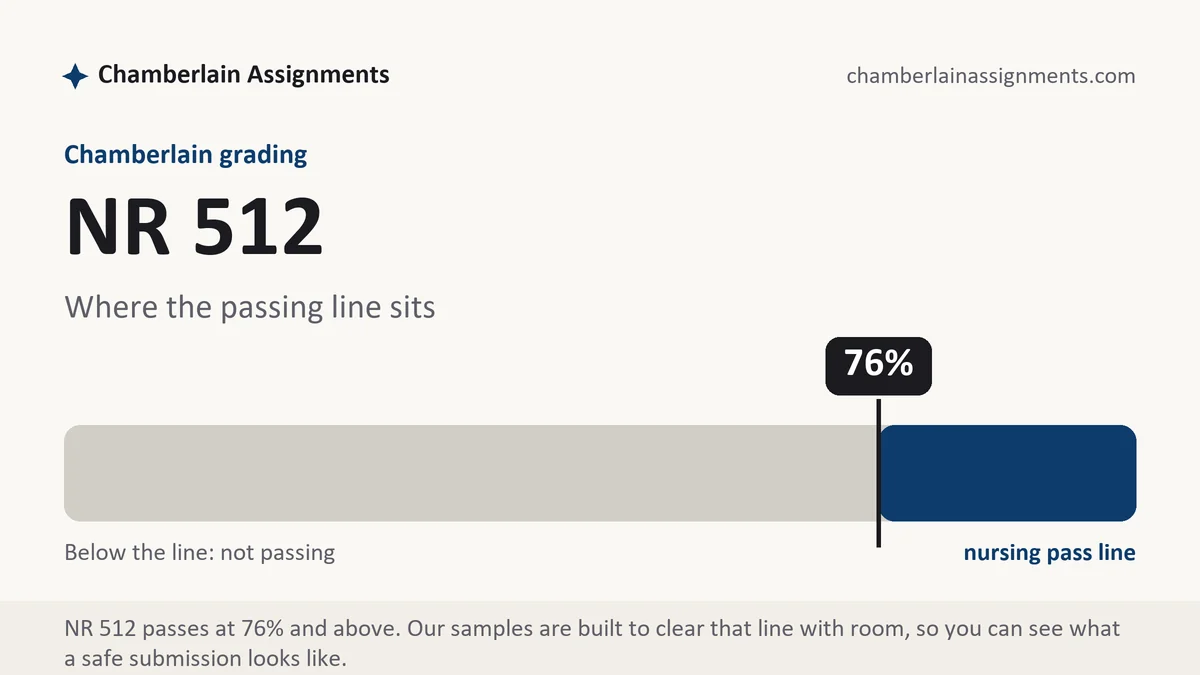
The discipline behind every paper here: the rubric is the outline, each row gets its section, one-shot discussions get the one-shot treatment, and the 76 percent floor is treated as the cliff it is. Send your week's instructions with a request and the sample matches them, revisions included.
NR 512 questions, answered
Does this course expect programming or database skills?
No. What it expects is precision with words, since the graded argument is about what an element means and who decided that. Some sections show a data model or a query as illustration, but the writing is judged on whether your definitions hold up and whether you can say where a value came from. Nurses with no technical background do well here.
Which item should I choose when the prompt lets me pick?
Pick one you record often and have argued about with a colleague, because disagreement is evidence that the definition is contested. Broad choices such as vital signs spread the paper thin, while something narrow like a wound stage or a fall risk score gives you a standard to cite and a reader downstream to name.
How much of this should be about the electronic record itself?
Less than most drafts contain. The record is where your item lives, so it appears whenever you explain capture or retrieval, but a page spent describing screens and menus buys nothing. Faculty reading these papers want the element, the rule behind it and the consequence when the rule is ignored. The system is only the container.