Send the exact assignment or rubric from your classroom and a custom sample written to it lands in 24 to 48 hours, the first one free. NR 518 is Chamberlain’s Population Health and Epidemiology in Nursing Practice course. It centers on asking why one group falls ill more often than another, and what has to be ruled out before that difference means anything. Searches like "nr 518 week 4 assignment example", "NR518 sample paper", and "NR 518 week samples" land on this page.
What NR 518 is really about
Epidemiology arrives in the master's sequence as a method rather than as a body of facts, and NR 518 is where nurses learn to run it. The method begins by forcing two definitions into the open. What exactly counted as exposed, and what exactly counted as a case? Until those are fixed, every figure that follows is negotiable, and a great deal of weak population writing is weak for exactly that reason. Once the definitions hold, the work becomes comparison: this group against that one, over a stated period, with the difference expressed as something other than a raw count. Nurses who have spent a career reading one chart at a time usually find that first move the hardest part.
What separates submissions is what happens after a difference appears. A gap between two groups always has more than one explanation available, and the course wants the alternatives handled before the interesting one is claimed. What else differs between the groups, what the design could not observe, who never made it into the count, and whether the outcome was measured the same way on both sides are the routine questions, and answering them is the analysis. Nursing practice is the destination throughout. A finding only counts in this classroom once you can say what a nurse would do differently because of it, and at what level that change would sit.
What NR 518’s assessments ask for
Weekly work tends to alternate between running a method and reading somebody else's. Measurement assignments typically ask for a rate or a ratio produced from supplied figures, with the choice of denominator defended in a sentence, since the arithmetic is rarely where the points are. Design assignments ask which study shape could answer a stated question and what choosing it would cost you, since following people forward answers different questions from starting with the cases and looking back. Applied assignments hand you a published population claim and ask what else could account for it. Discussions open the week on a determinant or an outbreak and expect a reply that tests the causal reasoning rather than the sentiment.
Where students lose points in NR 518
The most reliable loss is the association promoted to a cause in one sentence, usually because no alternative explanation was ever raised. Second is the measure chosen by habit: a ratio reported where the design cannot support one, or an incidence figure worked out over people who were never at risk. Third is the design named but not costed, where a writer says a trial would be ideal without saying who gets randomized, to what, and whether anybody would agree to take part. Case definitions left vague, screening discussed with no reference to how common the disease actually is, and findings stated with no practice consequence attached all thin the grade.
The NR 518 drawers
NR 518 Week 1 discussion post example
Week 1 often asks what epidemiology can answer that a clinical record cannot. On request, free, 24-48h.
NR 518 Week 2 case definition exercise example
Week 2 typically forces exposure and outcome into definitions somebody else could apply. On request, free, 24-48h.
NR 518 Week 3 measures of association exercise example
Week 3 commonly asks which measure the design allows and why the others fail. On request, free, 24-48h.
NR 518 Week 4 study design comparison example
Week 4 often weighs two designs against one question and counts the cost of each. On request, free, 24-48h.
NR 518 Week 5 outbreak investigation write-up example
Week 5 generally works an outbreak forward from the first cases anybody recorded. On request, free, 24-48h.
NR 518 Week 6 risk factor analysis example
Week 6 usually asks what else could explain a gap before the obvious answer wins. On request, free, 24-48h.
NR 518 Week 7 prevention program plan example
Week 7 in many sections turns a finding into prevention aimed at a stated level. On request, free, 24-48h.
NR 518 Week 8 population health paper example
Week 8 typically closes with one question carried from definition through to recommendation. On request, free, 24-48h.
Your classroom shows something else?
Chamberlain University revises courses; week counts and deliverables shift between terms. Send what your classroom shows and the desk matches it exactly.
Using a NR 518 sample the right way
The parts of a worked example worth copying here are structural. Look for where the case definition is stated before any counting starts, where the comparison group is introduced, and where the writer lists what else might explain a difference before settling on an answer. Notice that the practice recommendation stays proportionate to the strength of what was found. Then rebuild the argument on data you were actually given or gathered, because the figures your section supplies and the setting you work in are what the assignment marks, and borrowed numbers cannot be defended in a discussion.
How these samples are written
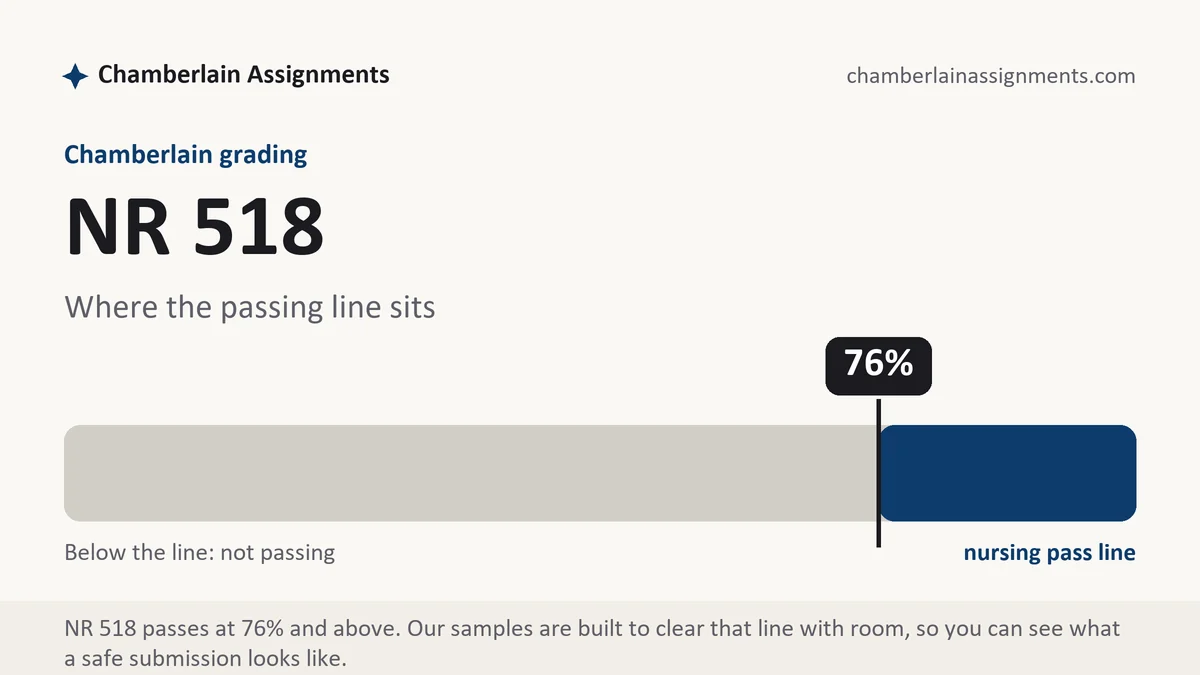
The discipline behind every paper here: the rubric is the outline, each row gets its section, one-shot discussions get the one-shot treatment, and the 76 percent floor is treated as the cliff it is. Send your week's instructions with a request and the sample matches them, revisions included.
NR 518 questions, answered
How much mathematics does this course involve?
Less than the name suggests, and the arithmetic is arithmetic. What carries the points is the reasoning around it: which denominator belongs under the number, which period it covers, which group it is being compared against. A correct calculation attached to the wrong denominator scores worse than a rough one that has been thought through and explained on the page.
Where does nursing practice come into an epidemiology assignment?
At the end of every argument, and it is the part people forget. Once you have a finding, say who would act on it, whether the action sits with a clinician, a unit or a policy, and what would tell you it worked. A population paper stopping at the number has answered about half of what was asked.
Can I use data from my own workplace?
Aggregate figures you are permitted to use are usually fine, with the organization unnamed and nothing that could identify a patient. Check with your instructor before building an assignment on internal data. Publicly reported county and state figures are safer, easier to cite, and let a grader confirm where every number in the paper came from.