Send the exact assignment or rubric from your classroom and a custom sample written to it lands in 24 to 48 hours, the first one free. NR 524 is Chamberlain’s Curriculum Development course. It centers on building a program of study as one ordered argument, where each course inherits something and owes something to the courses after it. Searches like "nr 524 week 4 assignment example", "NR524 sample paper", and "NR 524 week samples" land on this page.
What NR 524 is really about
Most people arrive in NR 524 with a course they would fix, and the first assignments move the question one level up. A curriculum is not a set of good courses sitting beside each other; it is a sequence with an order somebody has to defend. Something is taught early because a later thing depends on it, and if nothing depends on it the placement is decoration. The work asks you to say what a graduate should be able to do, then show where each of those abilities is introduced, practiced and finally evidenced. Written that way, a gap becomes visible: an outcome everybody assumed was covered turns out to be mentioned three times and assessed nowhere.
The rest of the course adds the constraint that makes this work hard, which is that you are designing for people who do not yet hold the material. Expert nurses build programs the way they would want to read one, front loading the parts they find interesting and compressing the part a beginner needs most. Credit hours are finite, so every addition is a removal, and a proposal that only adds tells a grader you have not yet sat with a curriculum committee. Assignments generally want the external anchors named too, since program outcomes answer to accreditation standards and to the licensure or certification a graduate is heading toward.
What NR 524’s assessments ask for
The weekly rhythm moves outward, from a single course to the program that contains it. Opening assignments often ask you to put a philosophy and a set of outcomes in writing, which sounds soft until a rubric wants each outcome measurable and each one owned by a named place in the sequence. Around the middle of the session a map is usually wanted: outcomes down one side, courses across the top, and an honest mark for where something is introduced, reinforced and evaluated. Late assignments in many sections want a revision argued to people who would have to approve it, so the rationale carries the evidence, the gap and the cost. The weekly discussion rewards a reply that asks where an outcome is actually assessed rather than praising a classmate's design.
Where students lose points in NR 524
The wish list loses points first: a curriculum built by adding everything worth knowing until the sequence has no room left and no order. Second is the map that marks every cell, since a matrix claiming each course covers each outcome proves only that nobody checked. Third is the outcome written as a feeling, because a graduate who values collaboration cannot be measured and a graduate who leads a handoff can. Rubrics also take points for a change proposed with no removal to pay for it, prerequisites asserted without saying what depends on what, an undergraduate outcome reappearing in a graduate program with the verb untouched, and a design that never names who would have to approve it.
The NR 524 drawers
NR 524 Week 1 discussion post example
Week 1 typically asks what your program promises a graduate and who decided that. On request, free, 24-48h.
NR 524 Week 2 curriculum philosophy statement example
Week 2 often wants beliefs about learning written so a later design decision can rest on them. On request, free, 24-48h.
NR 524 Week 3 program outcome set example
Week 3 usually asks for outcomes a graduate could be observed meeting, not values. On request, free, 24-48h.
NR 524 Week 4 curriculum map example
Week 4 commonly builds the grid where each outcome is introduced, reinforced and finally evidenced. On request, free, 24-48h.
NR 524 Week 5 sequencing rationale example
Week 5 generally asks why this course comes before that one, with the dependency named. On request, free, 24-48h.
NR 524 Week 6 gap analysis example
Week 6 in many sections hunts for the outcome everyone assumed somebody else was covering. On request, free, 24-48h.
NR 524 Week 7 revision proposal example
Week 7 frequently asks for a change argued to the committee that would approve it. On request, free, 24-48h.
NR 524 Week 8 curriculum evaluation plan example
Week 8 tends to ask how a program would know its own sequence is working. On request, free, 24-48h.
Your classroom shows something else?
Chamberlain University revises courses; week counts and deliverables shift between terms. Send what your classroom shows and the desk matches it exactly.
Using a NR 524 sample the right way
Read a sample here for its spine, not its wording. Follow one outcome from the philosophy statement through the map and into the course where it is finally evidenced, and watch how the writer resists adding content at every point where a paragraph could have been padded. Notice how each placement carries a reason pointing forward to something later. Then redraw the map around the program you actually work in, because the sequence that matters to your grade has your credit limits, your faculty and your accreditation anchors in it. A sample transfers the discipline of ordering; the program has to be yours.
How these samples are written
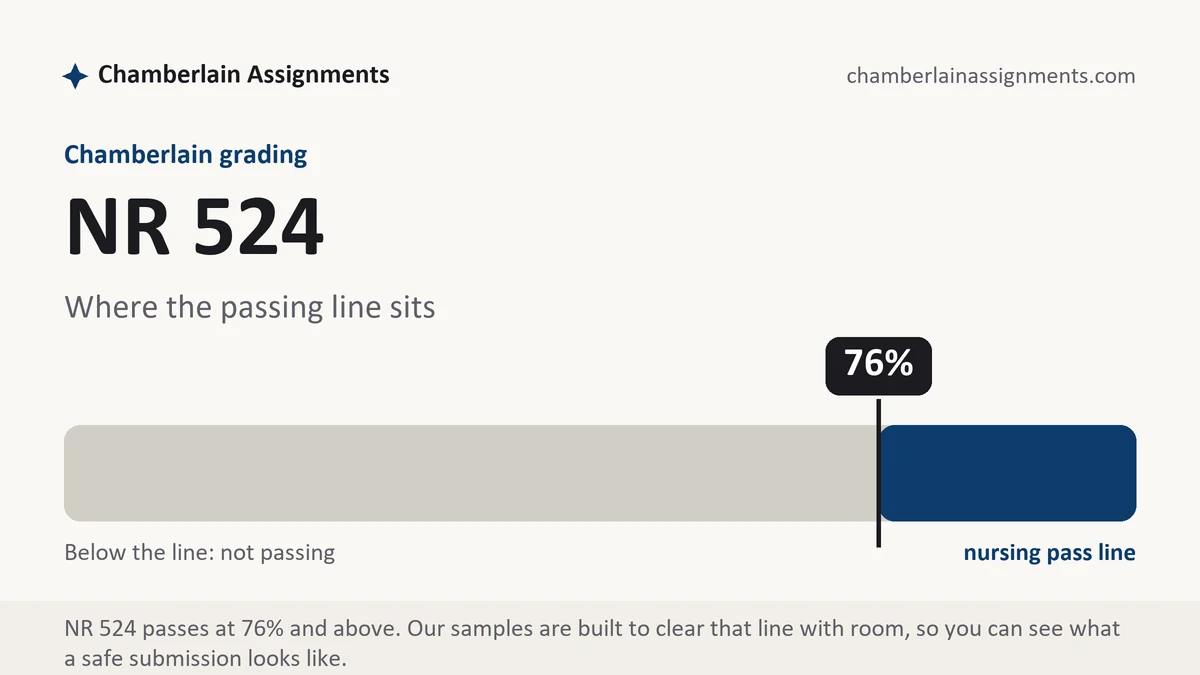
The discipline behind every paper here: the rubric is the outline, each row gets its section, one-shot discussions get the one-shot treatment, and the 76 percent floor is treated as the cliff it is. Send your week's instructions with a request and the sample matches them, revisions included.
NR 524 questions, answered
How specific do program outcomes have to be?
Specific enough that two readers would agree on whether a graduate met one. That usually means a verb somebody could observe and a condition saying where. Values and attitudes belong in the philosophy statement, where they explain the design. Once an outcome reaches the map it has to be the kind of thing a course can actually evidence, and vague ones stall there.
May I design a curriculum for a program that does not exist?
You can, and it costs you the constraints that make the work convincing. Invented programs get invented resources, so the design never has to choose. If your section allows a hypothetical, give it a real credit limit, a real faculty size and a real setting, then let those numbers force the removals. Graders reward a design that has clearly said no to something.
What separates curriculum work from lesson planning?
Scale and obligation. A lesson plan answers for one hour and can be excellent on its own; a curriculum answers for what a graduate can do and is only excellent in sequence. As you write, keep asking what the course before yours guaranteed and what the course after yours is counting on, because that dependency is the thing being graded.