Send the exact assignment or rubric from your classroom and a custom sample written to it lands in 24 to 48 hours, the first one free. NR 530 is Chamberlain’s Foundations Population Health course. It centers on the vocabulary population work runs on, starting with who exactly counts inside the group you keep calling a population. Searches like "nr 530 week 4 assignment example", "NR530 sample paper", and "NR 530 week samples" land on this page.
What NR 530 is really about
NR 530 sits at the front of the sequence because the rest of it will not hold without the words. Population sounds like a plain English term and behaves like a technical one. In a health system it usually means the group somebody has been made answerable for, which might be the patients attributed to a practice, the members a plan covers, or everyone inside a county line. Those three groups overlap and are not the same, and a sentence that slides between them has stopped meaning anything. So the first discipline the course teaches is stating the boundary out loud: who is inside, who drew the line, and what happens to the people who fall outside it.
The second thing the course establishes is that nobody owns the result. A hospital answers for the people who reach it, a health department for the residents inside its authority, an employer for the staff it insures, and a population's health falls through every one of those gaps. That absence is why population health exists as a field rather than as a department. It also explains the vocabulary that follows. Levels of prevention sort work by how early it happens, determinants sort causes by how far upstream they sit, and both say where in a long chain somebody chose to intervene. Used loosely they decorate a paragraph; used precisely they tell a reader which part of the problem a plan is aimed at.
What NR 530’s assessments ask for
Weekly work in this course tends to be definitional before it is analytical. Early assignments often ask you to describe a population in a way that could be counted, which means naming the boundary, the source supplying the members, and the period. Middle weeks commonly hand you a health problem and ask which level of prevention a proposed response belongs to, and why the answer is less obvious than it looks. Determinant assignments ask you to trace one outcome back through the conditions that produced it and to stop at a point you can defend rather than at the first social factor you reach. Discussion prompts early in the week generally reward a post that replaces a loose term with a precise one and shows what changed.
Where students lose points in NR 530
Points go first to the paper that uses population, community and public interchangeably inside the same argument, because a reader cannot tell which group any claim applies to. Second is the boundary nobody drew: a paper about a population that never says who is inside it, which leaves every later figure unverifiable. Third is the determinant paragraph that lists income, housing and transport as headings and never connects any of them to the outcome under discussion. Confusing primary with secondary prevention, treating screening as though it stopped disease from starting, describing a service without saying which body would be answerable for running it, and using upstream as a compliment rather than as a position in a causal chain all cost marks here.
The NR 530 drawers
NR 530 Week 1 discussion post example
Week 1 often asks what a population actually is once you have to count one. On request, free, 24-48h.
NR 530 Week 2 concept clarification example
Week 2 typically pulls public health and population health apart and makes the difference do work. On request, free, 24-48h.
NR 530 Week 3 social determinants map example
Week 3 in many sections traces one outcome back through the conditions that kept producing it. On request, free, 24-48h.
NR 530 Week 4 levels of prevention analysis example
Week 4 commonly sorts a proposed response by how early in the disease it arrives. On request, free, 24-48h.
NR 530 Week 5 defined population brief example
Week 5 generally fixes a boundary, then names who would be inside it tomorrow. On request, free, 24-48h.
NR 530 Week 6 accountability mapping example
Week 6 usually asks which body answers for an outcome nobody was made responsible for. On request, free, 24-48h.
NR 530 Week 7 framework comparison example
Week 7 frequently sets two population health frameworks against one problem to see what each misses. On request, free, 24-48h.
NR 530 Week 8 reflection example
Week 8 tends to close on which words you now refuse to use loosely. On request, free, 24-48h.
Your classroom shows something else?
Chamberlain University revises courses; week counts and deliverables shift between terms. Send what your classroom shows and the desk matches it exactly.
Using a NR 530 sample the right way
Read a sample here for its first paragraph. Watch how the writer fixes the population before saying anything about it, how a term is chosen and then held to for the rest of the piece, and how each cause is placed somewhere specific rather than gestured at. Then write your own around the group you were actually assigned, since the boundary you draw decides which data you are allowed to use and a grader will check the fit between them. What transfers from a sample is the habit of defining before describing, which is the entire point of a foundations course.
How these samples are written
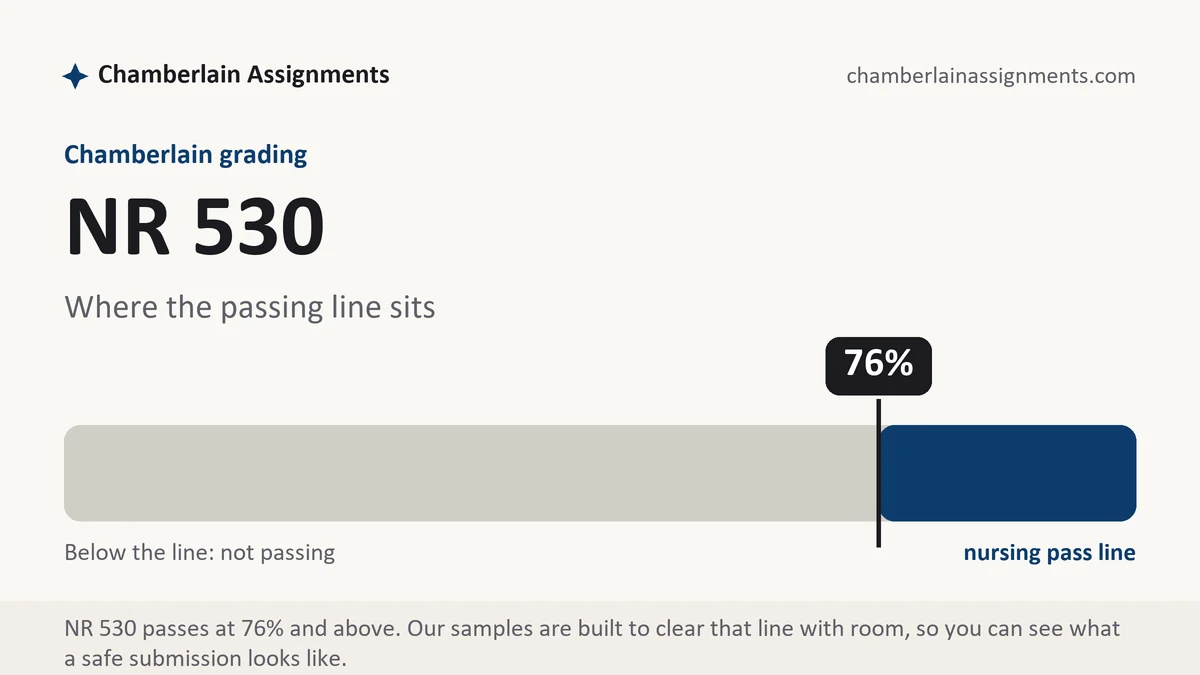
The discipline behind every paper here: the rubric is the outline, each row gets its section, one-shot discussions get the one-shot treatment, and the 76 percent floor is treated as the cliff it is. Send your week's instructions with a request and the sample matches them, revisions included.
NR 530 questions, answered
Is population health just public health with a newer name?
They overlap and they are not identical, and assignments here often turn on the difference. Public health usually names governmental work carried out under statutory authority for everyone in a jurisdiction. Population health names responsibility for the outcomes of a defined group, wherever that responsibility sits, including systems and employers with no legal authority at all. Say which one you mean and the argument stays readable.
How specific does my population have to be?
Specific enough that somebody could count it. Adults with diabetes is a topic. Adults with diabetes attributed to one clinic during one calendar year is a population, because a list could be produced. The extra clauses feel fussy until you need a rate, at which point the vague version supplies nothing to divide by and the writing stalls.
Can a sample be built on the population my section assigned?
Yes, and that is the better way to use one. Send the assignment instructions and the rubric your classroom posted, along with the group you were handed, and the first custom example comes back free in 24-48h. Definitions and sources differ enormously between a county, an insured panel and a clinic list, so a general model is worth less than one built on yours.