Send the exact assignment or rubric from your classroom and a custom sample written to it lands in 24 to 48 hours, the first one free. NR 537 is Chamberlain’s Assessment and Evaluation in Education course. It centers on deciding whether a score is honest, from the blueprint that plans a test down to the item and the rubric that reads a performance. Searches like "nr 537 week 4 assignment example", "NR537 sample paper", and "NR 537 week samples" land on this page.
What NR 537 is really about
Every assessment makes a claim, and NR 537 spends eight weeks testing whether the claim holds. A quiz says these learners can do the thing; a clinical evaluation tool says this student is safe; a course evaluation says the teaching worked. In each case the score stands in for something nobody can see directly, and the whole discipline is about how honest that substitution is. The course arrives with a small vocabulary that does most of the work. Validity asks whether you measured what you named. Reliability asks whether the same performance would score the same twice. Alignment asks whether the item, the objective and the teaching are talking about the same thing at the same level.
The failure this course exists to correct is comfortable and common. An objective promises that a learner will prioritize or decide, then the test asks for a definition, because recall items are quick to write and quick to defend. Scores come back high and everybody feels informed, though nothing about judgment was ever measured. Assignments here keep putting that gap in front of you: read the item, read the objective, say what the item actually requires somebody to do. The same logic runs through rubrics, where a level described as good work leaves the judgment in the grader instead of on the page, and through clinical evaluation, where a tool has to survive being used by two different people.
What NR 537’s assessments ask for
The session builds from single items up to whole evaluation plans. The opening assignments typically ask for items written against stated objectives, with a short defense of what each one measures and why the wrong options are wrong for instructive reasons. Middle weeks usually want a blueprint, so a test can be shown to sample the course rather than the parts easiest to ask about, plus a rubric whose levels differ by something observable instead of by adverbs. Later on, many sections hand back results and ask which items behaved badly and what you would change before using them again. The discussion each week runs on other people's items, and a useful reply names what a classmate's question is really testing.
Where students lose points in NR 537
Points leave fastest through the item measuring recall behind an objective that promised judgment, usually visible in a stem answerable from a glossary. Second is the rubric written in comparatives, where excellent is thorough and adequate is somewhat thorough, which tells a learner nothing beforehand and gives a grader no defense afterward. Third is the blueprint mirroring the lecture schedule instead of the objectives, so the heavily taught week owns most of the test whatever else matters. Readers also deduct for clued or absurd distractors, evaluation tools no two people could apply alike, results reported with no decision attached, and validity and reliability used as though they were one claim.
The NR 537 drawers
NR 537 Week 1 discussion post example
Week 1 often opens on a test you once sat that measured the wrong thing. On request, free, 24-48h.
NR 537 Week 2 test item set example
Week 2 typically asks for items written against stated objectives, each option defended. On request, free, 24-48h.
NR 537 Week 3 test blueprint example
Week 3 usually asks how a test samples the course instead of the memorable weeks. On request, free, 24-48h.
NR 537 Week 4 analytic rubric example
Week 4 commonly wants levels differing by something two readers could both see. On request, free, 24-48h.
NR 537 Week 5 item analysis write-up example
Week 5 generally asks which items behaved badly and what you would fix before reusing them. On request, free, 24-48h.
NR 537 Week 6 clinical evaluation tool critique example
Week 6 in many sections tests whether two instructors could apply one tool alike. On request, free, 24-48h.
NR 537 Week 7 course evaluation plan example
Week 7 frequently asks what a satisfaction survey can and cannot support as evidence. On request, free, 24-48h.
NR 537 Week 8 assessment plan synthesis example
Week 8 tends to gather the pieces into one plan a course could adopt. On request, free, 24-48h.
Your classroom shows something else?
Chamberlain University revises courses; week counts and deliverables shift between terms. Send what your classroom shows and the desk matches it exactly.
Using a NR 537 sample the right way
Read a sample here at the level of one item and one objective, side by side. Ask what a learner would have to do to answer, compare that with the verb the objective used, and notice how the writer defends a gap when there is one instead of hiding it. In the rubric samples, look at the difference between adjacent levels and check that it is something two graders could both see. Then rewrite against your own objectives, since the test that matters is the one your learners sit, and what a sample gives you is the habit of checking a claim before the score is trusted.
How these samples are written
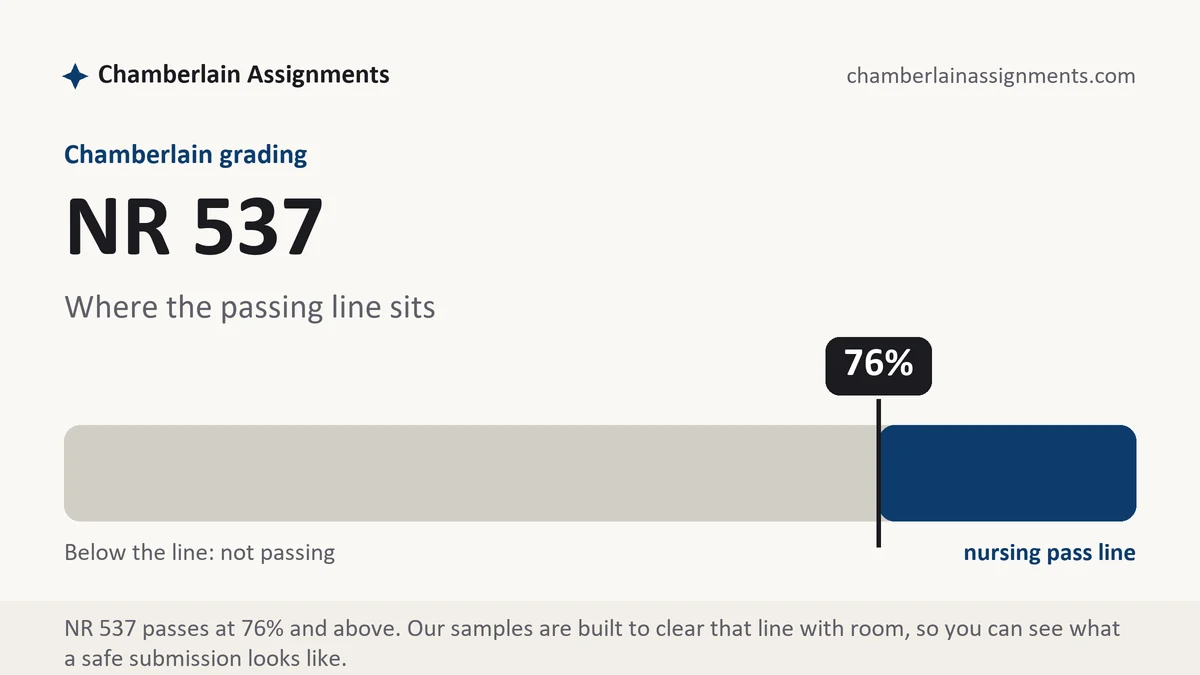
The discipline behind every paper here: the rubric is the outline, each row gets its section, one-shot discussions get the one-shot treatment, and the 76 percent floor is treated as the cliff it is. Send your week's instructions with a request and the sample matches them, revisions included.
NR 537 questions, answered
What makes an item test judgment rather than memory?
It puts the learner in a situation where more than one option is defensible and one is better. Recall items ask what something is; judgment items ask what to do next, given a patient with competing needs. Keep every option plausible to somebody who half knows the material, and make sure the reason the best answer wins is one you taught.
What makes a rubric level defensible?
A reader can see the difference without knowing your opinion. Write each level around what is present or absent in the work rather than around how well it was done, and keep the same features running across levels so a piece cannot sit in two places at once. If a level needs the word excellent to be understood, it is unfinished.
Can I write about evaluating a course rather than a learner?
Yes, and the same questions apply to different objects. Ask what the survey claims to measure, whether the people answering are placed to know, and what decision the result will feed. Course evaluation goes wrong the way item writing does, by collecting what is easy to ask and then treating it as evidence for something much larger.