Send the exact assignment or rubric from your classroom and a custom sample written to it lands in 24 to 48 hours, the first one free. NR 540 is Chamberlain’s Leading and Managing Population Health course. It centers on keeping a population program alive as ordinary work, with money, staffing and written agreements that do not depend on one person staying. Searches like "nr 540 week 4 assignment example", "NR540 sample paper", and "NR 540 week samples" land on this page.
What NR 540 is really about
Most population programs die quietly. Not from a bad idea and not from a hostile audience, but because the person holding it together took another post and nobody else knew who to call. NR 540 is the course that takes that failure seriously. The management questions it asks are unglamorous and decisive: which line of a budget pays for this next year, whose job description contains it, what happens to the data collection when the person doing it leaves, and whether the relationship with the partner organization exists on paper or only inside somebody's phone. A program that cannot answer those has a life expectancy measured in staff changes rather than in years.
The leadership half is complicated by the fact that almost nobody involved works for you. Population work is carried by schools, pharmacies, faith groups, housing offices and volunteers, none of whom can be told what to do and all of whom have priorities of their own. Authority here comes from holding something the partner also wants, and the writing has to name what that is for each one rather than assuming goodwill. The money question sits alongside it. Grant funding buys a program a start and a deadline; a recurring line buys it a future, and moving from one to the other is a management task with a plan behind it rather than something that happens because results were good.
What NR 540’s assessments ask for
Weekly work tends to be organizational rather than analytical. Some assignments ask for the structure: who reports to whom, which meetings exist, what gets escalated and to whom, drawn for work that crosses more than one employer. Others ask for the money, usually as a budget with the assumptions written beside each figure and a sentence on what happens when the first funding ends. Staffing work asks what competence each role needs and how a replacement would be brought up to speed, which is where documented routine earns its place. Discussions open the week and often present a program in trouble, rewarding the reply that identifies the structural cause rather than the personality everybody noticed first.
Where students lose points in NR 540
The costliest paper here answers a management question with enthusiasm, describing why a program matters where a reader asked who pays for it. Second is the plan resting entirely on one committed person, usually the writer, with no account of what happens when that person moves on. Third is the partner treated as a resource rather than as an organization with aims of its own, which produces agreements no partner would sign. Budgets with figures and no assumptions, meetings listed without saying which decision each one makes, sustainability described as a hope rather than as a mechanism, and evaluation data whose collection depends on nobody being off sick all lose points.
The NR 540 drawers
NR 540 Week 1 discussion post example
Week 1 often asks why a promising population program stopped after its first year. On request, free, 24-48h.
NR 540 Week 2 program structure brief example
Week 2 typically draws reporting lines for work spread across several employers. On request, free, 24-48h.
NR 540 Week 3 budget narrative example
Week 3 in many sections attaches a stated assumption to every figure in the budget. On request, free, 24-48h.
NR 540 Week 4 role and staffing plan example
Week 4 commonly writes the job so a stranger could be recruited into it. On request, free, 24-48h.
NR 540 Week 5 partnership agreement outline example
Week 5 generally sets out what each partner gains before what each partner gives. On request, free, 24-48h.
NR 540 Week 6 quality monitoring plan example
Week 6 usually decides which figures keep being collected once attention moves elsewhere. On request, free, 24-48h.
NR 540 Week 7 sustainability plan example
Week 7 frequently replaces the founding grant with money that arrives again next year. On request, free, 24-48h.
NR 540 Week 8 leadership reflection example
Week 8 tends to end on what you would hand over, and to whom. On request, free, 24-48h.
Your classroom shows something else?
Chamberlain University revises courses; week counts and deliverables shift between terms. Send what your classroom shows and the desk matches it exactly.
Using a NR 540 sample the right way
Read a sample here for the boring parts, because that is where the marks are. Look at how budget lines carry assumptions, how each partner appears with something it gains, and how the writer says what would happen to the work in a month when two staff are missing. Notice too that nothing important in it depends on goodwill. Then rebuild it around the program and the organization you were given, since the funding, the reporting lines and the partners are specific and a borrowed structure will not fit. What transfers is the standard of concreteness the rubric applies to anything called sustainable.
How these samples are written
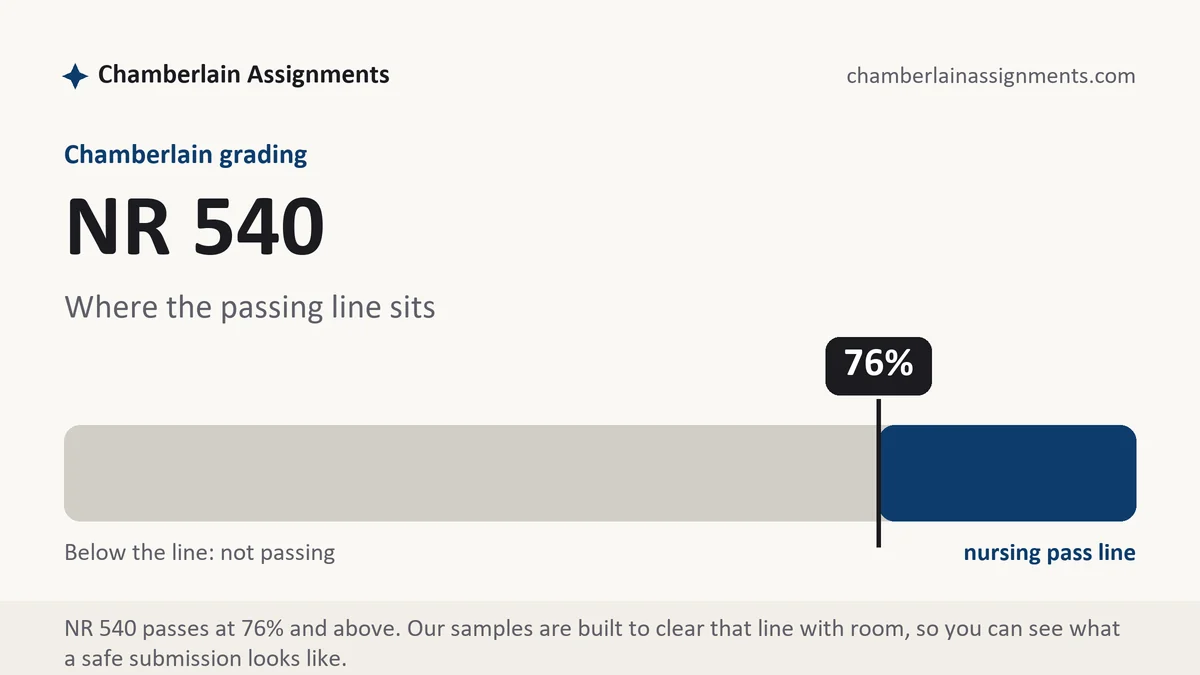
The discipline behind every paper here: the rubric is the outline, each row gets its section, one-shot discussions get the one-shot treatment, and the 76 percent floor is treated as the cliff it is. Send your week's instructions with a request and the sample matches them, revisions included.
NR 540 questions, answered
What counts as sustainability in an assignment here?
A mechanism somebody could point at. A named budget line, a role that contains the work, a written agreement with the partner, and a data collection somebody else could run without you. Sustainability described as continued commitment or as an ongoing partnership is a hope with nobody attached to it, and rubrics in this course tend to read it that way.
My program is hypothetical. Can I still write a budget?
Yes, and the assumptions matter more than the totals. State the hourly rate you assumed, the number of sessions, what the space costs and what you are treating as donated. A reader can accept an invented figure that is explained and cannot accept a confident one that arrived from nowhere. Keep the arithmetic simple and the reasoning visible beside it.
How much detail does the staffing section need?
Enough that somebody could be recruited from it. What the role does weekly, what qualification or license it requires, who supervises it, and how a person unfamiliar with the work would learn the routine. That last piece separates a program from a personal project, and it is often the difference between a competent paper and a strong one.