Send the exact assignment or rubric from your classroom and a custom sample written to it lands in 24 to 48 hours, the first one free. NR 548 is Chamberlain’s Psychiatric Assessment for Psychiatric-Mental Health Nurse Practitioner course. It centers on taking a psychiatric history and mental status examination, then recording them so a second reader can see what you saw. Searches like "nr 548 week 4 assignment example", "NR548 sample paper", and "NR 548 week samples" land on this page.
What NR 548 is really about
In most assessment courses the examination comes with instruments attached. Here the instrument is the conversation, and the findings are things you watched happen. That makes the writing unusually easy to fake and unusually easy to catch. A note saying a patient appeared anxious and guarded has recorded a conclusion. A note saying he answered in short phrases, checked the door twice and declined to sit has recorded evidence, and a second reader can reach their own conclusion from it. Most of the points in this course sit on that distinction, and the early assignments are built to force it into the open before any harder material arrives.
Risk is where the same discipline gets tested hardest. A number from a screening tool is a data point, not a verdict, and writing that leans on the number has handed away the judgment being graded. What earns points is the account: which factors are present, which ones protect, what the person said when asked directly, what you did next, and why that response fits what you found. Screening instruments elsewhere in the course get the same treatment. They organize an interview and give you something you can repeat at the next visit, but the reason behind a score still has to come out of the history you took.
What NR 548’s assessments ask for
Written work in many sections builds toward a full psychiatric evaluation, assembled in pieces first. Early assignments often isolate one component, an interview technique tried and reported honestly, or a mental status paragraph written from a recorded encounter, so the habit forms before the whole document is due. Later pieces typically want the components joined: history, observation, risk, and a summary that a colleague could act on without asking you anything. Discussions tend to open the week with a question about how you would ask something difficult, which is more useful practice than it looks. Any interview you conduct on placement, and the record your preceptor keeps of your performance, belong to you alone.
Where students lose points in NR 548
The most common loss is the mental status paragraph made of adjectives. Words like appropriate, cooperative and intact describe a judgment nobody can check, and a whole paragraph of them tells a grader nothing was observed carefully. The second is the risk section that ends at a score, with no factors weighed and no action stated, which is the one omission faculty treat as serious rather than careless. Third is the interview reported as a transcript, page after page of exchange with no summary doing any work. Collateral never sought, a history with no timeline, quotations used to fill space, and a summary that repeats the sections above it instead of interpreting them all cost points.
The NR 548 drawers
NR 548 Week 1 discussion post example
Week 1 typically opens on how to ask a question a patient would rather avoid. On request, free, 24-48h.
NR 548 Week 2 interview technique write-up example
Week 2 often asks you to report one technique tried and what it produced. On request, free, 24-48h.
NR 548 Week 3 mental status write-up example
Week 3 in many sections wants observations recorded without a single conclusion word. On request, free, 24-48h.
NR 548 Week 4 risk assessment note example
Week 4 commonly asks for factors weighed and an action stated plainly. On request, free, 24-48h.
NR 548 Week 5 screening tool appraisal example
Week 5 typically asks what an instrument tells you and what it cannot. On request, free, 24-48h.
NR 548 Week 6 psychiatric evaluation note example
Week 6 often asks for the components joined into one usable document. On request, free, 24-48h.
NR 548 Week 7 case analysis example
Week 7 in many sections presents an interview that went badly and asks why. On request, free, 24-48h.
NR 548 Week 8 assessment reflection example
Week 8 usually asks what changed in how you listen. On request, free, 24-48h.
Your classroom shows something else?
Chamberlain University revises courses; week counts and deliverables shift between terms. Send what your classroom shows and the desk matches it exactly.
Using a NR 548 sample the right way
Read a sample and watch its verbs. Notice how often the writer records something done or said rather than something concluded, and how the summary earns its place by saying what the observations add up to. Look at how the risk paragraph moves from findings to a decision without ever hiding behind an instrument. Then take your own encounter and write it that way, because the observations have to be ones you made. An example is most useful here as a demonstration of register: plain, specific, and willing to record what was awkward.
How these samples are written
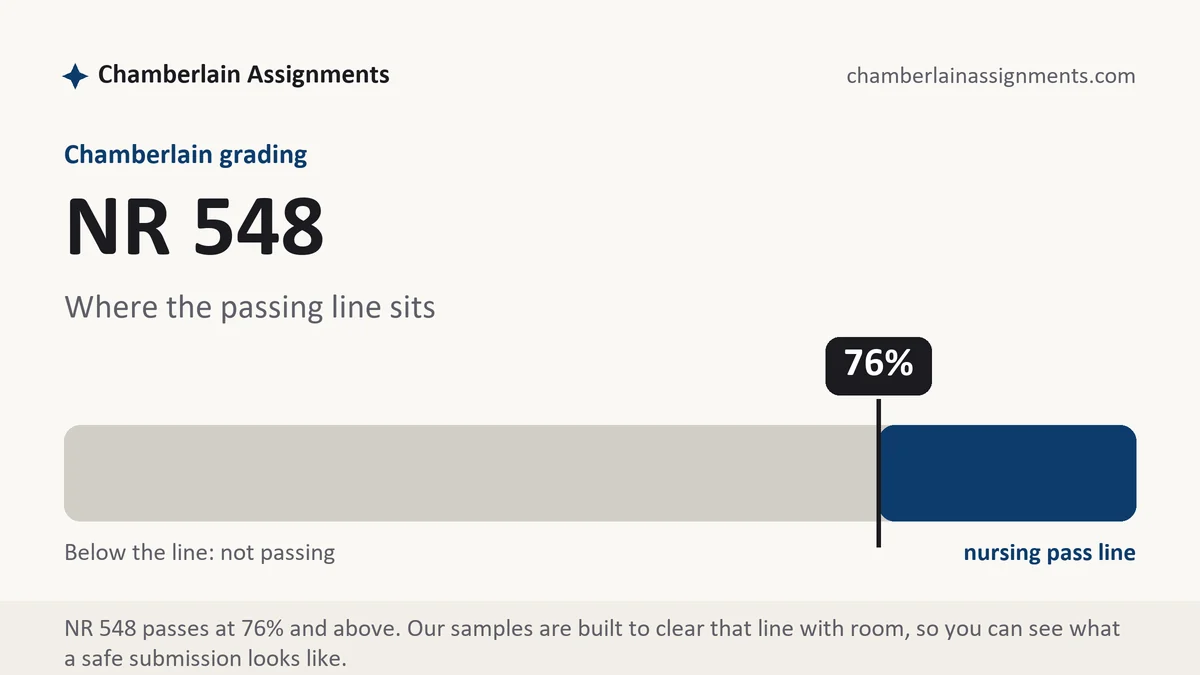
The discipline behind every paper here: the rubric is the outline, each row gets its section, one-shot discussions get the one-shot treatment, and the 76 percent floor is treated as the cliff it is. Send your week's instructions with a request and the sample matches them, revisions included.
NR 548 questions, answered
Can an example be written from a recorded interview my section assigns?
Yes, if the recording is one your classroom provides and you send what you are permitted to share. The sample then shows how that material becomes a written evaluation. Anything you record yourself on placement stays your own document, so what comes back is a model of the writing rather than a substitute for the encounter.
How much of the patient's own wording should a note carry?
Enough to let a reader hear something, which is usually a line or two in the places where paraphrase would lose the point. Quotations work hardest in the risk section and in thought content. Everywhere else they crowd out the observation. A note built mostly of quotations reads as a recording rather than an assessment.
Does the evaluation format change between sections?
Often, and a change of headings moves where each piece of reasoning is supposed to sit, which is why a published example can feel unusable. Send the template your section issued and the sample gets written straight into it. What sits underneath those headings changes far less from one version to the next.