Send the exact assignment or rubric from your classroom and a custom sample written to it lands in 24 to 48 hours, the first one free. NR 549 is Chamberlain’s Foundational Concepts for Professional Nursing Practice course. It centers on what the profession has already put in writing about this role, and what a master's prepared nurse is expected to add to it. Searches like "nr 549 week 4 assignment example", "NR549 sample paper", and "NR 549 week samples" land on this page.
What NR 549 is really about
The opening course of a master's is where most students expect orientation and find an argument instead. Your license does not change here. Nothing you are permitted to do on a shift becomes different because you enrolled, and the degree adds no new authority to your name. What it adds is expectation, and that is the subject. Professional bodies have published, at length, what a nurse prepared at this level is supposed to contribute to a service, and the classroom treats those documents as the terms of reference rather than as reading. So an assignment asking who you are professionally is not an invitation to describe yourself. It is asking you to place yourself against something already written.
The second thing the course installs is a way of writing that the rest of the degree assumes you have. Every claim now needs a source that a reader could check, and the sources that count are not the ones a search engine offers first. Students who have written well for years find this the irritating part, because the writing is not worse, it is differently accountable. Ethics arrives in the same register. A prompt about a difficult situation is asking which principle you are applying and what it costs, not which choice feels decent, and an answer that reaches the right conclusion without naming the reasoning is marked on the reasoning it skipped.
What NR 549’s assessments ask for
Assignments in many sections alternate between the profession and the person. Standards work hands you a published document and asks what it requires of somebody in your position, which means quoting the part that binds you. Role work asks where you sit now and where the degree is taking you, with the gap stated in terms somebody could verify rather than as enthusiasm. Ethics assignments usually supply a situation with no comfortable option and want the principles named on the way to a decision. There is often a written plan for the program itself, listing what you intend to be able to do by the end. A discussion generally opens the week by asking you to answer for a position the profession has taken, and the reply that scores says what it would require on a Tuesday.
Where students lose points in NR 549
The most common loss is the essay about yourself. A paper on professional identity that reports how much you care, how long you have worked and what your colleagues say about you has answered a question nobody asked, because nothing in it can be checked. Second is the standard cited as decoration, where a document is named in an opening paragraph and never quoted again, so the reader cannot tell which line of it applies. Third is the ethical answer that arrives without a route, stating what you would do and leaving the principle implied. Sources chosen for convenience, claims about the role with no document behind them, definitions borrowed from a dictionary rather than the literature, and a development plan made of intentions nobody could verify all thin a submission out.
The NR 549 drawers
NR 549 Week 1 discussion post example
Week 1 typically asks what changes about your practice when the degree adds no new license. On request, free, 24-48h.
NR 549 Week 2 professional standards brief example
Week 2 often takes one published standard and asks what it binds you to. On request, free, 24-48h.
NR 549 Week 3 role transition analysis example
Week 3 usually compares the position you hold now with the one being described. On request, free, 24-48h.
NR 549 Week 4 scholarly source appraisal example
Week 4 in many sections asks why one source belongs in graduate writing and another does not. On request, free, 24-48h.
NR 549 Week 5 conceptual framework write-up example
Week 5 commonly puts a framework to work on a situation from your own service. On request, free, 24-48h.
NR 549 Week 6 ethics position paper example
Week 6 generally supplies a case where every available option costs somebody something. On request, free, 24-48h.
NR 549 Week 7 professional identity paper example
Week 7 frequently wants the role argued in terms a colleague could check. On request, free, 24-48h.
NR 549 Week 8 closing reflection example
Week 8 often closes on what you now expect the rest of the program to give you. On request, free, 24-48h.
Your classroom shows something else?
Chamberlain University revises courses; week counts and deliverables shift between terms. Send what your classroom shows and the desk matches it exactly.
Using a NR 549 sample the right way
Start these samples at the point where a source enters, because that is the move the rest of the degree is built on. Look at how a published standard is quoted narrowly, one line doing the work, and how the sentence around it says what that line obliges rather than admiring the document. Then follow the same writer into the personal section and notice how much smaller the claims become once every one of them has to be evidenced. Write your own around the standards that govern where you actually work, since the role you are arguing for is the one you will be doing next year.
How these samples are written
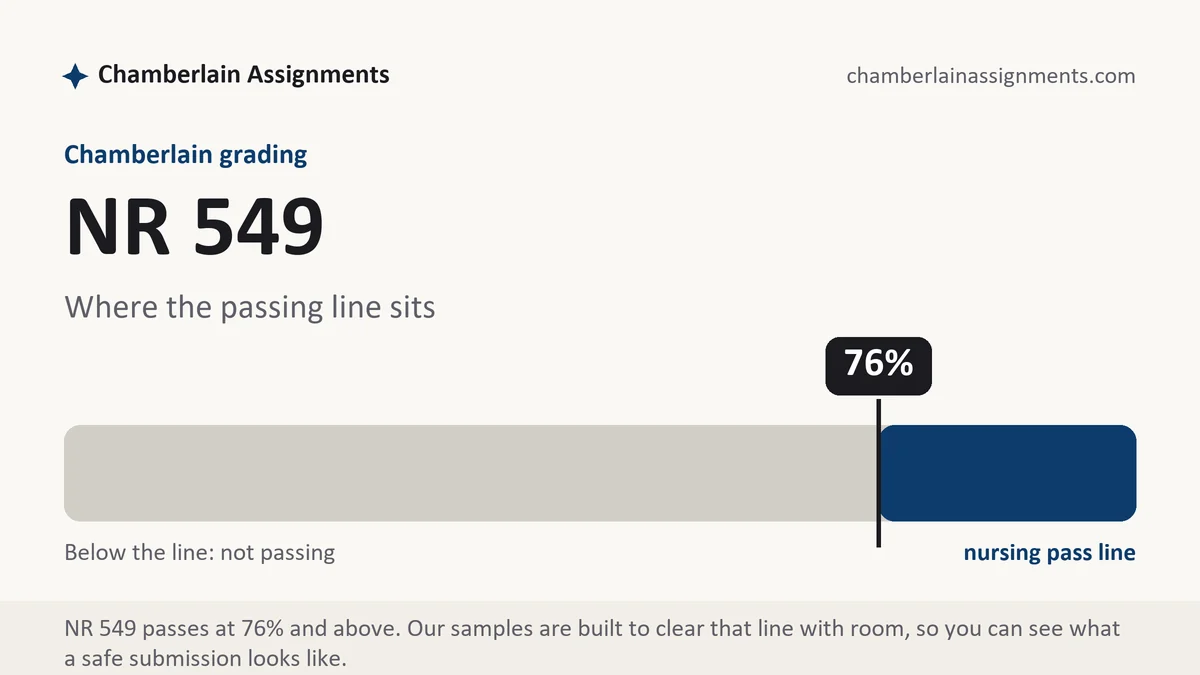
The discipline behind every paper here: the rubric is the outline, each row gets its section, one-shot discussions get the one-shot treatment, and the 76 percent floor is treated as the cliff it is. Send your week's instructions with a request and the sample matches them, revisions included.
NR 549 questions, answered
Does this course cover scope of practice and state regulation?
Only in passing. The version of this subject built for advanced practice students spends the session on practice acts and prescriptive authority, because their license is about to change. Yours is not. Here the boundary that matters comes from professional standards and from what your employer expects of a master's prepared nurse, which is a different kind of source.
How do I write about myself without it sounding like a cover letter?
Attach every claim to something outside you. Instead of saying you are committed to quality, name the standard that describes what a nurse at this level contributes to it and say where your current practice falls short of that line. The writing gets shorter, more specific, and considerably easier for a grader to award points to.
My APA is rusty after years away from school.
That is normal and it is fixable in one session. The formatting itself is a checklist, and most of the points people lose sit in citation practice rather than in a title page: a claim carrying no citation, a citation attached to the wrong sentence, a reference list that does not match the text. Send the assignment instructions and the sample arrives formatted the way your classroom asks.