Send the exact assignment or rubric from your classroom and a custom sample written to it lands in 24 to 48 hours, the first one free. NR 555 is Chamberlain’s Health Policy: Advancing Health Equity & Outcomes course. It centers on pulling health outcomes apart by group until an average stops hiding the gap, then arguing that gap as avoidable rather than natural. Searches like "nr 555 week 4 assignment example", "NR555 sample paper", and "NR 555 week samples" land on this page.
What NR 555 is really about
Equity is not a warmer word for cost, and NR 555 spends the session keeping the two apart. A cost argument asks whether a thing is worth buying. An equity argument asks who is currently getting it and who is not, and whether the pattern of that difference could have been otherwise. Not every difference qualifies. Older people carry more heart failure than younger people, which is a difference nobody caused. The graded distinction is between a variation that is simply there and one that is produced, avoidable, and falling on a group already carrying other burdens. Learning to say which of the two you are looking at is most of this course.
The method behind that claim is disaggregation, and nurses are unusually well placed to do it because the outcomes are already being counted. Readmissions, pressure injuries, birth outcomes, time to treatment, missed appointments: each one has an organizational number attached, and each one can be split by race, language, payer, postal code, disability status or rurality. The split is where the argument lives. A total tells you the organization's performance. A stratified total tells you whose performance it was. The course then asks the harder half, which is what in the system produced the pattern, because a gap with no mechanism behind it invites a grader to supply the wrong explanation.
What NR 555’s assessments ask for
The written work usually alternates between measurement and mechanism. Early assignments often ask you to select an outcome and defend the way you cut it, since the categories you choose decide what you are able to see, and some standard categories collapse very different people together. Middle weeks commonly take a documented gap and ask what produced it, working through access, referral patterns, interpreter availability, scheduling rules, transport, and the way a screening protocol actually gets applied. Toward the end of the session the work usually asks for a policy or protocol response with an equity measure attached, so the proposal has to say how anyone would know it worked. Discussions early in the week tend to reward the post that questions a measure rather than repeating the total.
Where students lose points in NR 555
The commonest loss is the paper that establishes a gap and then explains it with the group instead of the system, so a difference in outcomes quietly becomes a story about what those patients failed to do. Rubrics register that immediately. Close behind is the equity claim resting on an aggregate, where nothing was ever split and a reader has only a total and a strong feeling. Third is the recommendation that would lift everyone equally and therefore leave the gap exactly where it was found. Loose categories, an intervention proposed with no measure of who it reached, community input mentioned but never sourced, and cost slipped in as the real reason all cost points.
The NR 555 drawers
NR 555 Week 1 discussion post example
Week 1 often asks what makes a health difference unfair rather than simply real. On request, free, 24-48h.
NR 555 Week 2 outcome measure appraisal example
Week 2 typically asks which outcome you will follow and why that one counts. On request, free, 24-48h.
NR 555 Week 3 disparity data analysis example
Week 3 in many sections splits a single measure until a hidden group appears. On request, free, 24-48h.
NR 555 Week 4 determinants write-up example
Week 4 commonly hunts for the system behavior that produced the gap you found. On request, free, 24-48h.
NR 555 Week 5 equity-focused literature matrix example
Week 5 typically gathers what has been tried and who each attempt actually reached. On request, free, 24-48h.
NR 555 Week 6 policy analysis example
Week 6 often reads an existing rule for the groups it quietly leaves out. On request, free, 24-48h.
NR 555 Week 7 intervention proposal example
Week 7 in many sections designs a response and names the measure that would prove it. On request, free, 24-48h.
NR 555 Week 8 equity brief example
Week 8 usually compresses the whole argument for somebody with two minutes. On request, free, 24-48h.
Your classroom shows something else?
Chamberlain University revises courses; week counts and deliverables shift between terms. Send what your classroom shows and the desk matches it exactly.
Using a NR 555 sample the right way
Study a sample here for its tables and its verbs. The table shows how far the writer pushed the split and where the counts got too small to trust, which is a limit worth stating rather than hiding. The verbs show whether a gap is being described as something that happened to a group or something a system did, and the second reads far stronger. Then take the outcome your own setting already reports and cut it the same way, because a gap you can see in data you touch every week is easier to argue than one borrowed from a national report.
How these samples are written
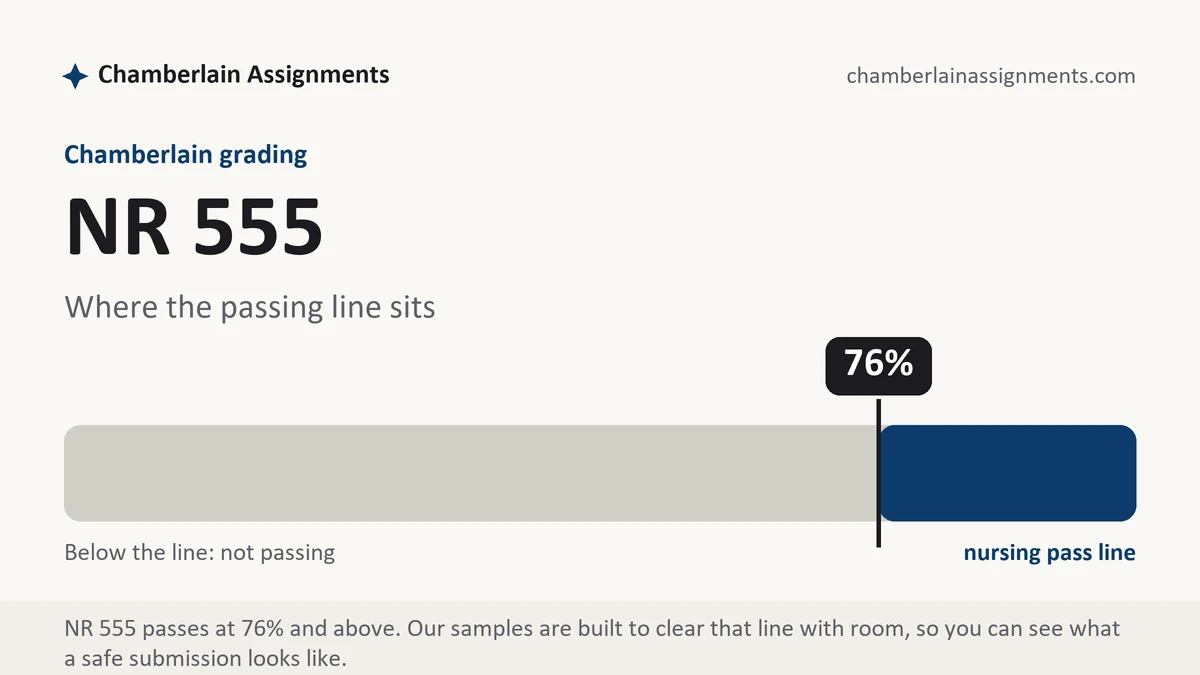
The discipline behind every paper here: the rubric is the outline, each row gets its section, one-shot discussions get the one-shot treatment, and the 76 percent floor is treated as the cliff it is. Send your week's instructions with a request and the sample matches them, revisions included.
NR 555 questions, answered
What if my organization's data is not broken out by group?
That absence is itself a finding and worth a paragraph. Say what is collected, what is not, and what the missing field prevents anybody from seeing. Then borrow a comparable public dataset for the pattern and keep your local claim modest. A paper that names the measurement gap reads as more careful than one that quietly writes around it.
Is a disparity the same thing as an inequity?
No, and the assignments usually turn on the difference. A disparity is any measured gap between groups. An inequity is a gap that is avoidable, systematically produced, and unfair in how it falls. You have to argue the second rather than assume it, which means showing a mechanism somebody could have changed. Skipping that step is what makes an otherwise sound paper read as opinion.
Can a custom sample be built on the outcome my section assigned?
Yes, and it works better that way, because the stratification and the mechanism differ completely between, say, a maternal outcome and a diabetes control measure. Send us the assignment instructions, your section's rubric and the outcome or population you were handed, and the first custom sample is free in 24-48h, built from public sources you can verify yourself.