Send the exact assignment or rubric from your classroom and a custom sample written to it lands in 24 to 48 hours, the first one free. NR 558 is Chamberlain’s Informatics for Professional Nursing Practice course. It centers on the decisions somebody else already made inside the software you use every shift, and what a nurse is entitled to ask about them. Searches like "nr 558 week 4 assignment example", "NR558 sample paper", and "NR 558 week samples" land on this page.
What NR 558 is really about
Every screen a nurse works in is the residue of meetings. Somebody decided which field is required, which box is checked before you arrive, which order set opens by default and what the printed summary contains. None of those people are on your unit and most of them left the project years ago. This course is about noticing their decisions. The reason it matters for the professional nursing practice track is that you will not be redesigning any of it, so the skill being graded is different: recognizing a default for what it is, working out whose choice it was, and framing a question about it that somebody is obliged to answer.
The second subject is what the system says about you. Time stamps, completion rates, overrides, response intervals: your shift produces a record of itself, and that record travels to managers, committees and sometimes to regulators without you ever seeing the version they read. Graduate work here asks you to look at one of those measures and say what it can honestly claim about practice, which is usually less than the dashboard implies. Privacy belongs in the same argument rather than in a separate paragraph about law, because the practical questions are about access: whose chart you may open, what your credentials let you reach that you have no reason to reach, and what an audit trail would show.
What NR 558’s assessments ask for
Assignments in many sections start from something you see rather than something you would build. A common prompt names a piece of the record you use daily and asks what it forces, what it permits and what it quietly prevents, with the consequence for practice written out. Other work hands you a report or a measure and asks what it can honestly support. Escalation assignments are the ones people underestimate: you are asked to write the problem up for whoever owns the system, in a form that would survive being forwarded. Privacy work generally arrives as a situation somebody has to decide, not as a summary of law. The discussion that opens a week often starts from a screen everybody complains about, where the reply that scores names the decision behind it.
Where students lose points in NR 558
The reliable loss is the complaint with a citation on the end. A paragraph about how the system is slow, how the alerts fire constantly and how nobody asked the nurses, followed by a reference, is still a complaint, and the rubric rows about analysis stay empty. Second is the recommendation aimed at the software, written as though you could authorize a change, which tells a grader you have not worked out where your influence actually reaches. Third is privacy handled as a summary of regulation with no situation in it, so nothing is ever decided. Vendor material used as evidence, a measure quoted without asking how it was produced, defaults described without naming who set them, and questions written with no addressee are each worth a row of the rubric on their own.
The NR 558 drawers
NR 558 Week 1 discussion post example
Week 1 typically asks which parts of your shift the record already decides for you. On request, free, 24-48h.
NR 558 Week 2 screen and default review example
Week 2 often takes one screen apart and names who chose what it requires. On request, free, 24-48h.
NR 558 Week 3 report interpretation brief example
Week 3 usually hands over a measure and asks what it can honestly say. On request, free, 24-48h.
NR 558 Week 4 clinical decision support critique example
Week 4 in many sections weighs a prompt that fires whether or not it fits. On request, free, 24-48h.
NR 558 Week 5 system problem escalation memo example
Week 5 commonly asks for a fault written up for the person who owns it. On request, free, 24-48h.
NR 558 Week 6 privacy in practice analysis example
Week 6 generally puts an access decision in front of you rather than a regulation. On request, free, 24-48h.
NR 558 Week 7 committee position brief example
Week 7 frequently asks what one nurse should say in a room of system owners. On request, free, 24-48h.
NR 558 Week 8 technology impact paper example
Week 8 often ends on one argument about a tool you use every shift. On request, free, 24-48h.
Your classroom shows something else?
Chamberlain University revises courses; week counts and deliverables shift between terms. Send what your classroom shows and the desk matches it exactly.
Using a NR 558 sample the right way
What repays attention in these samples is the question at the end of each section. Every one of them is addressed to somebody: a manager, an educator, an analyst, a committee, and every one names what would count as an answer. That is the difference between analysis and grumbling, and it is where the marking concentrates. Look also at how the writer describes a default before judging it, described closely enough that somebody who has never opened your record can picture the screen. Then rebuild the argument around a system you sign into, because the defaults that annoy you are specific and the generic ones convince nobody.
How these samples are written
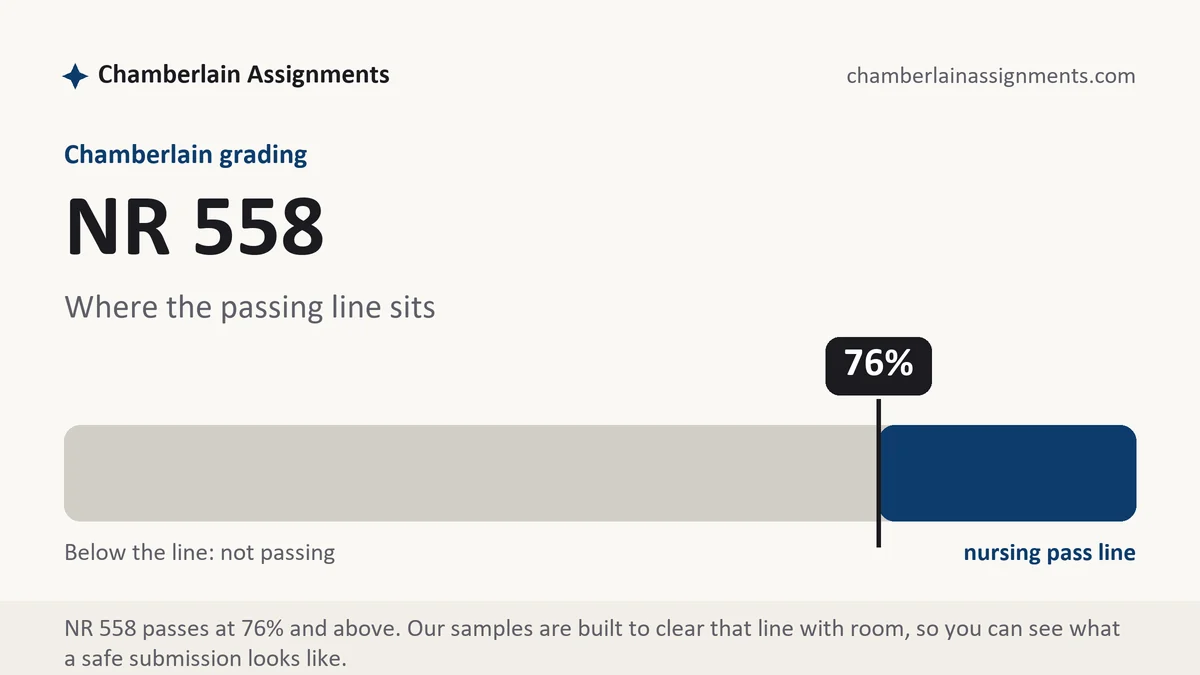
Every sample on this chart is written the way the custom ones are: the rubric decoded row by row, discussion samples sized for posts that cannot be edited after they land, templates filled field by field. Chamberlain revises classrooms; a custom request is always written to the rubric in YOUR course, never from a stale template.
NR 558 questions, answered
Is this the informatics specialization course?
No. The specialization sequence trains people who will define data, write requirements and own builds, and it assumes you are heading into that job. This course sits in the professional nursing practice track and assumes the opposite: you will keep using systems other people run, so it grades how well you can interrogate one from the outside.
Do I need technical knowledge to pass?
You need enough to ask precisely, which is a smaller amount than people fear. Knowing that a field is coded rather than free text matters because it decides whether anyone can count it later. Knowing what the vendor calls its module does not. Say what a term means at the moment it explains something, and give the rest of the space to the practice it changes.
Can I write about the system my employer uses?
Usually yes, and it makes the writing far better, provided you keep screenshots and internal documents out of the submission. Describe what you see and what it does to the work; do not attach anything your organization owns. If a prompt asks for evidence, published sources about that class of system carry more weight than material the vendor supplied.