Send the exact assignment or rubric from your classroom and a custom sample written to it lands in 24 to 48 hours, the first one free. NR 559 is Chamberlain’s Research Methods and Evidence-Based Practice for Professional Nursing Practice course. It centers on matching a research design to the kind of question it can answer, then keeping the recommendation inside what somebody in your position could change. Searches like "nr 559 week 4 assignment example", "NR559 sample paper", and "NR 559 week samples" land on this page.
What NR 559 is really about
Research courses get taught as if the hierarchy settled everything, with trials at the top and everything else arranged below in order of respectability. NR 559 takes that apart in the first weeks. A design is not strong or weak in general; it is strong or weak for a question. If you want to know whether a drug works, a trial. If you want to know why nurses on nights stopped using a checklist, a trial will tell you nothing and an interview study will tell you a great deal. Most of the marking in this course follows whether you noticed which kind of question you were holding before you decided which evidence could answer it.
The second half is about what you are allowed to do with an answer. A finding that a different dressing protocol reduces infection is interesting; the graded question is what a nurse in your actual position can do about it by next month. Some things you can change yourself on your own patients. Some need a unit council. Some need a policy owner and a budget, and saying which one you are looking at is more valuable than any enthusiasm about the finding. The same honesty runs backwards through the paper. Evidence that failed to support the change you wanted goes in, stated plainly, because a review that only found agreement was not a review.
What NR 559’s assessments ask for
Weekly work in many sections walks the same route twice, once for numbers and once for words. Early assignments want the practice problem written so a reader can see which kind of question is inside it, which usually means separating a question about effect from a question about experience. Critique work then takes single studies apart, asking what the design permitted, how the sample was assembled, and what the instrument was measuring when it claimed to measure a concept. Later assignments gather several studies and ask what they say together, disagreement included. A recommendation section generally closes the sequence and is marked on whether it is addressed to a level of the organization that exists. Discussions come early in the week and reward a reply that questions how a classmate's study was built rather than what it was about.
Where students lose points in NR 559
The first loss belongs to the paper that judges every study by the same yardstick. A qualitative study marked down for a small sample, or a survey criticized for not randomizing anything, tells a grader you applied a checklist rather than read a design. Second is the recommendation nobody in the paper could carry out, usually written as a call for the organization to adopt something, with no owner, no level and no sense of what a single nurse decides. Third is the tidy result, where every study agreed and the practice change follows obviously, which almost never happens and reads as selective reading when it appears. Instruments accepted because they have a name, sample sizes reported without who was in them, significance treated as size, and conclusions written before the appraisal each remove something the reading had earned.
The NR 559 drawers
NR 559 Week 1 discussion post example
Week 1 typically asks how a nurse decides that current practice is worth questioning. On request, free, 24-48h.
NR 559 Week 2 problem statement brief example
Week 2 often narrows a practice concern until a study could plausibly answer it. On request, free, 24-48h.
NR 559 Week 3 study design comparison example
Week 3 usually sets two designs beside one question and asks which one fits. On request, free, 24-48h.
NR 559 Week 4 quantitative study critique example
Week 4 in many sections works through one trial or survey from sampling onward. On request, free, 24-48h.
NR 559 Week 5 qualitative study critique example
Week 5 commonly reads an interview study on the terms it was built with. On request, free, 24-48h.
NR 559 Week 6 instrument and measurement review example
Week 6 generally asks what a scale measured and who it was validated on. On request, free, 24-48h.
NR 559 Week 7 unit level recommendation example
Week 7 frequently pushes findings into something one unit could try next month. On request, free, 24-48h.
NR 559 Week 8 evidence report example
Week 8 often assembles the session into a single account with the disagreements kept. On request, free, 24-48h.
Your classroom shows something else?
Chamberlain University revises courses; week counts and deliverables shift between terms. Send what your classroom shows and the desk matches it exactly.
Using a NR 559 sample the right way
Open these samples at the appraisal section and check what the writer refuses to say. A good one names the question the study was built to answer, then states where your question and its question stopped overlapping, which is the sentence students find hardest to write. Follow that through to the recommendation and notice how modest it is, and how clearly it says who would have to agree. Then rerun the whole thing with the studies you actually retrieved, since the search, the exclusions and the position you occupy are the parts being marked, and no sample can know which of them you have.
How these samples are written
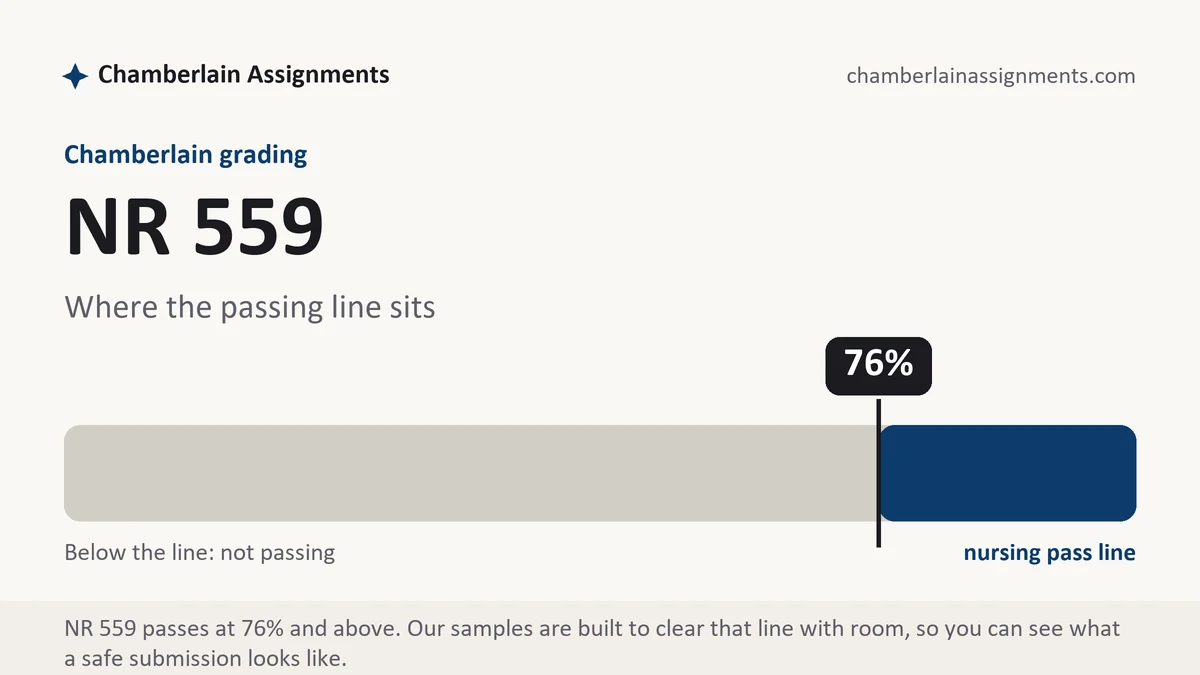
The discipline behind every paper here: the rubric is the outline, each row gets its section, one-shot discussions get the one-shot treatment, and the 76 percent floor is treated as the cliff it is. Send your week's instructions with a request and the sample matches them, revisions included.
NR 559 questions, answered
How is this different from the research course for advanced practice students?
The appraisal skills overlap; the ending does not. A prescriber can act on a finding inside their own practice, so their course pushes toward whether the evidence reaches their patients. Yours is the professional nursing practice version, and its closing section has to say what a nurse in your role can change alone and what needs somebody with authority.
Does qualitative research count as real evidence here?
It counts, and treating it as a weaker trial is a reliable way to lose points. Interview and observation studies answer questions about meaning, reason and experience, which no trial is built to reach. Appraise them on their own terms: how participants were chosen, how the analysis was done, whether the account holds together, and where the researcher's position shows.
What if the evidence does not support the change I wanted?
Write that down and the paper improves. A section that says what you expected, what the literature actually showed, and what you now think is worth doing is stronger than one where everything lined up. Graders read a great many reviews in which all the studies agreed with the author, and they do not believe many of them.