Send the exact assignment or rubric from your classroom and a custom sample written to it lands in 24 to 48 hours, the first one free. NR 561 is Chamberlain’s Addressing Global Health Disparities course. It centers on arguing why health differs so sharply between countries, and what an outsider proposing to fix any of it owes the place involved. Searches like "nr 561 week 4 assignment example", "NR561 sample paper", and "NR 561 week samples" land on this page.
What NR 561 is really about
The gap between countries is enormous and it is also not an accident, which is where NR 561 starts. A child's chance of reaching five differs by an order of magnitude depending on where the birth happened, and the explanations that hold up are structural rather than natural: what a country was allowed to build, what it owes and to whom, which staff it trains and then loses, what its trade arrangements permit it to manufacture, and where the money for its health budget originates. Writing that stops at poverty has named a condition rather than a cause. The course keeps asking the next question, which is what arrangement produced the poverty and who has been party to keeping it in place.
The harder half is what follows from the argument. Almost everyone writing in this course is proposing something from outside, and the record of that is mixed enough to be worth taking seriously. Priorities set by donors rather than by ministries, services that ran only while funding lasted, visiting teams treating a fortnight as a contribution, and measurement demanded in formats a local clinic could not sustain are documented failures rather than hypothetical ones. So a strong response in this classroom names who identified the problem, who will still be there in three years, what capability stays behind, and what the receiving organization is free to decline. Good intentions are assumed and are not evidence of anything.
What NR 561’s assessments ask for
Assignments here usually pair an argument with a proposal. The argument weeks ask you to take one difference between countries and trace it to something that could have been otherwise, which means reading history, trade and financing rather than only health data. The proposal weeks ask what you would do about it, and mark the parts most drafts skip: who requested this, who owns it locally, what becomes of it when your funding line ends, and how success would be judged by the people living there rather than by the people reporting upward. Discussions early in the week often present a well meaning program and reward the reply that asks who was consulted before it started.
Where students lose points in NR 561
The largest loss is the rescue paper, where a country appears as a setting for the writer's plan and never as a party with institutions and preferences of its own. Second is the cause that stops too early, so a gap is attributed to poverty or to a lack of education and the arrangements producing both go unexamined. Third is the proposal with no ending, which describes years of activity and never says who runs it after the funder moves on. Figures about a continent used to describe a village, local partners named only as recipients, cultural difference offered where a structural explanation was available, and success measured entirely in what was delivered all cost marks.
The NR 561 drawers
NR 561 Week 1 discussion post example
Week 1 often asks whether a difference between two countries could have gone another way. On request, free, 24-48h.
NR 561 Week 2 disparity argument brief example
Week 2 typically traces one gap back to a decision somebody actually made. On request, free, 24-48h.
NR 561 Week 3 historical determinants analysis example
Week 3 in many sections reads a health system for the obligations it inherited. On request, free, 24-48h.
NR 561 Week 4 case study analysis example
Week 4 commonly examines a service that ran well until its funding stopped. On request, free, 24-48h.
NR 561 Week 5 agenda setting review example
Week 5 generally asks who chose the problem before anybody chose the response. On request, free, 24-48h.
NR 561 Week 6 intervention proposal example
Week 6 usually designs a response a local organization could still be running later. On request, free, 24-48h.
NR 561 Week 7 ethics analysis example
Week 7 frequently tests what the receiving side is allowed to refuse. On request, free, 24-48h.
NR 561 Week 8 advocacy brief example
Week 8 tends to compress the argument for an audience that controls funding. On request, free, 24-48h.
Your classroom shows something else?
Chamberlain University revises courses; week counts and deliverables shift between terms. Send what your classroom shows and the desk matches it exactly.
Using a NR 561 sample the right way
Use a sample here for the questions it puts to its own proposal. Notice that the argument section ends at a mechanism somebody chose rather than at a sad fact, and that the proposal answers who asked, who stays and who could say no. Notice where the writer declines to recommend something because the evidence for it came from a very different setting. Then rebuild all of it on the country and the problem you were assigned, since what has already been tried there is the part a grader can check. What transfers is the standard of scrutiny applied to your own good idea.
How these samples are written
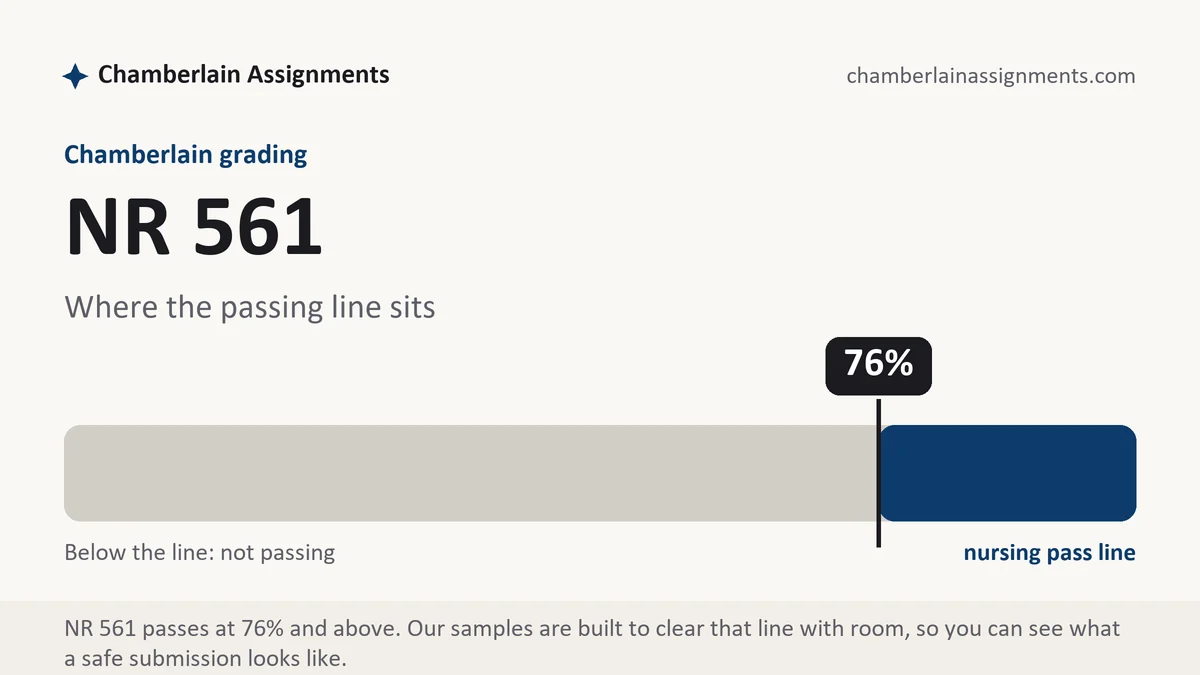
The discipline behind every paper here: the rubric is the outline, each row gets its section, one-shot discussions get the one-shot treatment, and the 76 percent floor is treated as the cliff it is. Send your week's instructions with a request and the sample matches them, revisions included.
NR 561 questions, answered
How far back does the explanation have to go?
Far enough to reach something a person or an institution decided. A gap explained by geography or by poverty alone is unfinished, because neither answers why the arrangement persisted. Trace it to a policy, a debt condition, a trade rule or a staffing pattern, and then stop. Two well evidenced steps beat five speculative ones every time.
What makes a proposal look sustainable rather than hopeful?
Somebody local owning it and a resource that does not depend on you. Name the organization that keeps it, the staff already employed there, and the cost it could carry alone. Then say what stops if outside funding ends. Assignments here mark that honesty rather than penalizing it, and vague continuation reads as no plan at all.
Can a custom example follow my section's assigned region?
Yes. Give us the region and the problem you were handed, plus whatever instructions and marking detail your section published, and the first one comes back free within 24-48h. It matters more here than elsewhere, because what has already been attempted differs completely between places and a general answer misses it.