Send the exact assignment or rubric from your classroom and a custom sample written to it lands in 24 to 48 hours, the first one free. NR 565 is Chamberlain’s Advanced Pharmacology Fundamentals course. It centers on defending one therapeutic choice against the alternatives a reasonable prescriber would also have considered. Searches like "nr 565 week 4 assignment example", "NR565 sample paper", and "NR 565 week samples" land on this page.
What NR 565 is really about
The recurring surprise in NR 565 is that the right answer is worth very little on its own. Assignments routinely accept several defensible agents, and the marks sit in why this one for this patient. That means the pharmacology has to be applied rather than recited: the mechanism matters only where it explains the choice, and the side effect profile matters only where it interacts with something true about the patient in front of you. A submission that lists what a drug does, accurately and at length, can still score poorly because it never argues, and that outcome surprises people every session.
The other half of the course is what happens after the prescription. Graduate pharmacology treats a therapeutic decision as an ongoing responsibility, so the work asks for monitoring parameters with intervals attached, adjustments for renal or hepatic function, interactions that matter in this patient's actual regimen, and the result that would trigger a change of course. Counseling belongs in the same frame rather than outside it. Writing what the patient needs to understand, in words a patient would actually use, is marked as part of the therapeutic plan rather than as an afterthought bolted to the end of a finished one.
What NR 565’s assessments ask for
Weekly work in many sections opens with a patient and a problem and asks for a plan. A strong response names the agent, the dose form and the reasoning in the same breath, then shows its work: the alternatives weighed, the patient factor that decided between them, and the contraindication that removed the otherwise obvious choice. From there the plan carries monitoring, an expected timeline to effect, and the counseling points that matter most for adherence. Discussions typically compress the same structure and expect you to test a classmate's choice against a factor they did not weigh. Current guidance is cited only where the recommendation is genuinely guideline driven rather than conventional.
Where students lose points in NR 565
The largest single loss is the undefended choice: a correct agent selected with no visible comparison, which reads as recall rather than reasoning. Close behind is the plan that stops at the prescription, with no monitoring, no interval, and nothing that would tell a reader how you would know the therapy is working or failing. Third is the generic adjustment, where renal dosing is mentioned as a principle but never applied to the function this patient actually has. Interactions listed without saying which ones matter here, counseling written in clinical vocabulary a patient would not follow, and guideline citations attached to claims the guideline does not actually make all cost marks reliably.
The NR 565 drawers
NR 565 Week 1 discussion post example
Week 1 typically opens on pharmacokinetic principles argued through a patient rather than defined. On request, free, 24-48h.
NR 565 Week 2 drug class write-up example
Week 2 often takes one class and asks where it fits and where it does not. On request, free, 24-48h.
NR 565 Week 3 prescribing rationale example
Week 3 in many sections wants a first choice defended against the alternatives rejected. On request, free, 24-48h.
NR 565 Week 4 case analysis example
Week 4 commonly introduces a comorbidity that removes the otherwise obvious agent. On request, free, 24-48h.
NR 565 Week 5 pharmacotherapy plan example
Week 5 typically asks for monitoring and adjustment written with intervals attached. On request, free, 24-48h.
NR 565 Week 6 patient education handout example
Week 6 often shifts the same plan into language a patient would actually follow. On request, free, 24-48h.
NR 565 Week 7 case analysis example
Week 7 in many sections adds polypharmacy, so interactions decide the plan. On request, free, 24-48h.
NR 565 Week 8 prescribing rationale example
Week 8 usually closes on a complex patient needing the whole argument at once. On request, free, 24-48h.
Your classroom shows something else?
Chamberlain University revises courses; week counts and deliverables shift between terms. Send what your classroom shows and the desk matches it exactly.
Using a NR 565 sample the right way
Read a sample for its argument structure. Watch how quickly the writer moves from what the drug does to why it fits, where the rejected alternative is named and dismissed, and how monitoring is written with numbers and intervals rather than as a promise to follow up. Then build your own plan for your own case, since the patient factors are what drive every decision the rubric marks. What transfers from a sample is the order of the argument and the density of the justification, both of which hold for any agent you go on to defend.
How these samples are written
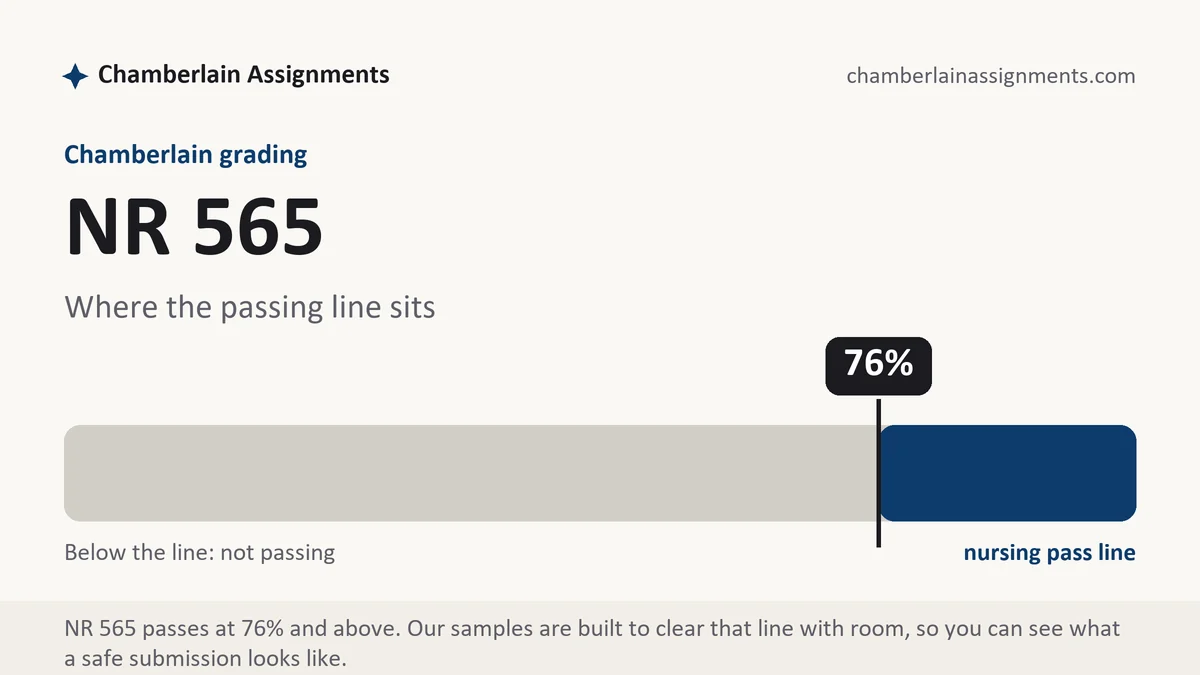
The discipline behind every paper here: the rubric is the outline, each row gets its section, one-shot discussions get the one-shot treatment, and the 76 percent floor is treated as the cliff it is. Send your week's instructions with a request and the sample matches them, revisions included.
NR 565 questions, answered
Is there one correct drug the rubric is looking for?
Usually not. Most cases admit several defensible agents, and the marks follow the quality of the justification rather than the identity of the choice. That is why a sample built around a different agent than yours is still useful: what transfers is how the comparison is staged and how the rejected options are dismissed.
How much detail do monitoring parameters need?
Enough that another prescriber could follow the plan without asking you anything. That means the parameter, a baseline, an interval, and what result would change the therapy. Monitoring written as a general intention to watch the patient is the version that loses marks, because it commits to nothing a reader can check.
Where do patient counseling points belong?
Inside the therapeutic plan, not appended after it. Counseling is marked as part of the decision, so it should name what the patient must recognize, what would make them stop, and what to expect and when. Writing it in plain language is part of the assessment rather than a stylistic preference.