Send the exact assignment or rubric from your classroom and a custom sample written to it lands in 24 to 48 hours, the first one free. NR 566 is Chamberlain’s Advanced Pharmacology for Care of the Family course. It centers on choosing and defending drug therapy for a whole family, where the same agent behaves differently at every age. Searches like "nr 566 week 4 assignment example", "NR566 sample paper", and "NR 566 week samples" land on this page.
What NR 566 is really about
The word family in this title is doing real work. A family practice panel holds a two month old, a teenager, someone in the second trimester, and a grandparent whose kidneys clear a drug at a fraction of the rate they once did, and the same agent is a different decision in each of them. That is why the course cannot be passed by memorizing drug lists. What it assesses is whether you can take a class you already know and adjust it for weight, for organ function, for pregnancy and lactation, and for the four other medicines already in the cabinet.
The second thing the course tests is restraint. Advanced practice writing tends to reach for the newest agent, and a family panel rewards the opposite instinct: the cheapest thing that works, at the smallest effective dose, for the shortest sensible time, in a form the patient will actually take twice a day. Cost belongs in the argument, so does what the pharmacy stocks, and so does whether a caregiver is the one measuring the dose. Older patients bring the opposite problem to children. With a child you are adding a first medicine and calculating carefully; with an eighty year old you are often deciding what to stop, and writing why stopping is the safer prescription.
What NR 566’s assessments ask for
Weekly work in many sections hands you a patient and a complaint and asks what you would prescribe and why. A full answer names the agent, the strength, the form and the schedule, then shows the calculation where a calculation is called for, because a pediatric dose written without the weight it came from cannot be checked. From there the assignment wants the boundaries: what the drug is being watched for, at what interval, what would make you stop, and what the patient or the parent has to recognize at home. Discussions earlier in the week compress this and usually ask what a classmate's plan missed, most often pregnancy, renal function, or an interaction hiding in the rest of the list. Guidelines are cited where the recommendation genuinely rests on them.
Where students lose points in NR 566
The biggest loss is the adult answer given to a child. A dose chosen without the weight, a form no toddler will swallow, or a schedule that assumes an adult can be relied on to take the second dose all read as therapy designed for the wrong patient. Second is silence on pregnancy and lactation in a course built around a family panel, where any agent prescribed to someone who could be pregnant needs that question answered on the page. Third is the plan with no exit: no monitoring interval, nothing that would signal failure, and no point at which the therapy would be reconsidered. Interactions listed generically, counseling written in vocabulary a parent would not use, and doses copied from a reference without adjusting for this patient's kidneys lose points every week.
The NR 566 drawers
NR 566 Week 1 discussion post example
Week 1 usually opens on how age and organ function change what a drug does. On request, free, 24-48h.
NR 566 Week 2 drug class comparison example
Week 2 often takes one class and asks who in a family it suits. On request, free, 24-48h.
NR 566 Week 3 prescribing rationale example
In many sections Week 3 turns to a first line choice defended for one patient. On request, free, 24-48h.
NR 566 Week 4 pediatric dosing write-up example
Week 4 commonly puts a child in front of you and the dose is calculated. On request, free, 24-48h.
NR 566 Week 5 case analysis example
Week 5 typically adds a pregnancy, which removes several otherwise reasonable agents. On request, free, 24-48h.
NR 566 Week 6 medication review example
Week 6 often turns to an older patient whose list is longer than it should be. On request, free, 24-48h.
NR 566 Week 7 patient teaching handout example
Week 7 in many sections rewrites a regimen into words a parent can follow. On request, free, 24-48h.
NR 566 Week 8 pharmacotherapy case paper example
Week 8 usually closes on one family whose members need different answers. On request, free, 24-48h.
Your classroom shows something else?
Chamberlain University revises courses; week counts and deliverables shift between terms. Send what your classroom shows and the desk matches it exactly.
Using a NR 566 sample the right way
Read a sample for how fast it gets from the drug to the patient. Watch where the writer states the weight, the function or the trimester before naming an agent, how the rejected option is dismissed in a line rather than a paragraph, and where monitoring is written with a number attached. Then rebuild the argument for your own case, because the patient factors are the whole decision and they will not be the ones in the sample. What carries over is the order of the reasoning and how much justification a rubric here expects per choice.
How these samples are written
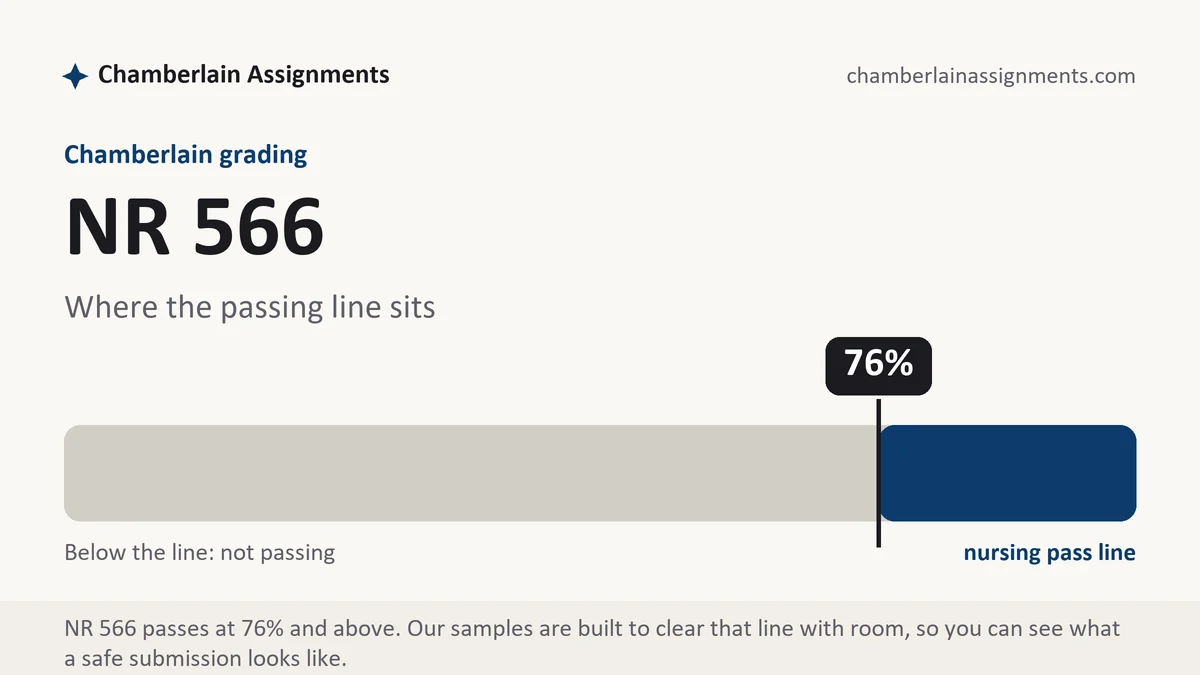
The discipline behind every paper here: the rubric is the outline, each row gets its section, one-shot discussions get the one-shot treatment, and the 76 percent floor is treated as the cliff it is. Send your week's instructions with a request and the sample matches them, revisions included.
NR 566 questions, answered
Does a sample have to use the same drug my case needs?
No, and often it should not. What transfers is the order of the argument: patient factor first, agent second, monitoring and counseling attached rather than appended. A sample built on a different class still shows how a choice is defended and how far the justification has to go before a rubric is satisfied.
How much detail does a pediatric dose need?
Enough that a pharmacist could check it without calling you. That means the weight you used, the milligrams per kilogram you applied, the total per dose, the interval, and the maximum you stayed under. A dose stated as a finished number with no arithmetic behind it cannot be checked by a grader, and unchecked numbers are marked as unsupported rather than as correct.
The patient in my case could be pregnant. Does that change the assignment?
It changes the answer, and rubrics in this course notice when it does not. Anything prescribed to a person of childbearing age needs the pregnancy and lactation question raised and settled on the page, even when the answer is that the agent is acceptable. Leaving it unaddressed reads as a decision you never made.