Send the exact assignment or rubric from your classroom and a custom sample written to it lands in 24 to 48 hours, the first one free. NR 567 is Chamberlain’s Advanced Pharmacology for the Adult Gerontology Acute Care Nurse Practitioner course. It centers on prescribing for an unstable adult where onset, route and an organ that is failing decide the drug before the diagnosis does. Searches like "nr 567 week 4 assignment example", "NR567 sample paper", and "NR 567 week samples" land on this page.
What NR 567 is really about
Pharmacology changes character when the patient cannot wait for it. The question that decides a mark in NR 567 is rarely which agent treats the condition, because several usually do. It is how fast the drug starts, how it gets in, and how quickly it stops once you turn it off. Something given by mouth to a patient whose gut has stopped absorbing is a decision that failed before it was written, and an agent with a long tail is a commitment you cannot take back when the pressure overshoots. Route, onset and offset sit at the front of the argument here, where a calmer setting would put class and mechanism.
The second demand is that every dose points at a number. Prescribing in this setting runs toward a measured endpoint rather than a schedule, so the writing has to name what you are chasing, what you would accept, and what tells you the drug has done as much as it is going to do. That discipline extends to stopping. An infusion holding somebody up is also hiding whether they still need it, and the sentence saying when you would start coming down is graded as part of the plan. Clearance is the other moving part, since the organ you dosed against this morning may be supported by a machine tonight.
What NR 567’s assessments ask for
Weekly work in many sections hands over a patient who is already deteriorating and a therapy that has to start now. A typical assignment wants the agent, the route, the starting dose or rate, the endpoint you are titrating toward, and how soon you would check whether it moved, all in a form somebody else could run at three in the morning. Assignments frequently ask what you would give before the confirming result arrives and what would make you narrow or withdraw it afterwards. Dose questions attach to organ support rather than to a baseline value, so the number you dosed against has to be named. Discussions early in the week compress the same problem, and points come from testing whether a classmate's drug can actually be turned off.
Where students lose points in NR 567
The expensive submission here is the one written as though somebody had time. A plan naming an agent and a dose with no endpoint attached gives a reader no way to judge whether the therapy is working, and a promise to monitor closely is where that failure usually hides. Second is the route left unexamined, where a slow or an oral choice is made for a patient who needs an effect inside ten minutes. Third is the dose built on a value that stopped being true, since function moves hour to hour in this population and support changes it again. Loading doses skipped when a level was needed immediately, infusions started with nothing said about coming off, and interaction tables copied whole rather than the two pairings that alter tonight all take points.
The NR 567 drawers
NR 567 Week 1 discussion post example
Week 1 often opens on what changes once a drug has to work immediately. On request, free, 24-48h.
NR 567 Week 2 critical illness dosing brief example
Week 2 typically asks how a failing organ and its machine support change a dose. On request, free, 24-48h.
NR 567 Week 3 titration plan example
Week 3 usually wants the number you are chasing named before any rate is written. On request, free, 24-48h.
NR 567 Week 4 vasoactive support write-up example
Week 4 commonly holds a pressure with an infusion and asks what would let it come down. On request, free, 24-48h.
NR 567 Week 5 sedation and analgesia plan example
Week 5 in many sections weighs comfort against the need to wake somebody up. On request, free, 24-48h.
NR 567 Week 6 empiric antimicrobial rationale example
Week 6 generally treats before the culture returns and says when you would narrow. On request, free, 24-48h.
NR 567 Week 7 anticoagulation case analysis example
Week 7 frequently sets bleeding against clotting in a patient already doing both. On request, free, 24-48h.
NR 567 Week 8 de-escalation plan example
Week 8 tends to close on how each agent comes off once the endpoint holds. On request, free, 24-48h.
Your classroom shows something else?
Chamberlain University revises courses; week counts and deliverables shift between terms. Send what your classroom shows and the desk matches it exactly.
Using a NR 567 sample the right way
Read a sample here for its timings. Find where the writer states how long the agent takes to work, the number the titration is aimed at, and the point at which the drip would start coming down, because those three sentences carry most of the marks and most people write around them. Then rebuild the plan for your own case, since the function, the support and the endpoint your patient is being held at are the facts the reasoning has to fit. What a sample transfers is the order: route and speed first, dose second, endpoint third, and withdrawal decided before it is needed.
How these samples are written
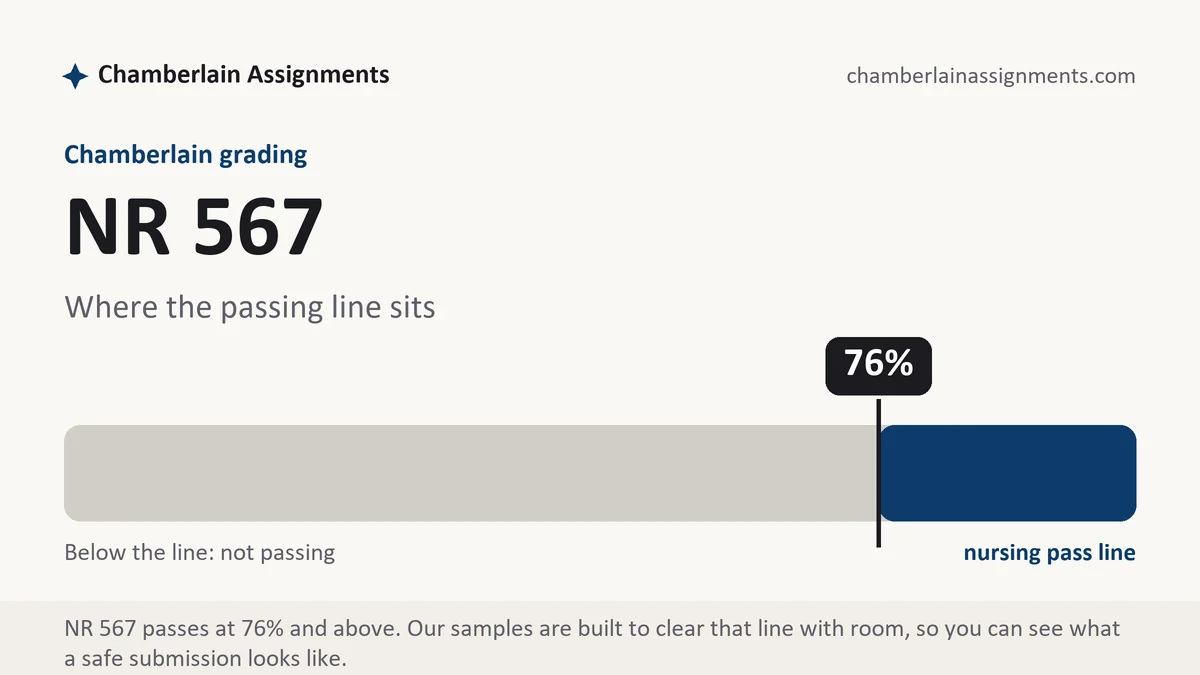
The discipline behind every paper here: the rubric is the outline, each row gets its section, one-shot discussions get the one-shot treatment, and the 76 percent floor is treated as the cliff it is. Send your week's instructions with a request and the sample matches them, revisions included.
NR 567 questions, answered
How much pharmacokinetics does a plan in this course need?
Only the part that changes what you do tonight. A half-life earns its place when it tells a reader how long you are committed after the last dose, and a volume of distribution earns its place when it explains why a standard dose will not reach a level in this patient. Parameters recited with no decision attached read as revision notes, and the marking follows the decision.
My patient is sedated. Where does the education section go?
To whoever is actually going to receive it, and the plan should say which. Name what a surrogate has to understand about the infusion running now, what would be explained to the patient once they can hold a conversation, and what somebody needs told before a drug follows them out of the unit. An empty section costs more than a short one written for a named listener.
Can a sample follow the protocol my hospital uses?
Send it and the writing is built inside it. Titration bands, order sets and the ranges one unit accepts vary between hospitals, and a grader in your section reads against the assignment instructions and rubric you were given rather than against a national default. Attach those along with any template, and the figures in the sample sit exactly where your classroom expects to find them.