Send the exact assignment or rubric from your classroom and a custom sample written to it lands in 24 to 48 hours, the first one free. NR 570 is Chamberlain’s Common Diagnosis and Management in Acute Care Practicum course. It centers on the second rung of the acute care practicum, where a common presentation is carried from admission to discharge on paper. Searches like "nr 570 week 4 assignment example", "NR570 sample paper", and "NR 570 week samples" land on this page.
What NR 570 is really about
After a term spent shortening lists, this one hands over conditions whose names arrive early and asks for everything that follows. A pneumonia, a flare, a decompensation, chest pain that turns out to be what it usually is: the diagnosis is rarely the interesting part, and the grade is not there either. It sits in whether the record is complete. An admission note omitting the functional baseline, a daily note repeating yesterday, a discharge summary leaving the next clinician to guess what was changed and why, all lose marks against a rubric that reads like a checklist because the work itself is one.
The second demand is the standard. A common condition has an accepted way of being managed, and writing here is measured against that rather than against your own invention. An assignment wants the source named, the recommendation stated, and any departure from it defended in the same paragraph. Departures are allowed; unacknowledged ones are not. Consistency is part of the same test, since the fifth patient with a familiar condition is marked exactly like the first and the rubric has no row for fatigue. The term keeps its ordinary shape: eight weeks, assignments posted weekly, discussion threads that publish permanently, and points weighted toward the documents a service actually produces rather than toward essays about them.
What NR 570’s assessments ask for
Submissions follow the paper trail of an admission. Early weeks want a full admission note built from one encounter on your rotation: presenting problem, relevant history, examination, an assessment written as a sentence rather than as a word, and a plan with a reason beside each line. Middle weeks move to daily notes, usually two or three in sequence, marked on whether anything changed between them and whether the change was explained. A discharge summary appears later in the term, aimed at whoever picks the patient up next. Most sections add a piece setting one of your cases against published recommendations, and a weekly discussion carries points of its own, usually on a condition the whole cohort has met.
Where students lose points in NR 570
The expensive habit here is treating a routine case as beneath a full record. Assessments written as a single noun, plans listing orders with no reason attached, and daily notes copied forward with the date changed are the three biggest losses, and all three are easy to spot. A discharge summary ending at the diagnosis without saying what was started, stopped or adjusted costs a row of its own. Citations go the same way: naming a recommendation with no source, or pasting a source with no recommendation drawn from it, reads as decoration. Social and functional detail left out is the loss people miss, because it is where the readmission rows are hiding.
The NR 570 drawers
NR 570 Week 1 discussion post example
Week 1 usually opens on why a familiar diagnosis still earns a full record. On request, free, 24-48h.
NR 570 Week 2 frequent presentation case paper example
Week 2 takes one of the presentations your service sees most often and works it through. On request, free, 24-48h.
NR 570 Week 3 guideline concordance write-up example
Week 3 sets a case beside published recommendations and defends the gaps. On request, free, 24-48h.
NR 570 Week 4 admission note critique example
Week 4 reads a completed admission note for the rows a marker checks first. On request, free, 24-48h.
NR 570 Week 5 progress note sequence example
Week 5 runs three consecutive daily notes and asks what moved between them. On request, free, 24-48h.
NR 570 Week 6 discharge summary draft example
Week 6 boils an entire stay down to what whoever follows the patient must know. On request, free, 24-48h.
NR 570 Week 7 supervised encounter write-up example
Week 7 documents a single visit from your rotation in the form the rubric asks for. On request, free, 24-48h.
NR 570 Week 8 common case portfolio piece example
Week 8 gathers the term's ordinary cases into one piece marked on completeness. On request, free, 24-48h.
Your classroom shows something else?
Chamberlain University revises courses; week counts and deliverables shift between terms. Send what your classroom shows and the desk matches it exactly.
Using a NR 570 sample the right way
Most of the value in a completed example here is proportion. People spend six paragraphs on the history and two lines on the plan, when the rubric weights them the other way. Seeing a complete admission note shows what an assessment sentence contains, how a plan line reads once its reason is attached, and how much of a discharge summary is about the handover rather than about the stay. The encounter is yours to bring; a sample is written against the rubric rows and word count you send, and it stands as a model of the form rather than as the submission.
How these samples are written
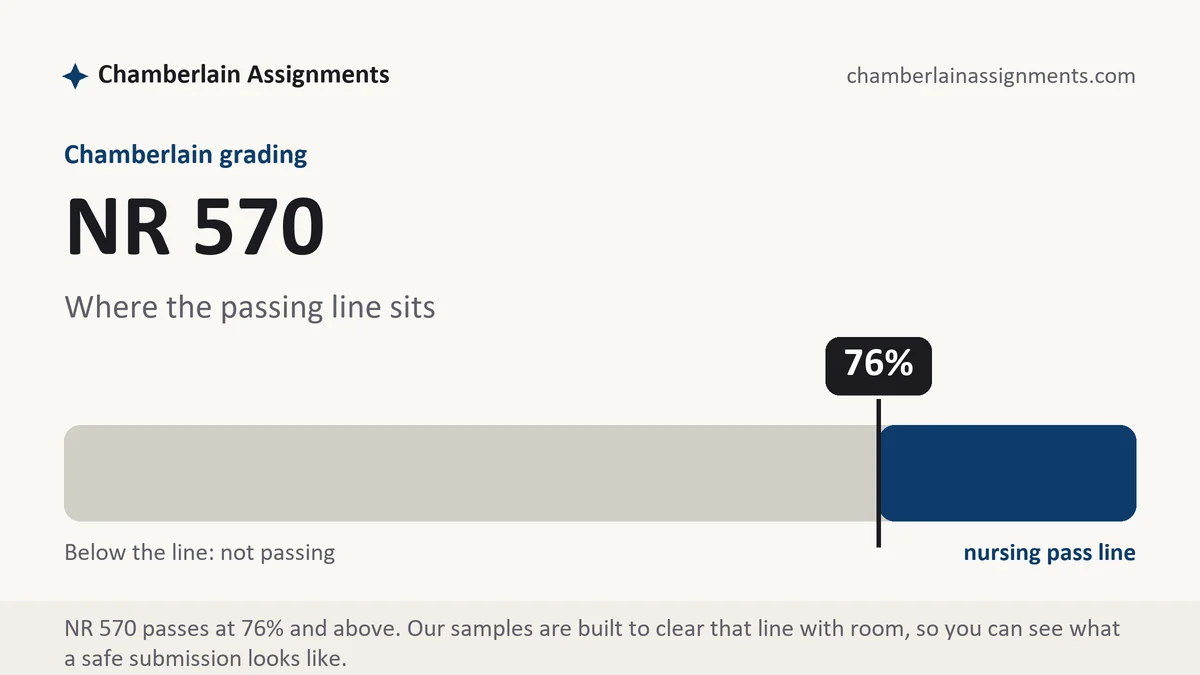
The discipline behind every paper here: the rubric is the outline, each row gets its section, one-shot discussions get the one-shot treatment, and the 76 percent floor is treated as the cliff it is. Send your week's instructions with a request and the sample matches them, revisions included.
NR 570 questions, answered
Do I have to send a real case?
No. Three or four lines of shape are enough: the presentation, the setting, the length of stay, and the documents the week asks for. A sample gets built on a constructed patient, which keeps it clear of anything that would read as evidence about a visit. The details of the encounter you actually documented stay yours to write in.
Which guidelines do the samples cite?
Whatever your section names, if you say so. When nothing is specified, an example cites widely published national recommendations by organization and year, so the reference can be checked and swapped. A sample is not clinical advice and is not written for use on a patient; it shows how a citation sits inside an assessment paragraph and how a departure from a recommendation gets argued rather than skipped.
Are daily notes really worth writing out?
They carry more points than people expect. A sequence of three is marked on the difference between them, so markers read the second and third against the first looking for something that moved and a sentence explaining it. Two notes that could swap places without anyone noticing score as one note submitted twice, whatever either of them contains.