Send the exact assignment or rubric from your classroom and a custom sample written to it lands in 24 to 48 hours, the first one free. NR 575 is Chamberlain’s Acute Care Practicum II course. It centers on the closing rung, where every document is cumulative and has to agree with what the earlier practicum already claimed. Searches like "nr 575 week 4 assignment example", "NR575 sample paper", and "NR 575 week samples" land on this page.
What NR 575 is really about
The second hours-bearing rotation is graded as a continuation, which is the whole difference. Faculty have your objectives from NR 574, the appraisal you wrote at its midpoint and the summary you closed it with, and documents produced here are read against all three. An aim repeated word for word from the earlier term reads as a term that taught nothing. A competency claimed now that was described as developing before has to show what closed the distance. This work is cumulative, and the commonest failure is writing it as though the reader is meeting you for the first time.
The other half is readiness, assessed by specificity rather than by confidence. A closing statement declaring you are prepared for independent practice earns nothing; one naming two situations you would still want somebody beside you for, and what you plan to do about each inside six months, earns the row. Portfolio work carries the same test. Evidence has to be pointed at: a competency matched to the assignment, journal entry or encounter demonstrating it, rather than asserted in a paragraph. The session is eight weeks long and the assignments arrive in the same weekly rhythm as every other NR course.
What NR 575’s assessments ask for
The term opens by revising the aims from the earlier practicum, and most sections ask for the reason each one changed. A continuity piece follows in many sections, tracking one patient or one problem across more of the stay than a single shift allows. Middle weeks build a portfolio: competencies from your program listed, each matched to something written this term or last, with a line saying what the match demonstrates. A readiness appraisal sits near the end and is marked on what it admits rather than on what it claims. A transition piece covering the first months of practice closes most sections, with a discussion thread each week carrying its own points.
Where students lose points in NR 575
The costly submission is the one that could have been handed in for either practicum. Aims carried over unchanged, a portfolio of assertions with no assignment named behind any of them, and a readiness statement built from adjectives are the three showing up most. Contradictions cost more here than anywhere else in the sequence, because two terms of your own documents are available to the marker: a competency claimed as met this term and reported as a gap last term needs the sentence that joins them. A transition plan with no timeline, and a closing piece reviewing the specialty instead of the writer, also lose rows, as does a portfolio line pointing at a document the marker cannot open.
The NR 575 drawers
NR 575 Week 1 discussion post example
Week 1 frequently opens on what a second rotation should change about the first. On request, free, 24-48h.
NR 575 Week 2 objective revision memo example
Week 2 rewrites last term's aims and gives a reason for every change. On request, free, 24-48h.
NR 575 Week 3 continuity case narrative example
Week 3 follows one patient across more of the stay than a shift allows. On request, free, 24-48h.
NR 575 Week 4 competency evidence map example
Week 4 matches each program competency to something you have already written. On request, free, 24-48h.
NR 575 Week 5 practice readiness appraisal example
Week 5 states plainly what you would still want somebody standing beside you for. On request, free, 24-48h.
NR 575 Week 6 transition to practice plan example
Week 6 sets out the first six months with a period against each aim. On request, free, 24-48h.
NR 575 Week 7 cumulative portfolio entry example
Week 7 assembles two terms of evidence into one document a reader can audit. On request, free, 24-48h.
NR 575 Week 8 practicum closing memo example
Week 8 closes the sequence on what remains rather than on what was achieved. On request, free, 24-48h.
Your classroom shows something else?
Chamberlain University revises courses; week counts and deliverables shift between terms. Send what your classroom shows and the desk matches it exactly.
Using a NR 575 sample the right way
The portfolio is where a finished example repays the time, because the format is unfamiliar and the temptation is to write an essay. A worked version shows a competency line with its evidence named and a sentence saying what that evidence proves, a shape most people only get right after losing marks once. It also shows how a readiness appraisal admits a limit without reading as unfit. Your evaluations, hours and dates are yours to enter; the sample is written to your rubric and is there to be written against, not handed in.
How these samples are written
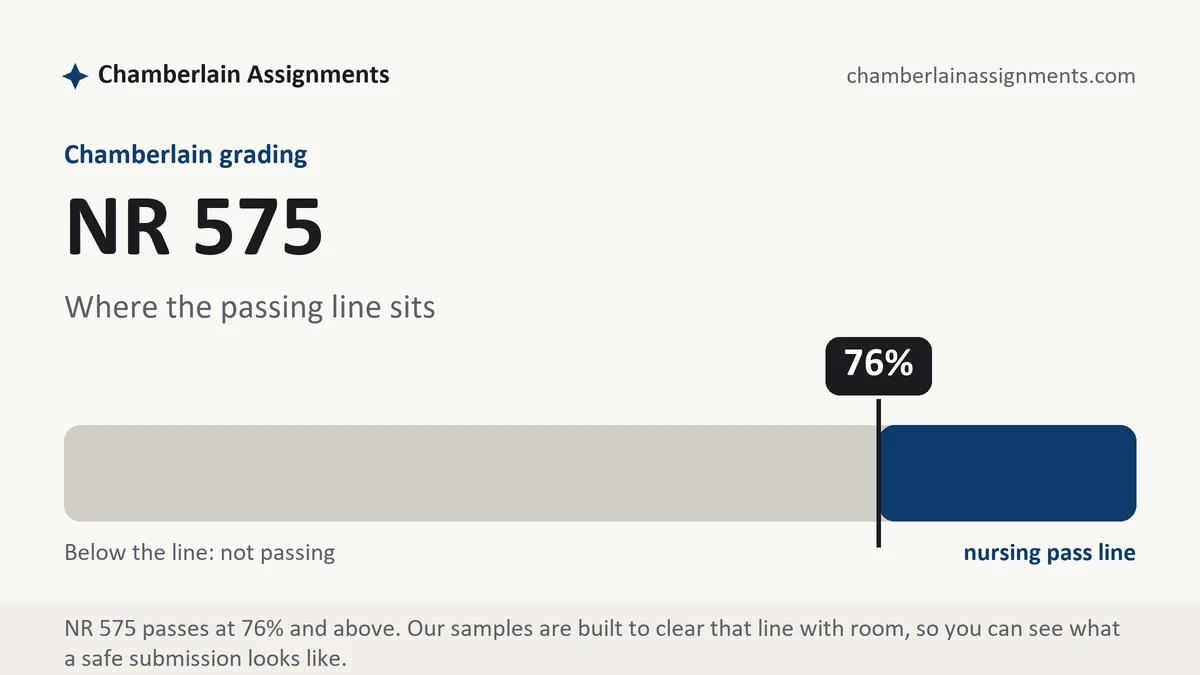
The discipline behind every paper here: the rubric is the outline, each row gets its section, one-shot discussions get the one-shot treatment, and the 76 percent floor is treated as the cliff it is. Send your week's instructions with a request and the sample matches them, revisions included.
NR 575 questions, answered
Can a sample complete my evaluation form?
No. An evaluation is signed by somebody who watched you work, and nothing written here can stand in for that. What an example can do is show what a complete self-appraisal holds beside it: the competency named, the evidence pointed at, the limit stated plainly, and the plan attached. The entries and the signatures on your own forms are yours to supply.
How do I show progress from the earlier practicum?
By quoting yourself. Send the aims you wrote for NR 574 and whatever you said at its midpoint, and a sample will show the revision argued against them rather than written fresh. Markers reading the two terms together are looking for a named change and a reason for it, which is impossible to demonstrate if the earlier documents never appear.
What goes into a transition piece?
A timeline more than a mood. Most rubrics want the setting you expect to enter, two or three things you intend to work on with a period attached to each, the supports you will use, and an honest sentence about what would make the first months hard. Statements of enthusiasm fill no rows, which surprises people every term.