Send the exact assignment or rubric from your classroom and a custom sample written to it lands in 24 to 48 hours, the first one free. NR 583NP is Chamberlain’s Informatics for Advanced Nursing Practice course. It centers on whether a system actually fits the work it lands in, and what the data it produces can honestly be asked to prove. Searches like "nr 583np week 4 assignment example", "NR583NP sample paper", and "NR 583NP week samples" land on this page.
What NR 583NP is really about
The word informatics makes people expect a technology course, so the first surprise is how little of the grade sits in the technology. A system can be described accurately, feature by feature, and earn very little, because the question the course keeps asking is what the work looked like before and what it looks like after. That is a question about people. Every new field on a screen is time taken from someone, usually a nurse, and every alert that fires is attention spent whether or not it was worth spending. Writing that skips the human ledger reads as a product summary, and product summaries are the most common weak submission in this classroom.
The second half of the argument is about the data itself. Documentation produces the numbers that later get reported as quality, so a field entered carelessly at two in the morning becomes a statistic somebody trusts. The course wants you to notice that chain and to write about data with the standard, the definition and the entry point in view: what counts as a completed medication reconciliation, who decides, where it lands, and what happens to the record afterwards. Privacy sits inside the same discussion rather than in a separate paragraph about regulations, because access rules are design decisions that shape who can see what while doing their job.
What NR 583NP’s assessments ask for
Assignment work here usually starts with description and only then allows proposal. A typical prompt asks for the current process in steps, drawn or written, including the parts that happen outside the system on paper or by phone, and only after that for the change you would make. Evaluation assignments hand you a system or a module and ask whether it fits the people using it, which means usability, training load and the workaround staff have already invented. Implementation work asks who is affected, what they lose in the first month, and how you would know adoption happened rather than compliance. Discussions early in the week often circle one failure, and the useful reply names the step where the workflow actually broke.
Where students lose points in NR 583NP
The costly habit is the feature tour: three paragraphs of what the system offers, none of which say what anyone does differently on a Tuesday. A second loss comes from proposing a change with no workflow underneath it, so the reader cannot tell which step you removed and which one you quietly added. Third is the adoption plan that consists of training, as though the reason people abandon a system is that nobody showed them once. Alerts recommended without asking who dismisses them, benefits claimed with no measure attached, privacy handled as a paragraph of law rather than as an access decision, and screenshots used where the rubric wanted an explanation all pull points off a submission.
The NR 583NP drawers
NR 583NP Week 1 discussion post example
Week 1 usually starts on how data becomes something a nurse can act on. On request, free, 24-48h.
NR 583NP Week 2 workflow analysis example
Week 2 typically maps a current process step by step before anything gets changed. On request, free, 24-48h.
NR 583NP Week 3 system evaluation example
Week 3 often weighs one system against the people who would have to use it. On request, free, 24-48h.
NR 583NP Week 4 data brief example
Week 4 in many sections asks what a single documented field can honestly support. On request, free, 24-48h.
NR 583NP Week 5 implementation plan example
Week 5 commonly hands you a rollout and asks who absorbs the first month. On request, free, 24-48h.
NR 583NP Week 6 training and adoption plan example
Week 6 often turns to the workarounds staff invent when a system fights them. On request, free, 24-48h.
NR 583NP Week 7 privacy and access memo example
Week 7 usually tests who should see a record and who decides that. On request, free, 24-48h.
NR 583NP Week 8 informatics proposal example
Week 8 commonly ends with one change argued from workflow through to adoption. On request, free, 24-48h.
Your classroom shows something else?
Chamberlain University revises courses; week counts and deliverables shift between terms. Send what your classroom shows and the desk matches it exactly.
Using a NR 583NP sample the right way
Read a sample for the part most people skip: the before. Find where the writer describes the existing process in enough detail that the problem becomes obvious without being announced, and watch how the proposal that follows only touches steps that were named earlier. Then swap in your own setting, because the workflow has to be one you have actually seen, and a borrowed process produces a proposal that solves nothing. The structure is what transfers here, along with the discipline of saying who does the extra work before claiming the benefit. Notice too how little space the technology itself takes up, and how much of the letter grade sits in the paragraph about people.
How these samples are written
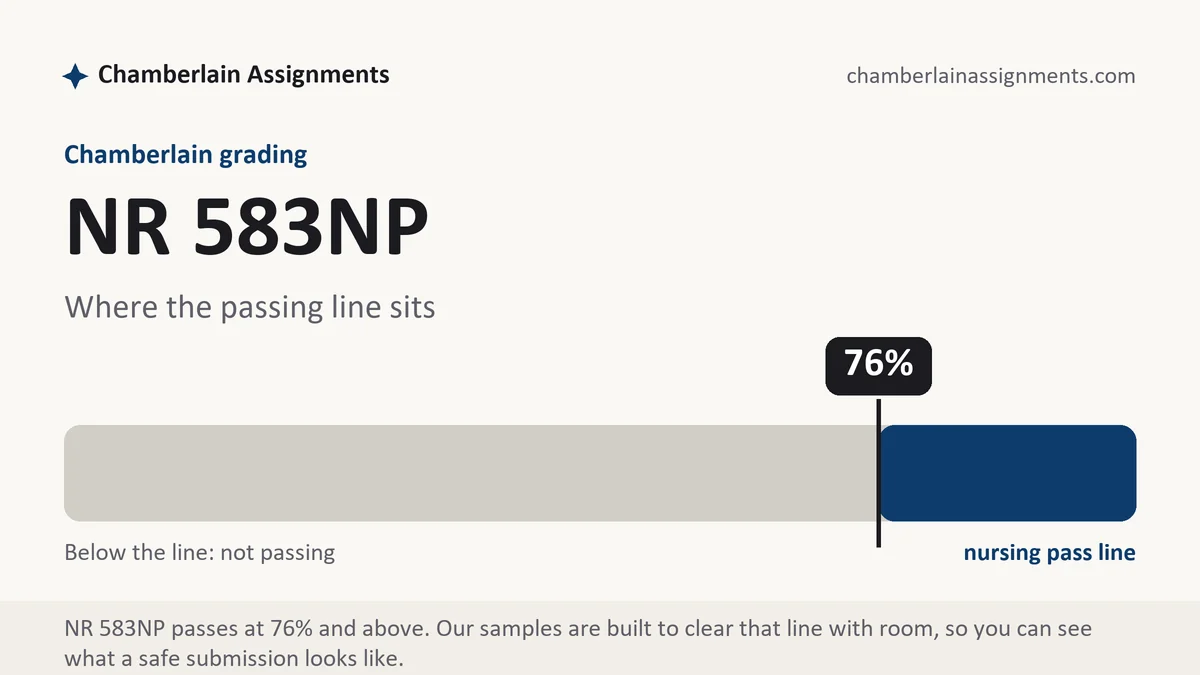
The discipline behind every paper here: the rubric is the outline, each row gets its section, one-shot discussions get the one-shot treatment, and the 76 percent floor is treated as the cliff it is. Send your week's instructions with a request and the sample matches them, revisions included.
NR 583NP questions, answered
Do I need to know the system my assignment is about?
You need to know a workflow, which is different. Most prompts accept the setting you work in, and the strongest submissions come from writers describing steps they have actually watched, including the paper form nobody has retired. If the assignment names a system you have never touched, write about the process it would sit inside and say what you would need to verify.
How technical should the writing be?
Less technical than most people assume. The reader is a nursing faculty member marking whether you understand the work, so vocabulary like interoperability earns nothing on its own and a great deal when it explains why two departments cannot see the same record. Define a term once, in a clause, then spend the paragraph on the consequence for the people using it.
The assignment wants a diagram and I have only prose.
Send whatever template or drawing tool your classroom expects and the sample is built to match it. A process drawn as boxes and a process written as numbered steps make the same argument, and the marking usually follows whether every handoff is visible rather than which format carried it. Say which one you need when you ask.