Send the exact assignment or rubric from your classroom and a custom sample written to it lands in 24 to 48 hours, the first one free. NR 587 is Chamberlain’s Advanced Nursing Leadership Within Healthcare Environments course. It centers on the working environment as something an executive is accountable for, measured in vacancy, turnover and whether people will say what they saw. Searches like "nr 587 week 4 assignment example", "NR587 sample paper", and "NR 587 week samples" land on this page.
What NR 587 is really about
NR 587 sits where leadership stops being about what you do and starts being about what your area is like. An advanced nurse leader inherits an environment: a vacancy rate, a turnover pattern, a set of behaviors people have learned are tolerated, a reputation among staff deciding whether to transfer in. The course treats all of that as your accountability rather than as weather. What makes the writing hard is that the levers are blunt and expensive. Changing an environment usually means funding positions, altering schedules, removing somebody technically good at the job, or holding a standard against a physician who outranks your influence. None of those are free, and all of them are visible.
Running beside all of that is a hard demand for evidence. Environment work invites the softest writing in graduate nursing, so rubrics here push toward the measured version: engagement results read as data rather than as a score to celebrate, exit interviews treated as a pattern, reporting rates read as a statement about whether staff believe reporting is safe. Assignments generally want a plan attached to those figures, with what you would fund, what you would stop doing, who owns each part and when you would look again. Statements of value with nothing behind them read as decoration at this level of the program. A figure, an owner and a date turn the same paragraph into a plan.
What NR 587’s assessments ask for
Written work in NR 587 tends to run diagnosis, plan, defense. Early assignments ask you to characterize an environment you actually work in using whatever it already publishes about itself: turnover, vacancy, agency use, survey results, the measures your employer collects anyway. Middle weeks convert that reading into an intervention with money and time attached, since the course expects an executive to spend rather than exhort. Later work is usually the harder conversation, holding a standard with somebody who has power, protecting a change from a manager who quietly does not want it, or telling staff what you will not be able to fund this year. Discussions test whether a classmate's plan survives its first budget review. Budget review is where environment plans usually die.
Where students lose points in NR 587
The predictable loss here is the culture paper written entirely in adjectives. Supportive, respectful and transparent are the destination, not the plan, and a rubric asking for an intervention cannot mark a description of where you would like to arrive. The second loss is the environment analysis with no figures in it, where the writer knows morale is poor and never touches the turnover, vacancy or agency numbers that would make the claim arguable. Third is the plan that only asks other people to change, since an executive holding authority is expected to spend something, whether money, a position or their own standing. Recommendations with no owner, no cost and no review date complete the set, and they are easy to spot.
The NR 587 drawers
NR 587 Week 1 discussion post example
Week 1 often asks what your area is actually like to work in. On request, free, 24-48h.
NR 587 Week 2 practice environment assessment example
Week 2 typically reads turnover, vacancy and agency use as one description of a place. On request, free, 24-48h.
NR 587 Week 3 engagement data analysis example
Week 3 commonly turns survey results into two or three claims you can defend. On request, free, 24-48h.
NR 587 Week 4 workforce investment plan example
Week 4 often costs an intervention meant to keep experienced staff from leaving. On request, free, 24-48h.
NR 587 Week 5 standards enforcement memo example
Week 5 usually asks how you would hold a standard with somebody who outranks you. On request, free, 24-48h.
NR 587 Week 6 safety climate brief example
Week 6 frequently examines whether staff believe that reporting an error here is safe. On request, free, 24-48h.
NR 587 Week 7 resource allocation memo example
Week 7 in many sections forces a choice about what goes unfunded this year. On request, free, 24-48h.
NR 587 Week 8 executive action plan example
Week 8 often closes with owners, costs and the date you would look again. On request, free, 24-48h.
Your classroom shows something else?
Chamberlain University revises courses; week counts and deliverables shift between terms. Send what your classroom shows and the desk matches it exactly.
Using a NR 587 sample the right way
Look first at what a sample commits, not at what it praises. The instructive part is where a writer turns a survey result into a funded action with an owner attached, and where they accept the unpopular half of a standard instead of leaving it implied. Notice too how the figures stay fastened to the argument all the way through to the conclusion. Then rebuild it inside the area you are responsible for or hope to be, using measures your own employer publishes, because an environment paper convinces only when the environment in it is recognizable. Recognizable means a colleague could read it and name the place.
How these samples are written
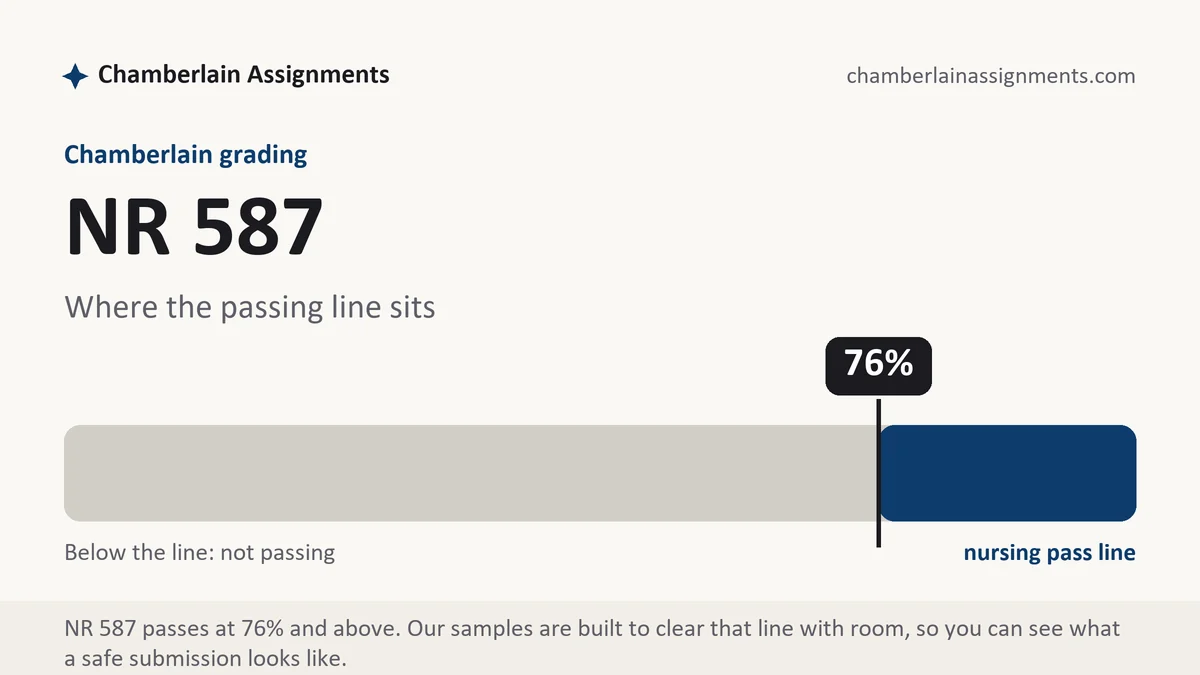
The discipline behind every paper here: the rubric is the outline, each row gets its section, one-shot discussions get the one-shot treatment, and the 76 percent floor is treated as the cliff it is. Send your week's instructions with a request and the sample matches them, revisions included.
NR 587 questions, answered
My workplace will not share its engagement results. What can I use?
More than you would think. Turnover and vacancy are often visible in job postings and internal announcements, agency use is obvious on any schedule, and public quality reporting says something about the environment too. Name what you used and what you could not get, then argue from what you have. A limited data set described honestly is acceptable.
Am I supposed to write about a place where I hold authority?
Write from the chair you are preparing for, even if you do not sit in it yet. Take an area you know well and answer as the person who could fund a position or change a schedule there. The analysis fails when a writer keeps the manager's view of what is wrong and none of the executive's ability to spend.
How specific can I be about a difficult colleague?
Describe the behavior and its effect on the environment, not the person's identity. Remove names, alter identifying detail, and keep the focus on what a standard requires and how you would enforce it. That is also better writing, since the rubric rewards the response you designed rather than the story you are still annoyed about.