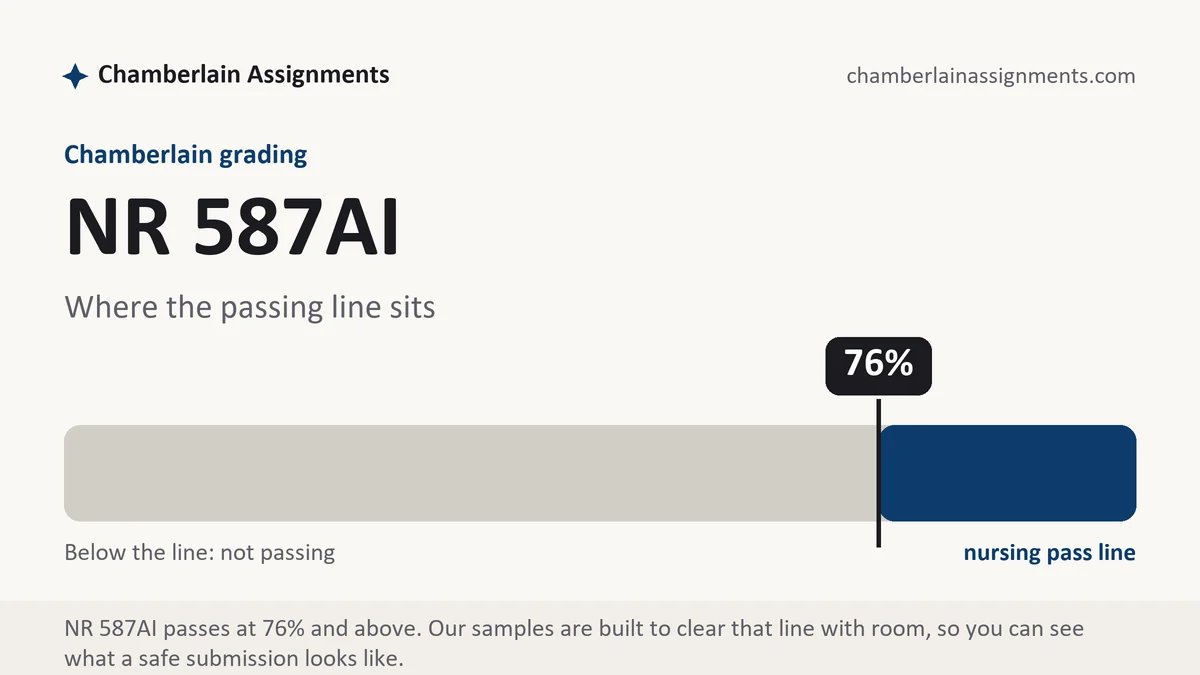
Send the exact assignment or rubric from your classroom and a custom sample written to it lands in 24 to 48 hours, the first one free. NR 587AI is Chamberlain’s Advanced Nursing Leadership in Artificial Intelligence-Integrated Healthcare Environments course. It centers on leading a service where a model recommends and a person signs, so accountability for a wrong recommendation has to be assigned in advance. Searches like "nr 587ai week 4 assignment example", "NR587AI sample paper", and "NR 587AI week samples" land on this page.
What NR 587AI is really about
The problem NR 587AI is built around is not a technical one. A predictive tool arrives on your service, it scores patients for deterioration, it proposes an acuity-based assignment or flags who should be seen first, and the executive who has to sign for it cannot personally verify how the number was reached. Neither can the vendor's presenter, in the way that matters. What a leader can do is ask the questions that decide whether the tool is safe to run here: what population it learned from, how close that population is to yours, what it does when uncertain, and what work its output adds to the nurses who receive it. None of those need a data scientist to ask.
The second half of the course is accountability, and it is the part rubrics press hardest. When a recommendation is wrong and a patient is harmed, the answer cannot be that the system suggested it. Somebody accepted the recommendation, somebody approved the tool, somebody decided how often it would be reviewed, and an executive who cannot say which of those people they are has not finished the assignment. Assignments therefore keep asking for a named owner, a review interval, a route for clinicians who disagree with the output, and a decision about the conditions under which you would switch the thing off entirely. An oversight plan with no off switch has not answered the question.
What NR 587AI’s assessments ask for
Weekly work here tends to alternate between interrogation and governance. One week hands you a tool and asks what you would want to know before it went live, graded on whether your questions could actually be answered by a vendor rather than on how skeptical they sound. Another asks what happens after go-live: who watches whether clinicians are overriding the output, what an override rate would tell you, and what you would do if the tool performed differently for one group of patients than another. Later assignments usually want a decision written down, either a recommendation to deploy with conditions attached or a case for stopping something already running. Discussions frequently argue about disclosure and about whether a clinician can reasonably be asked to overrule a machine.
Where students lose points in NR 587AI
The commonest failure is a paper about artificial intelligence in general, which reads as an essay somebody could have written without taking the course. A rubric asking about your own service does not want a survey of what algorithms can do in health care. The second failure is enthusiasm with no conditions attached, where the tool improves detection, saves nursing time and reduces error, and nothing in the paper says how you would find out if it stopped working. Third is diffuse accountability, a plan where oversight belongs to a committee meeting quarterly and to nobody in particular between meetings. Warnings about bias that never name which patients belong there as well. A fourth treats the vendor's validation figures as the end of the question rather than the start.
The NR 587AI drawers
NR 587AI Week 1 discussion post example
Week 1 often asks where a model already influences decisions in your own workplace. On request, free, 24-48h.
NR 587AI Week 2 tool evaluation brief example
Week 2 typically lists what you would need answered before a clinical tool went live. On request, free, 24-48h.
NR 587AI Week 3 training data critique example
Week 3 commonly asks whose patients the system learned from and how yours differ. On request, free, 24-48h.
NR 587AI Week 4 model risk assessment example
Week 4 often weighs the harm a wrong recommendation could do against what it prevents. On request, free, 24-48h.
NR 587AI Week 5 oversight plan example
Week 5 usually assigns a named owner, a review interval and a route for disagreement. On request, free, 24-48h.
NR 587AI Week 6 override monitoring analysis example
Week 6 frequently reads how often clinicians ignore an output and asks what follows. On request, free, 24-48h.
NR 587AI Week 7 disclosure brief example
Week 7 in many sections asks what patients and staff are told about the tool. On request, free, 24-48h.
NR 587AI Week 8 deployment decision paper example
Week 8 often closes with a decision to run, restrict or stop something. On request, free, 24-48h.
Your classroom shows something else?
Chamberlain University revises courses; week counts and deliverables shift between terms. Send what your classroom shows and the desk matches it exactly.
Using a NR 587AI sample the right way
Study the questions in a sample before its conclusions. What carries over is the interrogation, the specific things a writer asks about the training population, the performance monitoring and the workload an output creates, phrased so that a vendor has to answer rather than reassure. Notice where accountability is pinned to a role with a name and a review date beside it. Then rewrite it around the tool your organization is actually buying or already running, because a governance argument becomes useful only once it is attached to a system somebody in your building must answer for. That person is usually easier to name than students expect.
How these samples are written
Method, in one line: rubric first, structure from the rubric, templates exact, discussions final on arrival. Week counts vary by course version; the catch-all row absorbs the difference. Your free request matches what your classroom actually shows.
NR 587AI questions, answered
I am not technical. Can I write competently about a model I do not understand?
That is exactly the position the course is written for. An executive is not expected to inspect the mathematics; they are expected to ask what the tool was built on, how its performance is checked over time, what it costs clinicians in attention, and who answers when it is wrong. Those are leadership questions, and they are what the rubric marks.
Is this the same as the informatics courses?
It overlaps and the seat is different. Informatics work builds, selects and manages information systems. This course is about leading a service where one of those systems now issues recommendations, which puts the weight on oversight, disclosure and accountability rather than on design, workflow or implementation mechanics. If your draft is explaining how a system was built and rolled out, you have drifted into the other course.
How do I write about bias without being vague?
Name a group, a measure and a comparison. Say which patients you would expect the tool to serve worse, what figure would reveal it, and how often somebody would check. Broad warnings that an algorithm may perpetuate inequity earn little, because they give an executive nothing to monitor and nothing to act on when a check comes back bad.