Send the exact assignment or rubric from your classroom and a custom sample written to it lands in 24 to 48 hours, the first one free. NR 588AI is Chamberlain’s Advanced Nursing Leadership in Artificial Intelligence-Integrated Complex Systems course. It centers on governing decision support no one in the room can fully explain, and staying answerable when its recommendation is wrong. Searches like "nr 588ai week 4 assignment example", "NR588AI sample paper", and "NR 588AI week samples" land on this page.
What NR 588AI is really about
The temptation in a course with artificial intelligence in its title is to write about the technology, and that is reliably the lowest-scoring version. NR 588AI is a leadership course. It assumes the model already exists, already sits inside a workflow somebody approved, and already produces a recommendation that a nurse on nights either accepts or overrides at three in the morning. What you are asked to write about is the structure of decisions around it: who evaluated the tool before it was bought, on which population, against which local outcome, who is permitted to override it, and what happens to that nurse afterward. The technology is the setting; the leadership is the subject.
The harder demand is accountability for something you cannot personally verify. A nurse executive will not inspect training data or read validation statistics, and the organization still holds them answerable for what the system does across every unit that uses it. Writing that resolves the tension by deferring to the vendor, or by refusing the tool on principle, reads to a grader as an absence of judgment either way. What earns points is a governance answer with parts: named ownership, a stated review interval, a signal that would tell you performance had drifted for one group of patients, an escalation route a bedside nurse can actually use, and a position on what the organization says when the recommendation was followed and it was wrong.
What NR 588AI’s assessments ask for
Weekly work tends to alternate between governing a tool and defending a decision about one. Assignment weeks often ask for a document an executive would actually sign: an evaluation of a proposed system against the population it will be used on, an oversight plan naming who reviews what and how often, or a briefing that tells a board what the organization is exposed to. Discussions open the week and usually put a contested case on the table, a recommendation that was followed with a bad result or ignored with a good one, and the reply that earns points argues about accountability rather than agreeing that oversight matters. Rubrics reward specificity about mechanism: which committee, which interval, which signal, which person.
Where students lose points in NR 588AI
The characteristic failure here is the explainer. A paper that spends two pages defining machine learning, lists benefits and risks in parallel columns, and closes by recommending careful implementation has answered a technology question nobody asked. Second is the tool with no owner: an oversight plan full of review and monitoring in the passive voice, where nothing is attached to a role that could be held responsible. Third is the equity paragraph that mentions bias, cites a general source, and never says which patients this particular system would serve worse or how anyone would find out. Writing that quotes vendor material as evidence, treats accuracy as a single number, or ends on a call for further study gives a grader nothing to reward.
The NR 588AI drawers
NR 588AI Week 1 discussion post example
Week 1 often asks what changes about leadership when part of the decision is automated. On request, free, 24-48h.
NR 588AI Week 2 technology governance brief example
Week 2 typically wants the control structure around one named tool, not described in general. On request, free, 24-48h.
NR 588AI Week 3 vendor evaluation memo example
Week 3 commonly weighs a proposed system against the population your organization would use it on. On request, free, 24-48h.
NR 588AI Week 4 bias and equity review example
Week 4 often asks which patients a model would serve worse and how you would notice. On request, free, 24-48h.
NR 588AI Week 5 oversight plan example
Week 5 usually attaches monitoring to a named role, an interval and a trigger. On request, free, 24-48h.
NR 588AI Week 6 override policy draft example
Week 6 frequently examines what happens to the nurse who disagrees with the recommendation. On request, free, 24-48h.
NR 588AI Week 7 accountability case analysis example
Week 7 in many sections traces responsibility after a recommendation turned out badly. On request, free, 24-48h.
NR 588AI Week 8 executive briefing example
Week 8 often closes by telling a board what the organization is exposed to. On request, free, 24-48h.
Your classroom shows something else?
Chamberlain University revises courses; week counts and deliverables shift between terms. Send what your classroom shows and the desk matches it exactly.
Using a NR 588AI sample the right way
Work through a sample holding one question: if this recommendation caused harm on Tuesday, which sentence in the document says who answers for it. Follow how the writer converts a worry into a mechanism, so concern about bias becomes a named subgroup, a metric and a review date. Notice how the vendor's claims are treated as claims. Then rebuild the analysis around a system your own organization actually uses or is being sold, because the committee structure, the override culture and the units affected are local facts, and they are what makes the governance argument land. A sample supplies the frame; the exposure has to be yours.
How these samples are written
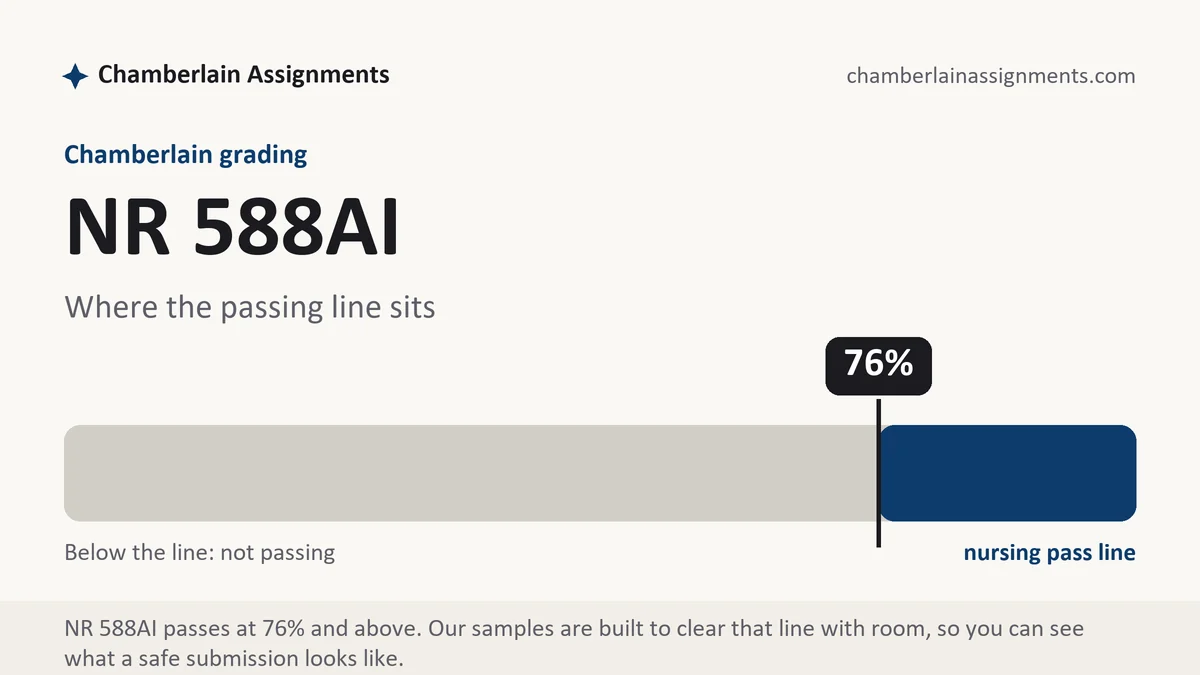
The discipline behind every paper here: the rubric is the outline, each row gets its section, one-shot discussions get the one-shot treatment, and the 76 percent floor is treated as the cliff it is. Send your week's instructions with a request and the sample matches them, revisions included.
NR 588AI questions, answered
Do I need a technical background to do well in this course?
No, and writing as though you have one usually hurts. The graded question is not how the model works but how the organization controls it: who approved it, who watches it, who is permitted to overrule it, and who carries the consequence of a bad recommendation. Those are leadership questions, and a nurse executive is expected to ask them without being able to read the code.
Can I write about a system my employer already uses?
That is the strongest material available to you. Describe what it recommends, who acts on it, and what an override looks like on a real shift, then keep identifying detail out. Send the assignment instructions and rubric with your request and the first custom sample is free in 24-48h, written to a setting close enough that your own facts drop straight into it.
How current do sources have to be for this subject?
Currency matters more here than in most graduate courses, because a position paper resting on writing from several product generations ago describes tools that no longer behave that way. Pair recent professional and regulatory material with the governance literature, which ages more slowly, and say plainly when a source is describing an earlier state of practice.