Send the exact assignment or rubric from your classroom and a custom sample written to it lands in 24 to 48 hours, the first one free. NR 607 is Chamberlain’s Diagnosis & Management in Psychiatric-Mental Health III Practicum course. It centers on managing psychiatric illness over time and across services, and writing records a colleague who was not there can act on. Searches like "nr 607 week 4 assignment example", "NR607 sample paper", and "NR 607 week samples" land on this page.
What NR 607 is really about
By the third management course the patient has a history with you, and the writing changes again. The unit of analysis is no longer a visit or a change but a course of illness: what has been tried, what worked and for how long, what was abandoned and why. That history has to be compressed rather than recounted, because nobody reading a chart wants sixteen paragraphs in order. The other shift is audience. Earlier assignments were read by a grader who knew the case; here the assumption is a colleague who does not, which is why so much of the assessment rests on whether a stranger could pick up your record and continue safely.
Severity is the second thing that separates this course from the two before it. Presentations at this end involve people whose illness is persistent, whose treatment involves more than one service, and whose safety has to be planned rather than assessed once. Safety planning is written work with a particular standard: specific enough to be followed by somebody in distress, agreed rather than issued, and reviewed like anything else in the plan. Coordination sits beside it. What you write to a case manager, a school, a housing worker or an emergency department is judged on whether it gives them what they need to act, and not on how thoroughly it explains the psychiatry.
What NR 607’s assessments ask for
Written work in many sections is longer and less forgiving than earlier in the sequence. A common assignment takes one patient across months and asks for a summary somebody else could use, with the treatment history condensed and the current position stated plainly. Others ask for a safety plan written in the patient's own terms, or a transfer document for a service picking the case up. Sections frequently add something argued rather than recorded, a consultation question or a decision defended against a reasonable objection. Discussion threads tend to circle situations with no clean answer. Anything the placement itself produces, your hours, your log and the preceptor's evaluation, stays outside what a sample can cover.
Where students lose points in NR 607
The characteristic loss at this level is the summary that is really a transcript. Every visit reported in sequence, nothing subordinated, and a reader who has to do the synthesis the assignment asked you to perform. Second is the safety plan written for the file rather than the person: general advice, a hotline number, and nothing the patient recognizes as theirs. Third is the coordination document that explains the diagnosis at length and never states the request, so the person receiving it does not know what they are being asked for. A history with no dates, a current position left implicit, and risk described once and never revisited also cost points.
The NR 607 drawers
NR 607 Week 1 discussion post example
Week 1 typically opens on what a record owes the person who reads it next. On request, free, 24-48h.
NR 607 Week 2 longitudinal case write-up example
Week 2 often asks for months of treatment compressed into a usable summary. On request, free, 24-48h.
NR 607 Week 3 safety plan write-up example
Week 3 in many sections wants a plan a person in distress could follow. On request, free, 24-48h.
NR 607 Week 4 care coordination note example
Week 4 commonly asks for a request another service can act on. On request, free, 24-48h.
NR 607 Week 5 case analysis example
Week 5 typically presents persistent illness where the easy options are gone. On request, free, 24-48h.
NR 607 Week 6 transition of care summary example
Week 6 often asks what a receiving clinician needs on day one. On request, free, 24-48h.
NR 607 Week 7 consultation write-up example
Week 7 in many sections asks a question of a colleague in writing. On request, free, 24-48h.
NR 607 Week 8 synthesis case paper example
Week 8 usually asks for one long case argued as a whole. On request, free, 24-48h.
Your classroom shows something else?
Chamberlain University revises courses; week counts and deliverables shift between terms. Send what your classroom shows and the desk matches it exactly.
Using a NR 607 sample the right way
Read an example for what it leaves out. The skill on display is subordination: months of treatment reduced to the few facts that change what happens next, with everything else dropped. Look at how the safety section reads as an agreement instead of an instruction, and at how short the request is in any document written to another service. Skip the clinical specifics, since your case is its own. Then write from the chart you actually hold. What an example teaches at this level is compression, which is the hardest thing to learn from a rubric.
How these samples are written
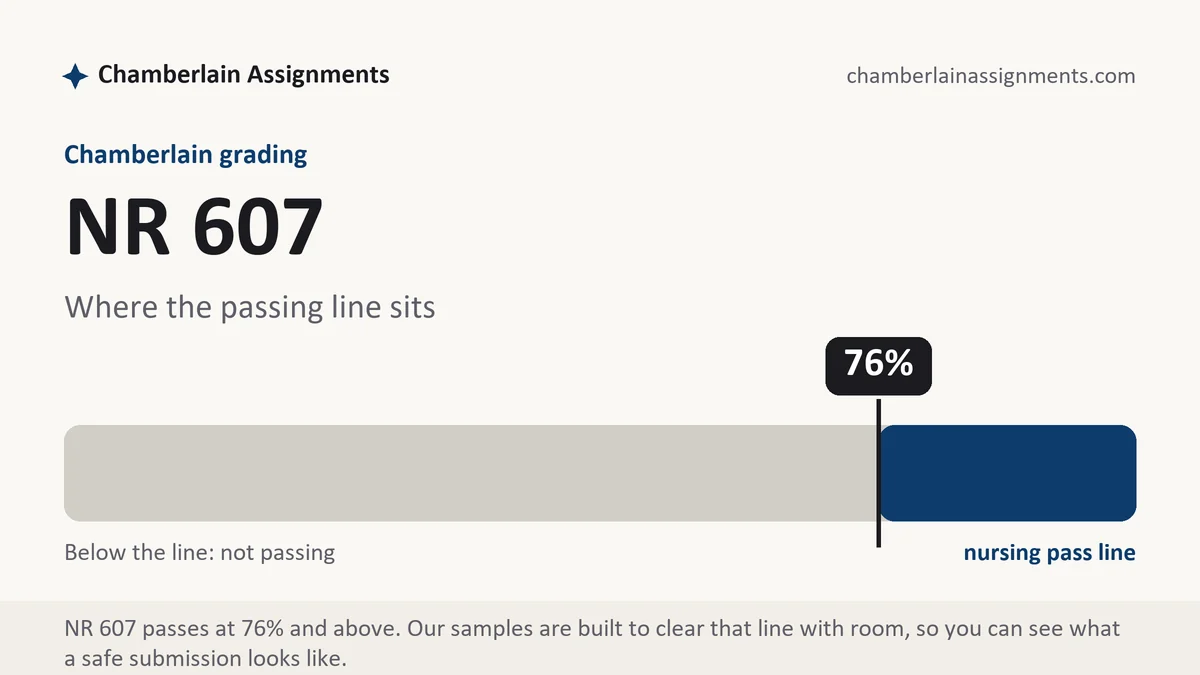
The discipline behind every paper here: the rubric is the outline, each row gets its section, one-shot discussions get the one-shot treatment, and the 76 percent floor is treated as the cliff it is. Send your week's instructions with a request and the sample matches them, revisions included.
NR 607 questions, answered
How long should a longitudinal summary be?
Shorter than the history it covers, which is the whole exercise. A reader wants the current position first, then the treatment history in the order that explains it, then what is outstanding. Length usually signals that nothing has been ranked. If your section sets a page limit, treat it as the point of the assignment rather than an obstacle to it.
Can you write a safety plan as an example?
A model one, yes, built on a described scenario rather than a real person. What it demonstrates is form: how warning signs get written in somebody's own words, how the steps stay short enough to follow badly, and where review belongs. A plan for an actual patient has to be made with them, which is work no example can stand in for.
Is this course just harder versions of the earlier assignments?
The difficulty is different rather than greater. Earlier the question was whether your reasoning was sound; here it is whether your writing works for somebody else, over time, under pressure. A submission can be clinically impeccable and still lose points because a colleague reading it could not tell what to do on Monday morning.