Send the exact assignment or rubric from your classroom and a custom sample written to it lands in 24 to 48 hours, the first one free. NR 642 is Chamberlain’s Informatics Nurse Specialist Concluding Graduate Experience I course. It centers on turning an observed information problem into a scoped project with a sponsor, a baseline and a deliverable somebody has agreed to. Searches like "nr 642 week 4 assignment example", "NR642 sample paper", and "NR 642 week samples" land on this page.
What NR 642 is really about
The first concluding course is mostly negotiation written down. You arrive with something that annoys people at a site and you have to leave with a problem narrow enough to finish, wanted by somebody with the authority to let you work on it. That conversion is the graded skill. Students underestimate it because the clinical problem feels obvious, then discover that obvious problems are usually four problems in a coat, only one of which can be measured before you start. Written work in this stretch keeps forcing the same discipline: say what is happening now, in figures if any exist, and say what would be different if you succeeded.
Everything else follows from the scoping. A sponsor has to be named, because a project nobody owns dies the week you leave. A baseline has to be captured, because a change you cannot show is a change nobody will fund again. The people affected have to be asked, because informatics work fails at adoption far more often than at design. Literature appears in service of the same argument, showing that the approach has worked somewhere and what conditions it needed. Your hours, your logbook and anything a site signs are your own record and stay outside what we write, which is the plan itself.
What NR 642’s assessments ask for
Written deliverables in many sections build in sequence rather than by theme. Early submissions usually restate the problem in the site's own terms, with whatever measurement exists and an honest note where none does. A needs assessment then gathers what the affected staff say, which the marking treats as evidence rather than as decoration. Middle work often maps the current process and the systems touching it, since a project proposed without that map tends to solve something already solved elsewhere. Later submissions typically produce the plan itself, with the deliverable defined, the sponsor named, a timeline realistic for eight weeks, and risks written by somebody who expects at least one of them to happen.
Where students lose points in NR 642
The expensive mistake is scope. A plan to improve documentation across a service cannot be completed, evaluated or defended, and faculty will say so early. A second loss is the project with no sponsor, where the writing implies permission that was never granted. Third is the missing baseline, which turns every later claim into an assertion, since without a before there is no after. Needs assessments made of assumptions about what staff want, literature cited to justify a decision already taken, timelines with no dependencies, and risks listed as generic categories rather than as things likely to happen at this particular site all cost marks. Scope is where most of this is decided, so a first draft that survives contact with a sponsor has usually already been cut twice.
The NR 642 drawers
NR 642 Week 1 discussion post example
Week 1 usually asks what problem at your site is actually finishable. On request, free, 24-48h.
NR 642 Week 2 problem scoping brief example
Week 2 typically narrows a broad complaint until one measurable change remains. On request, free, 24-48h.
NR 642 Week 3 needs assessment example
Week 3 often gathers what affected staff say before any solution is chosen. On request, free, 24-48h.
NR 642 Week 4 sponsor and stakeholder map example
Week 4 in many sections names who must agree and who will sponsor. On request, free, 24-48h.
NR 642 Week 5 current state analysis example
Week 5 commonly describes the systems and steps the project would touch. On request, free, 24-48h.
NR 642 Week 6 evidence review example
Week 6 often shows where this approach worked and under what conditions. On request, free, 24-48h.
NR 642 Week 7 baseline measurement plan example
Week 7 typically decides what will be counted before anything changes. On request, free, 24-48h.
NR 642 Week 8 project plan paper example
Week 8 usually assembles scope, sponsor, baseline and risk into one plan. On request, free, 24-48h.
Your classroom shows something else?
Chamberlain University revises courses; week counts and deliverables shift between terms. Send what your classroom shows and the desk matches it exactly.
Using a NR 642 sample the right way
Read a sample for its scoping paragraph and count how much was thrown away. The narrowing is the technique worth stealing, since what looks like modest ambition on the page is what allows a finished project at the end. Follow how the baseline is described, how measurement is claimed only where a source exists, and how the sponsor appears as a person with an interest rather than a name in a box. Then rebuild it around your own site, because a borrowed plan collides with reality in week two and the collision shows in the writing.
How these samples are written
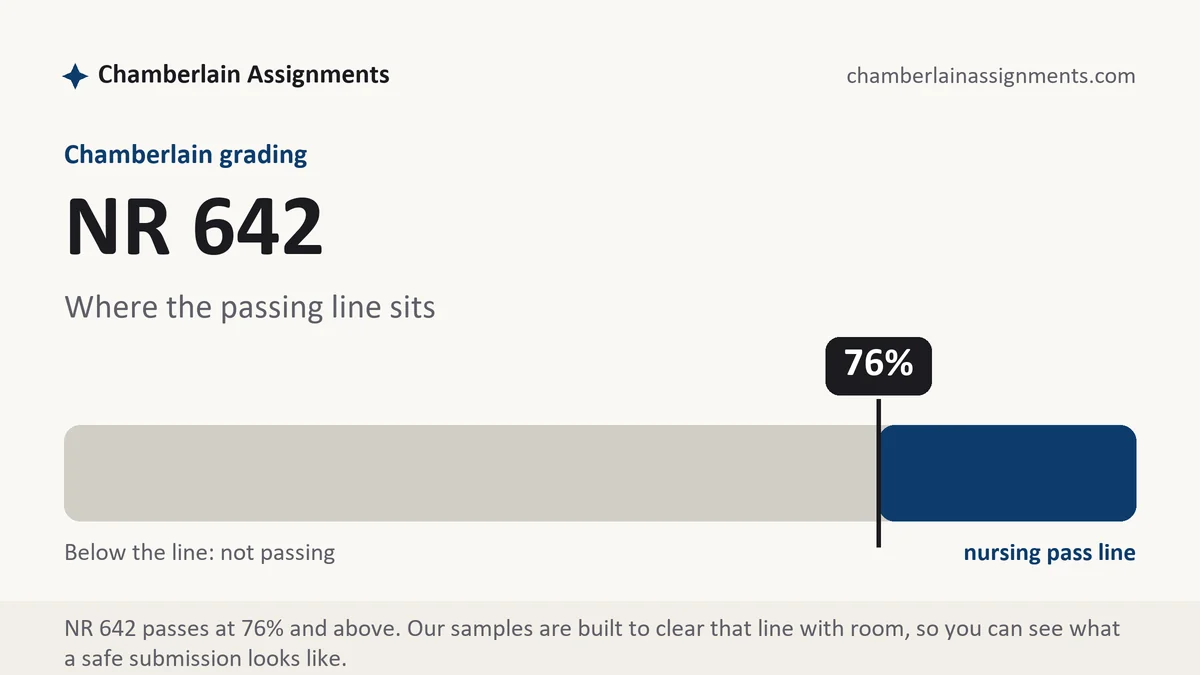
The discipline behind every paper here: the rubric is the outline, each row gets its section, one-shot discussions get the one-shot treatment, and the 76 percent floor is treated as the cliff it is. Send your week's instructions with a request and the sample matches them, revisions included.
NR 642 questions, answered
Can you write my practicum hours or the log my site signs?
No. Hours, logs, evaluations and anything a preceptor or site representative signs are your own record and we do not touch them. What we can model is the written project work around them, so the problem statement, the needs assessment, the process map, the plan and the risk section. Those are the parts a rubric marks as writing.
My site will not let me use their data. What then?
Scope to what you can observe and describe. Counts you generate yourself, timings you take, and what staff tell you in conversation are usually available when reporting output is not, and a project built on them is honest and defensible. Say in the writing what measurement was unavailable and what you used instead, since faculty read that as judgment.
How narrow is narrow enough?
Narrow enough that you can say in one sentence what will be different, for whom, by when, and how you would notice. If that sentence needs an 'and' to hold two changes, you have two projects. Most students who struggle in the second course chose a scope in the first that nobody could have completed.