Send the exact assignment or rubric from your classroom and a custom sample written to it lands in 24 to 48 hours, the first one free. NR 652 is Chamberlain’s Healthcare Policy Concluding Graduate Experience II course. It centers on carrying an approved policy project through execution, evaluation and handover, and writing up what actually happened rather than what was intended. Searches like "nr 652 week 4 assignment example", "NR652 sample paper", and "NR 652 week samples" land on this page.
What NR 652 is really about
The second concluding experience trades planning for contact with reality, and reality has opinions. Staff turn over. The committee meets a week later than promised. The report you were going to pull turns out to live in a system nobody in your department can query. Faculty at this stage are not grading whether everything went smoothly, because it rarely does. They are grading whether you noticed the deviation, recorded it, decided what to do about it, and can explain that decision afterward. A project that changed course for a reason you can state reads far better than one whose write-up pretends the plan ran exactly as written.
The other half of this session is handover. Course work usually ends with something meant to be used by people who will never read your paper: a revised protocol, a recommendation with its approval route attached, a short brief, a presentation to the committee that could adopt it. Writing for that audience is a genuinely different task from writing for a grader, and many sections assess both versions. The question underneath all of it is sustainability. If the change depends on you being there, it ends when the session does, and a graduate-level write-up is expected to say who owns the work next and what would make it stop.
What NR 652’s assessments ask for
Assignments in many sections track the project as it runs. Early weeks often ask for an implementation account with the variances named and dated, which is easy to write if you kept notes and painful if you did not. The middle usually turns to results, and the analysis expected here is modest but honest: what moved, what did not, and what the numbers are too small to tell you. Later work typically produces the outward-facing pieces, the document a committee could act on and the presentation carrying it, plus a reflection connecting the whole thing to the competencies the program claims. Discussions run in parallel and tend to reward specific troubleshooting over encouragement.
Where students lose points in NR 652
The most common problem in a final write-up is the tidied narrative, where obstacles vanish and the results section quietly implies more than the data supports. Faculty read a great many of these and the smoothness itself becomes suspicious. Second is the overclaimed result, a small change over a short period presented as proof the intervention worked, with no mention of everything else happening on the unit at the same time. Third is the deliverable written for the grader instead of the adopting audience, which reads as an academic paper handed to people who wanted a decision. Missing limitations, a result reported with no sense of its size, no plan for what happens after you leave, a presentation that runs long, and a reflection praising the experience without naming one thing learned all draw deductions.
The NR 652 drawers
NR 652 Week 1 discussion post example
Week 1 often asks what has already drifted from the plan you submitted. On request, free, 24-48h.
NR 652 Week 2 implementation log write-up example
Week 2 typically records what was done, when, and what refused to cooperate. On request, free, 24-48h.
NR 652 Week 3 stakeholder update memo example
Week 3 in many sections tells the site what is happening in their own terms. On request, free, 24-48h.
NR 652 Week 4 data collection summary example
Week 4 commonly reports the numbers so far without deciding what they mean. On request, free, 24-48h.
NR 652 Week 5 outcome evaluation example
Week 5 typically compares the ending figure against the baseline and resists overstating it. On request, free, 24-48h.
NR 652 Week 6 policy recommendation document example
Week 6 often produces the short document a committee could actually vote on. On request, free, 24-48h.
NR 652 Week 7 dissemination presentation example
Week 7 in many sections rebuilds the project for an audience that never read it. On request, free, 24-48h.
NR 652 Week 8 reflective synthesis example
Week 8 usually asks what the program actually taught, evidenced rather than asserted. On request, free, 24-48h.
Your classroom shows something else?
Chamberlain University revises courses; week counts and deliverables shift between terms. Send what your classroom shows and the desk matches it exactly.
Using a NR 652 sample the right way
Look at a sample for its limitations section and its results section together, because that pair is where credibility gets won or lost. A strong write-up states the size of what it measured, resists the word proved, and lets a modest finding stay modest. Look also at the handover piece and notice how little of the academic apparatus survives into it, and how much shorter it is than anyone expects. Then write your own version from your own records, since the one thing an example cannot supply is what actually happened in your setting during those eight weeks.
How these samples are written
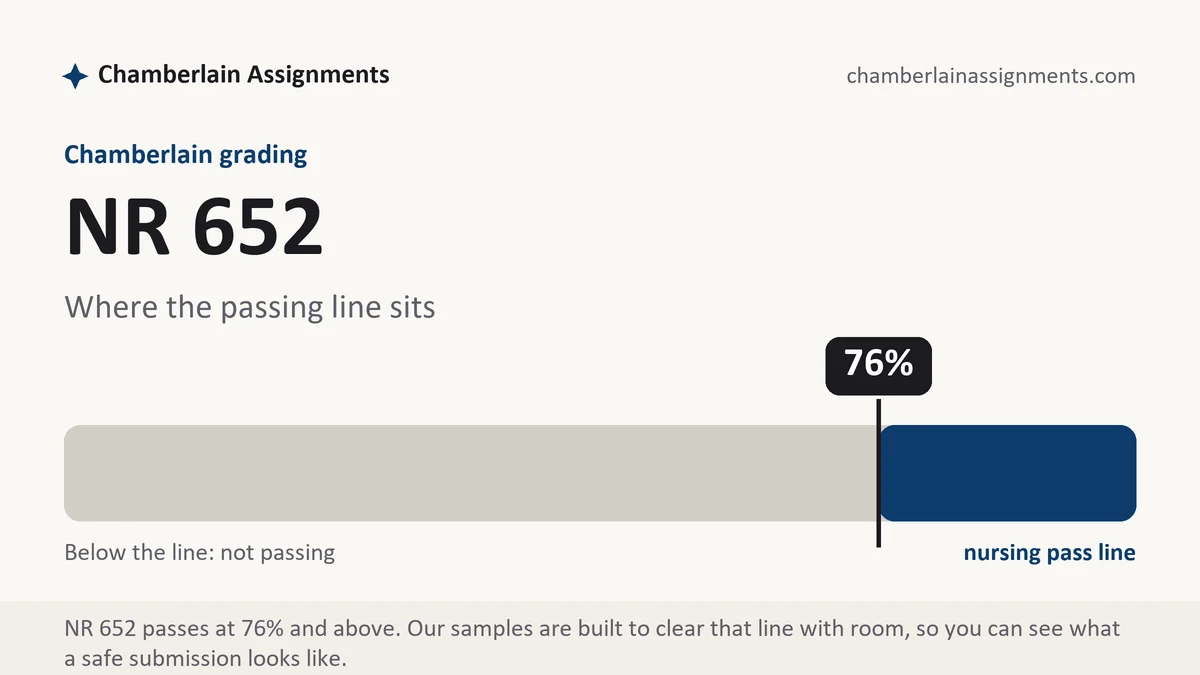
The discipline behind every paper here: the rubric is the outline, each row gets its section, one-shot discussions get the one-shot treatment, and the 76 percent floor is treated as the cliff it is. Send your week's instructions with a request and the sample matches them, revisions included.
NR 652 questions, answered
My results did not show what I expected. Does that hurt the grade?
Not by itself, and pretending otherwise usually does. Faculty grade the reasoning, the execution and the honesty of the reporting, not the direction of the finding. A project that says what happened, offers plausible explanations, and names what it would do differently next time is a stronger document than one claiming an improvement its numbers cannot support.
How different should the committee document be from the paper?
Different enough that they do not look related. The paper carries the full method, the citations and the reasoning. The committee document carries the recommendation, the evidence compressed to what a decision needs, and the workload or cost attached to it. If your one-page version is the paper with paragraphs deleted, it has not been rewritten for its reader yet.
Can you help with the final presentation as well as the paper?
Yes, and sections that grade a presentation usually grade its fit to the audience. Send the instructions, the rubric, any slide template your classroom provides and your results, and the first custom sample comes back free in 24-48h. Speaker notes and structure are modeled; your own hours, site logs and anything you sign stay with you.