Send the exact assignment or rubric from your classroom and a custom sample written to it lands in 24 to 48 hours, the first one free. NR 667 is Chamberlain’s FNP Capstone Practicum and Intensive course. It centers on proving readiness to practice, in writing, by measuring your own cases and gaps against what an entry level provider must do. Searches like "nr 667 week 4 assignment example", "NR667 sample paper", and "NR 667 week samples" land on this page.
What NR 667 is really about
Capstone courses confuse people because they add almost no new material. Everything assessed here was taught somewhere earlier, and the question being asked is different in kind: can you do this without the course scaffolding around you. That shows up in the writing as a shift of subject. Instead of arguing about a patient, you are arguing about your own practice, using patients as evidence. The submissions that go wrong treat that as an invitation to be modest and general, saying that clinical experience was valuable and that confidence grew. Nothing in that can be marked, because it names no encounter, no decision, and no gap that anyone could act on.
Reflective writing that earns marks is specific and slightly uncomfortable. It names a real encounter, states what you did, says what the better decision would have been, and connects that to a competency you are expected to hold on the day you start. Then it says what you did about it afterwards. The other strand of the course is everything nobody teaches in a clinical week: scope of practice in the state you will work in, the credentials and the paperwork that let you bill for what you do, and how you describe your own role to a patient and a practice. Written work on those subjects is marked on accuracy about a real jurisdiction, not on enthusiasm about the profession.
What NR 667’s assessments ask for
Weekly work in many sections moves between case work and self examination. The case side asks you to present a patient the way a colleague would want to hear it: the story in order, the reasoning compressed, the plan defensible, and the literature behind it named where it actually decided something. The self examination side asks for evidence rather than sentiment, so an assignment about a gap wants the encounter that revealed it and the concrete thing you did next. Discussions early in the week often circle practice questions with no clean answer, and they reward a position taken and defended. Nothing in a capstone practicum record, from hours to preceptor evaluations, is written by anyone but you.
Where students lose points in NR 667
The signature loss is the reflection with no self in it. Writing that describes what a competent provider should do, in the third person, avoids the only question the assignment asked. Second is the gap admitted and then abandoned, where a weakness is named with nothing said about what changed afterwards, which reads as a confession rather than a plan. Third is the case presentation that never lands: a patient described at length with the reasoning implied and the decision buried, when the point of the exercise is to be understood quickly by someone who was not there. Vague future intentions, sources cited to decorate a claim about your own practice, and answers about scope that ignore the actual state you will work in also cost points.
The NR 667 drawers
NR 667 Week 1 self assessment write-up example
Week 1 typically starts with an honest inventory of what you can already do. On request, free, 24-48h.
NR 667 Week 2 discussion post example
Week 2 often opens a practice question that has no comfortable answer. On request, free, 24-48h.
NR 667 Week 3 case presentation example
Week 3 in many sections asks for one patient presented as a colleague would hear it. On request, free, 24-48h.
NR 667 Week 4 board style case analysis example
Week 4 commonly works a case under the pressure of limited information. On request, free, 24-48h.
NR 667 Week 5 practice readiness write-up example
Week 5 typically measures your recent cases against what an entry level provider handles. On request, free, 24-48h.
NR 667 Week 6 professional issues brief example
Week 6 often turns to scope, credentialing and the rules of the state you enter. On request, free, 24-48h.
NR 667 Week 7 portfolio reflection example
Week 7 in many sections gathers evidence of competence into one written account. On request, free, 24-48h.
NR 667 Week 8 capstone synthesis paper example
Week 8 usually asks what the whole program added up to in practice. On request, free, 24-48h.
Your classroom shows something else?
Chamberlain University revises courses; week counts and deliverables shift between terms. Send what your classroom shows and the desk matches it exactly.
Using a NR 667 sample the right way
A sample is worth more here for structure than for content, because the content has to be your own practice. Read one to see how an encounter is compressed into a presentation without losing the decision, how a gap is stated in one sentence and then answered with an action, and how a competency is referenced without the writing turning into a list of them. Then write from your own hours and your own cases, which is the only material this course accepts. What you take from the sample is the register: direct, specific, and willing to say what went wrong.
How these samples are written
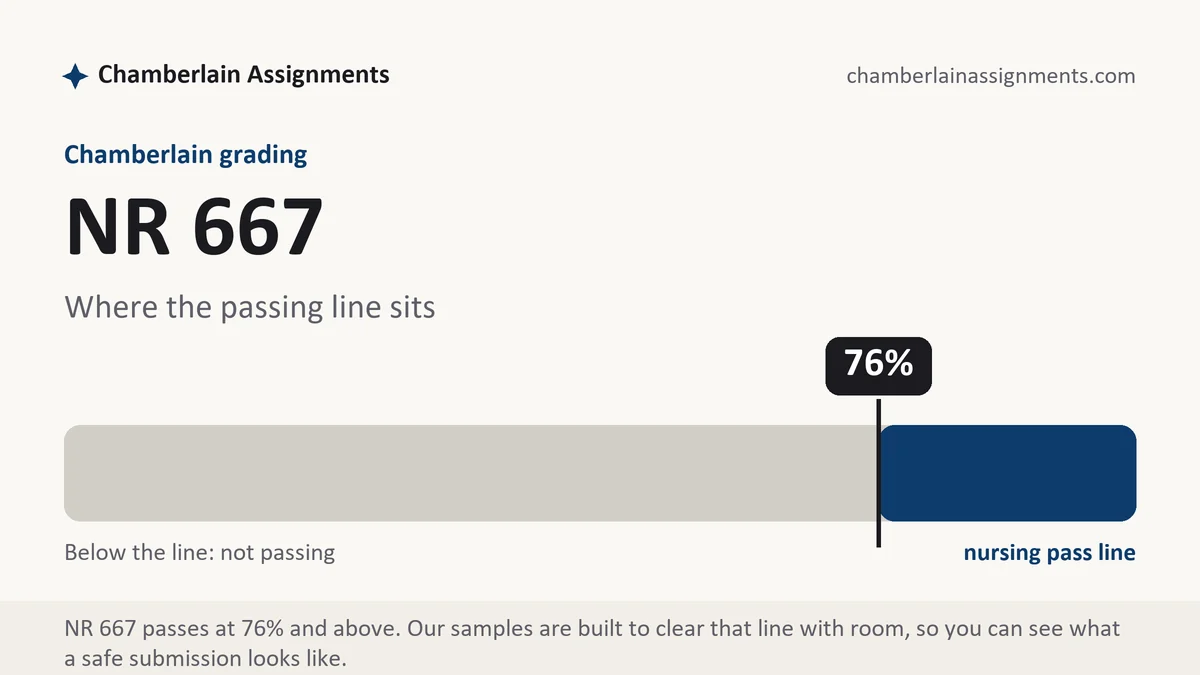
The discipline behind every paper here: the rubric is the outline, each row gets its section, one-shot discussions get the one-shot treatment, and the 76 percent floor is treated as the cliff it is. Send your week's instructions with a request and the sample matches them, revisions included.
NR 667 questions, answered
Can you write my capstone reflection if I send my case list?
A sample can be built around the kind of case you describe, and it will show the shape a strong reflection takes. It cannot be your reflection, because the encounters, the hours and the evaluations behind them are records only you hold. Send an outline of what happened and the sample gives you a model to write your own against.
How specific should a weakness be?
Specific enough to be fixable. A statement about needing more confidence gives a grader nothing, while an admission that you were slow to recognize one presentation, followed by the reading and the encounters you sought afterwards, is exactly what the assignment is built to reward. Naming a limit is treated as maturity here rather than as a mark against you.
The intensive portion feels separate from the written work.
It usually is not. Most sections expect what happens in the intensive to appear in the writing afterwards, as cases you can present, questions you answered under time pressure, and gaps the experience exposed. Treating it as an event to get through and the assignments as paperwork alongside it is the reading that costs the most points in the final weeks.