Send the exact assignment or rubric from your classroom and a custom sample written to it lands in 24 to 48 hours, the first one free. NR 669 is Chamberlain’s Advanced Nursing Role Immersion Part 3 course. It centers on the final stretch of an immersion, where the written work has to show what standing in the role taught you that reading could not. Searches like "nr 669 week 4 assignment example", "NR669 sample paper", and "NR 669 week samples" land on this page.
What NR 669 is really about
This page has to be careful, because a course numbered as a third part is not one course. Immersion sequences differ by track, by cohort and by what the earlier parts already covered, so the deliverables in your section may look nothing like the deliverables in somebody else's. Two things are usually true anyway. The first is that a Part 3 sits at the end, which means it inherits objectives set earlier and is measured against them rather than starting fresh. The second is that immersion writing is evidence of judgment formed in a setting, so the classroom keeps asking what you saw, what you did in response, and what you now think differently.
There is a line in this course that we do not cross, and it is worth stating before anything else. Immersion hours, the log you keep, the evaluations a preceptor or site completes, and any form somebody signs are your record of your own presence in a setting. Nobody else can produce them and we do not try. What can be worked on is the writing that sits beside them: the analysis of a situation you observed, the plan you are carrying forward, the account of what changed and what did not, the piece you present at the end. Those are arguments, and arguments can be modeled. Attendance cannot.
What NR 669’s assessments ask for
What a section asks for varies more here than anywhere else in the program, so treat the following as a shape rather than a schedule. Early weeks commonly revisit the objectives carried in from the earlier parts and ask whether the setting can still deliver them, which sometimes produces a renegotiation. Middle weeks usually want analysis of something happening in front of you, written so a reader who has never been to the site can follow the sequence and the decision. Later weeks often ask for an account of the whole immersion against what was planned, and many sections close with a presentation or paper for an audience outside the placement. Discussions run early in the week in many sections and tend to ask what surprised you.
Where students lose points in NR 669
The commonest weakness is the diary. Week after week of what happened, honestly written, with nothing in any entry that says why it mattered or what it changed about your thinking, and the analysis rows stay blank. Second is the immersion reported as uniformly successful, where the site was welcoming, the preceptor generous and every objective met on time, which faculty read as an account that has left things out. Third is the objective quietly abandoned, still listed at the start and never mentioned again, when saying it became impossible and explaining why would have marked better. Observations with no consequence, reflection that repeats the same insight weekly, and a closing piece that describes activity rather than showing judgment leave a strong placement looking ordinary on paper.
The NR 669 drawers
NR 669 Week 1 discussion post example
Week 1 typically asks what you are carrying into this part from the last. On request, free, 24-48h.
NR 669 Week 2 immersion objectives review example
Week 2 often checks whether the setting can still deliver what was agreed earlier. On request, free, 24-48h.
NR 669 Week 3 setting and role analysis example
Week 3 usually describes where you are placed and what the role does there. On request, free, 24-48h.
NR 669 Week 4 reflective practice analysis example
Week 4 in many sections asks what one situation changed about your thinking. On request, free, 24-48h.
NR 669 Week 5 progress brief example
Week 5 commonly reports what has moved and what has quietly stalled. On request, free, 24-48h.
NR 669 Week 6 evidence and application write-up example
Week 6 generally asks what published work supports something you watched happen. On request, free, 24-48h.
NR 669 Week 7 outcome and impact summary example
Week 7 frequently accounts for the immersion against the objectives it started with. On request, free, 24-48h.
NR 669 Week 8 immersion synthesis paper example
Week 8 often closes with the whole placement argued for readers outside it. On request, free, 24-48h.
Your classroom shows something else?
Chamberlain University revises courses; week counts and deliverables shift between terms. Send what your classroom shows and the desk matches it exactly.
Using a NR 669 sample the right way
Because the deliverables differ so much, the useful thing to take from these samples is the register. Notice how an observation is written so that it arrives with a consequence attached, how the writer separates what was seen from what was inferred, and how a difficulty is reported without either excusing it or dramatizing it. Notice too how short the descriptive parts are. Then write your own from the setting you are actually in, because everything of value in an immersion is local, and send the assignment instructions along with it, since a Part 3 in your track may ask for something this page cannot anticipate.
How these samples are written
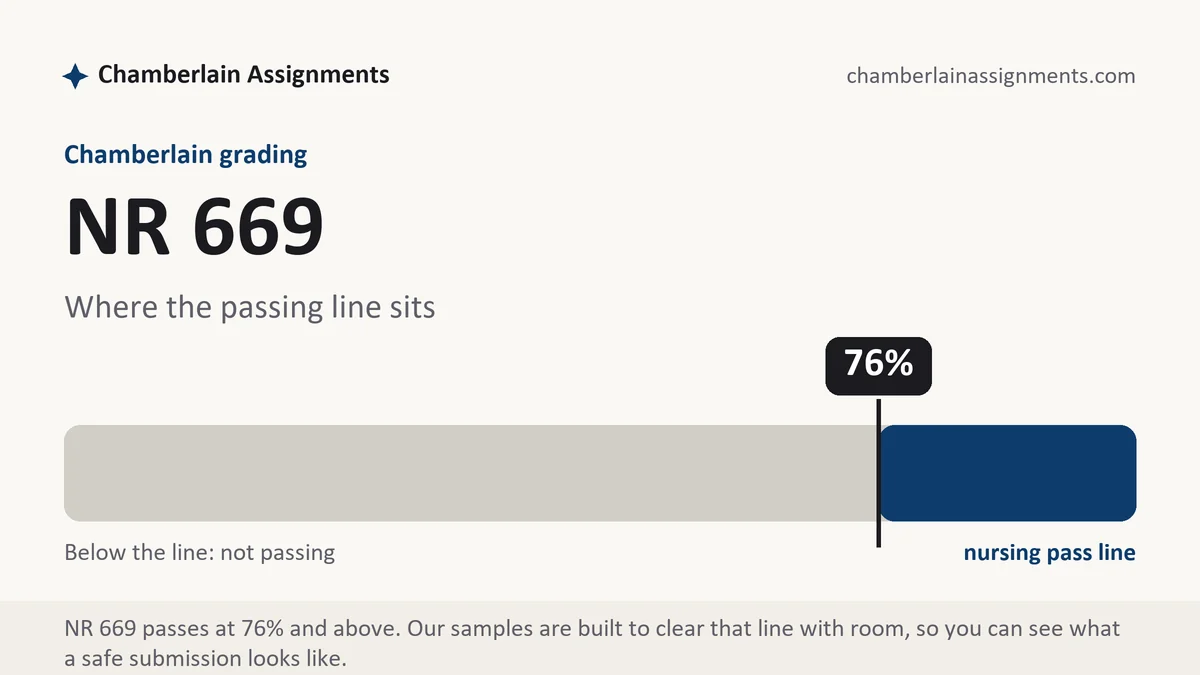
The discipline behind every paper here: the rubric is the outline, each row gets its section, one-shot discussions get the one-shot treatment, and the 76 percent floor is treated as the cliff it is. Send your week's instructions with a request and the sample matches them, revisions included.
NR 669 questions, answered
There are no pages here for Parts 1 and 2.
Correct, and that is deliberate rather than an oversight. Immersion sequences vary enough between tracks that writing a page about an earlier part would mean guessing at its contents. Send what your classroom shows for this part and the work is built to that. If the earlier parts produced something you are carrying forward, send that too.
Can somebody complete my immersion hours or the paperwork around them?
No, and nobody should offer to. Hours, logs, site agreements and preceptor evaluations are records of your presence and somebody else's assessment of you, and they belong entirely to you and your program. The written analysis that sits alongside them is a different thing, and that is what a sample models.
My placement is not going the way it was planned.
Say so in the writing, in the section where it belongs, with what you did about it. An immersion that changed direction is ordinary and reporting it accurately usually marks better than a smooth account, because the analysis has something to work on. Speak to your faculty about anything affecting hours or objectives; that part is not a writing problem.