Send the exact assignment or rubric from your classroom and a custom sample written to it lands in 24 to 48 hours, the first one free. NR 707A is Chamberlain’s DNP Project & Practicum III course. It centers on the change actually running on a unit, and the gap between the plan written last term and the data that arrives while it runs. Some program versions carry this course as NR 707B and NR 707C; the same drawers apply. Searches like "nr 707a week 4 assignment example", "NR707A sample paper", and "NR 707A week samples" land on this page.
What NR 707A is really about
Nothing in the first two terms prepares a writer for how differently implementation reads. A design is tidy because it is hypothetical; a rollout has dates, a nurse who was on vacation the week it started, a tool that was printed wrong, and a first month of data that arrives in the wrong format. Term three writing has to hold all of that without apologizing for it. Faculty are not looking for a clean run, because clean runs do not exist. They are looking for a record accurate enough that someone could reconstruct what happened from the pages alone, months later.
The second thing this term teaches is that data has a character before it has a meaning. Half the records are missing a field; the audit sample turns out to include a shift that does not use the workflow; two weeks of entries were made by one person and the rest by nobody. Describing that, early and in writing, is what separates a project that can defend its results from one that cannot. This is also the term where the practicum documentation itself becomes a graded deliverable, because the hours have to be accounted for alongside the work they produced and the competencies they touched.
What NR 707A’s assessments ask for
Assignments in this term are mostly records. Early weeks commonly ask for the rollout itself written out in sequence: the date the change started, who was trained and when, what was handed out, and which unit or shift went first. The middle of the term usually asks for deviations, since almost every project departs from its design, and faculty want the departure named along with the reason and the effect. Many sections ask for a midpoint look at the numbers, and for a separate account of data quality: what is missing, what is duplicated, what cannot be trusted. Later weeks often ask for staff feedback gathered in writing, the practicum record, and a progress report delivered to faculty.
Where students lose points in NR 707A
The most expensive mistake in term three is the future tense. An implementation section that says what will be done, in a term whose work is already half over, tells faculty the rollout has not started. Second is the deviation nobody mentions: a reader who later finds a two-week gap in the data and no explanation for it stops trusting the rest. Third is the midpoint number presented as a result, with a percentage over a denominator of eleven and a claim attached. Feedback summarized as positive, a practicum record listing hours against no deliverable, and a progress report that repeats the design instead of reporting against it all cost points.
The NR 707A drawers
NR 707A Week 1 discussion post example
Week 1 often opens on what start-up looked like in the first days. On request, free, 24-48h.
NR 707A Week 2 rollout narrative example
Week 2 typically asks for the sequence: dates, training, and who went first. On request, free, 24-48h.
NR 707A Week 3 protocol deviation memo example
Week 3 commonly asks what departed from the design and what it cost. On request, free, 24-48h.
NR 707A Week 4 midpoint data summary example
Week 4 in many sections asks what the numbers look like so far. On request, free, 24-48h.
NR 707A Week 5 missing data memo example
Week 5 usually asks which records are incomplete and how that was handled. On request, free, 24-48h.
NR 707A Week 6 staff feedback write-up example
Week 6 often asks what the people doing the work reported back. On request, free, 24-48h.
NR 707A Week 7 practicum log narrative example
Week 7 typically asks for hours tied to deliverables and competencies, in the writer's own entries. On request, free, 24-48h.
NR 707A Week 8 committee progress presentation example
Week 8 commonly asks for a status report delivered against the original plan. On request, free, 24-48h.
Your classroom shows something else?
Chamberlain University revises courses; week counts and deliverables shift between terms. Send what your classroom shows and the desk matches it exactly.
Using a NR 707A sample the right way
Read a term three example for dates. Implementation writing that carries specific days, counts and names reads as real, and the same passage with those removed reads as a plan, which is exactly the note faculty write in the margin. Look at how a deviation is reported: stated first, explained second, and followed by what it did to the numbers rather than by a defense of the original design. The entries in a practicum record, the feedback from staff and every figure in the midpoint summary have to come from your own site; an example carries the shape and the register, never the content.
How these samples are written
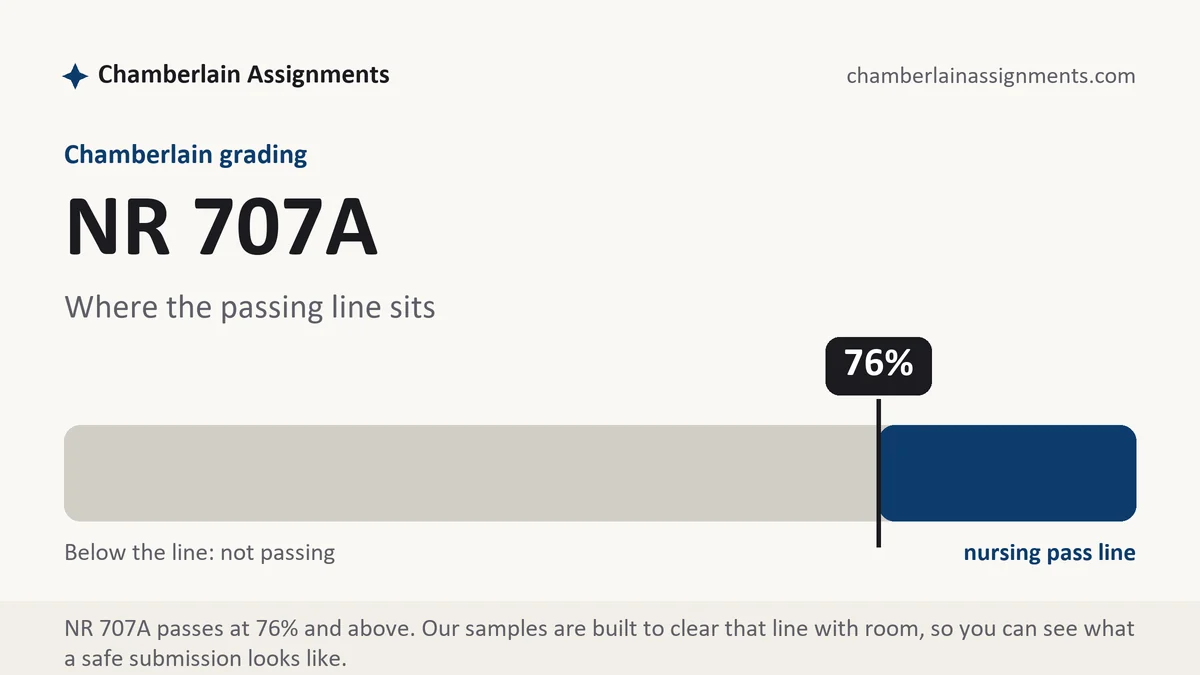
The discipline behind every paper here: the rubric is the outline, each row gets its section, one-shot discussions get the one-shot treatment, and the 76 percent floor is treated as the cliff it is. Send your week's instructions with a request and the sample matches them, revisions included.
NR 707A questions, answered
Can you complete my practicum log or hours record?
No. Hours, dates, activities and anyone's sign-off belong to the writer and to the site, and a record filled in by someone else is worthless to a faculty reviewer and worse than that to a program. What a sample shows is what a complete entry contains, how activity is tied to a competency, and how the narrative around the record is marked.
My implementation fell apart halfway. Is that reportable?
It is the report, and faculty read it more carefully than a smooth one. A project that stalled in week four has a cause, a date and a consequence, and describing all three is doctoral work. The version that loses points is the one written as though the design ran as printed while the data plainly says otherwise.
How is this different from the implementation section in NR 730?
NR 730 assembles the finished document, so its implementation section is written once, at the end, in the past tense. This term produces the material that section is later built from: dated rollout notes, deviation memos and midpoint data described while it is still arriving and still incomplete.