Send the exact assignment or rubric from your classroom and a custom sample written to it lands in 24 to 48 hours, the first one free. PA-532 is Chamberlain’s Surgical and Clinical Skills course. It centers on procedures and the period around them: indication, consent, the order of the steps, and what the timing of a complication means. Searches like "pa 532 week 4 assignment example", "PA532 sample paper", and "PA-532 week samples" land on this page.
What PA-532 is really about
Surgical and Clinical Skills sits at the point where thinking becomes doing. Its first question is not which operation but whether an operation is warranted at all, and the readings put real weight there: the patient who will not benefit, the patient too unwell to tolerate it, the alternative nobody offered. From there the course moves to the conversation that precedes anything invasive, where risks, benefits and alternatives have to be said in a form the person can repeat back. Bedside work follows, and it is procedural in the plain sense, meaning a fixed order carried out the same way every time. Sterile technique and local anesthesia belong to that stretch, and so does knowing when to stop.
The back half belongs to the period after, which is where most of the marking sits. Recovery has a calendar. A fever on the second day is a different problem from a fever on the seventh, pain that changes character means something other than pain that simply persists, and the assignments are built around that timing. Wound behavior, fluid balance, return of bowel function, and the moment a finding stops being expected and becomes a reason to call someone all get a week somewhere in the session. You are also writing for the next clinician, since the record of a procedure is what travels with the patient. Everything else about the day will have been forgotten by the time somebody needs it.
What PA-532’s assessments ask for
Assignments in this course arrive in three registers. The first is a decision piece: given a patient and a problem, argue that the procedure is indicated or that it is not, against the alternatives including doing nothing at all. The second is procedural writing, where marking falls on order and completeness rather than on prose, and a missing step reads as a missing thought. A consent conversation is usually written out in full somewhere in the session, in words a patient could follow. The last register belongs to the later weeks, where a case unfolds by day and you are asked what the timing of a finding suggests and at which point you would escalate. Weekly posts carry visible points.
Where students lose points in PA-532
Points go first on indication. A paper describing an operation in confident detail without ever arguing that it was the right thing to do has answered a question nobody asked. Consent sections lose marks when they list risks and omit the alternatives, including the alternative of no procedure at all, or when they sit in a register no patient could follow. Procedural descriptions lose marks on order: a step out of place, or a sequence with no decision points anywhere inside it, reads as memorized rather than understood. The later sections fail most often by describing an uneventful recovery, or by naming a complication without the day it appeared, since the day carries most of the reasoning. Vague escalation language costs the remainder.
The PA-532 drawers
PA-532 Week 1 discussion post example
Week 1 usually asks where your own limits sit before you have done any of this. On request, free, 24-48h.
PA-532 Week 2 surgical indication brief example
Week 2 commonly gives a patient and asks whether the operation is warranted at all. On request, free, 24-48h.
PA-532 Week 3 preoperative risk summary example
Week 3 often assembles what makes this particular person a harder case than the procedure alone suggests. On request, free, 24-48h.
PA-532 Week 4 informed consent script example
Week 4 in many sections wants the conversation written out, alternatives included, in plain words. On request, free, 24-48h.
PA-532 Week 5 procedure step sequence example
Week 5 typically asks for the order itself, with every point where a decision is made marked. On request, free, 24-48h.
PA-532 Week 6 wound closure rationale example
Week 6 frequently asks why this closure, this material and this follow-up interval. On request, free, 24-48h.
PA-532 Week 7 postoperative day plan example
Week 7 generally lays out the first several days afterward, one day at a time. On request, free, 24-48h.
PA-532 Week 8 complication timeline analysis example
Week 8 often gives a finding and a day number, then asks what the timing narrows it to. On request, free, 24-48h.
Your classroom shows something else?
Chamberlain University revises courses; week counts and deliverables shift between terms. Send what your classroom shows and the desk matches it exactly.
Using a PA-532 sample the right way
Use an example to find where the argument sits inside procedural writing. The step list is the easy part and it is not what separates a strong paper; look instead at the sentence saying why this patient and why now, and at the places where the writer marks a decision rather than an action. In the later sections, watch how a day number is attached to every finding. The patients are invented, so nothing real is carried anywhere, and the sample is a reference rather than a submission. Send the prompt with any procedure checklist your section supplies and the first sample is free.
How these samples are written
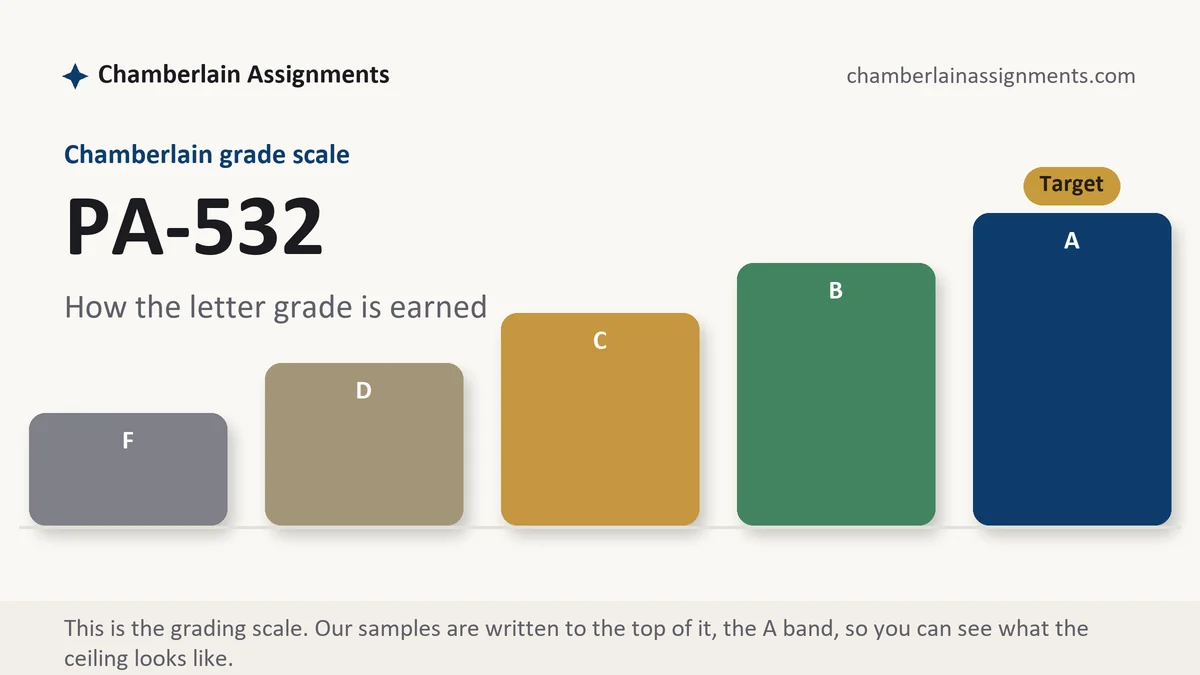
The discipline behind every paper here: the rubric is the outline, each row gets its section, one-shot discussions get the one-shot treatment, and the 76 percent floor is treated as the cliff it is. Send your week's instructions with a request and the sample matches them, revisions included.
PA-532 questions, answered
I have never seen this operation. Can I still write the procedure section?
Yes, because the assignment is not asking you to perform it. What gets marked is whether the sequence is in the right order, whether the decision points inside it are visible, and whether the description matches the source your section assigned. Send that source along with the prompt and the sample follows it rather than some general account picked up elsewhere.
Is the consent assignment a legal exercise or a clinical one?
It is graded as a clinical conversation, even though the elements come from a legal standard. Faculty look for risks, benefits, alternatives and the option of declining, all said in language a patient could repeat back, plus a check that they understood. A paragraph reading like a form rather than a conversation loses marks even when every required element is present in it.
My prompt only covers the procedure. Does the sample include the days after?
Only if you want it to. The desk builds to the prompt, so a procedure-only assignment comes back procedure-only and the recovery material stays out unless your instructions ask for it. If you are unsure which reading your prompt supports, send it exactly as written and the reply will say which one the rubric points at before anything is drafted.