Send the exact assignment or rubric from your classroom and a custom sample written to it lands in 24 to 48 hours, the first one free. POLI-330N is Chamberlain’s Political Science course. It centers on political science in general: founding design, the split with the states, elections and the bench, with authority located before argument begins. Searches like "poli 330n week 4 assignment example", "POLI330N sample paper", and "POLI-330N week samples" land on this page.
What POLI-330N is really about
This shelf holds the general course, which matters because the site also carries six health policy shelves and two graduate ones, and their assignments look nothing like these. Here the material is the founding design and how it parcels out power, the split of labor between one national government and fifty others, what each branch can accomplish without help, how citizens vote and organize and press, and what the bench does with all of it. A public problem shows up only as something for those bodies to handle. Aim a remedy at a government with no authority over the matter and the first marked row is gone, along with the credibility of everything after it.
Participation occupies much of the rest. Ballots, campaigns, party machinery, organized interests and a direct approach to somebody holding office are all treated as machinery with results you can observe, and assignments frequently want the register a real channel uses instead of an essay. Two conventions sit underneath everything. A law passed by a legislature, a rule written by an agency and an opinion issued from a bench are three separate instruments doing three separate things. And a figure with no year on it establishes nothing, because money and eligibility get rewritten every session. Both of those are separately marked. Neither is hard to satisfy once the instrument gets named on first mention and the year travels attached to the figure.
What POLI-330N’s assessments ask for
The term opens on institutions: an essay on one founding principle and the failure it was engineered against, or a side-by-side of what a state may do against what only the national government may. It then turns procedural, tracking a genuine proposal through both chambers with its actual status named at each point, or reading an opinion for what it decided rather than for who won. Later assignments want alternatives: two or three that could really happen, each carrying a price, somebody who gains and somebody who blocks, measured against standards you committed to first. Many sections finish with correspondence to an officeholder. Discussion posts are worth points every week and no editing is possible afterward.
Where students lose points in POLI-330N
A remedy pointed at a government lacking the power to deliver it is the standard loss, and it follows from never asking the authority question. Reproducing one party's material as though it were analysis is the second, since every real dispute has structured arguments on more than one side of it. A figure carrying no year is the third, because a claim about the present cannot rest on a number from a previous session. Omitting the option of changing nothing is the fourth, and that option wins by default more often than any other. Calling a rule a law, or an opinion either, empties the institutional row on its own. So does treating something merely introduced as though it were already in force.
The POLI-330N drawers
POLI-330N Week 1 discussion post example
Week 1 usually opens on what government is for and which model the founding document chose. On request, free, 24-48h.
POLI-330N Week 2 constitutional principles essay example
Separation of powers, checks and the amendment route, written as what the design was built to prevent. On request, free, 24-48h.
POLI-330N Week 3 federalism comparison paper example
What a state may do beside what only the national government may do, with the shared middle named. On request, free, 24-48h.
POLI-330N Week 4 bill to law write-up example
One real proposal followed through the chambers, with introduced, passed and in force kept apart. On request, free, 24-48h.
POLI-330N Week 5 voter participation analysis example
Turnout, registration rules and who actually votes, argued from figures that carry a year. On request, free, 24-48h.
POLI-330N Week 6 court ruling write-up example
A ruling read for its holding and its reasoning rather than for the side it favored. On request, free, 24-48h.
POLI-330N Week 7 government options memo example
Two or three real alternatives on a public problem, each with a cost, a beneficiary and a barrier. On request, free, 24-48h.
POLI-330N Week 8 constituent letter draft example
Plenty of sections end the term with a letter to an elected official; we draft it and you send it. On request, free, 24-48h.
Your classroom shows something else?
Chamberlain University revises courses; week counts and deliverables shift between terms. Send what your classroom shows and the desk matches it exactly.
Using a POLI-330N sample the right way
Order is what the example supplies. These assignments come apart in sequence rather than in prose: the preferred answer gets written first and the evidence is recruited afterward to agree with it. A finished sample shows the standards committed to on the page before any alternative is weighed, changing nothing sitting in the list as a genuine entry, and the closing preference admitting the standard it fails. Read the correspondence for register, which runs shorter and flatter than an essay. We do not contact any office or officeholder for you. The draft leaves under your own name, and the sample is cut to the prompt and the rubric your section published.
How these samples are written
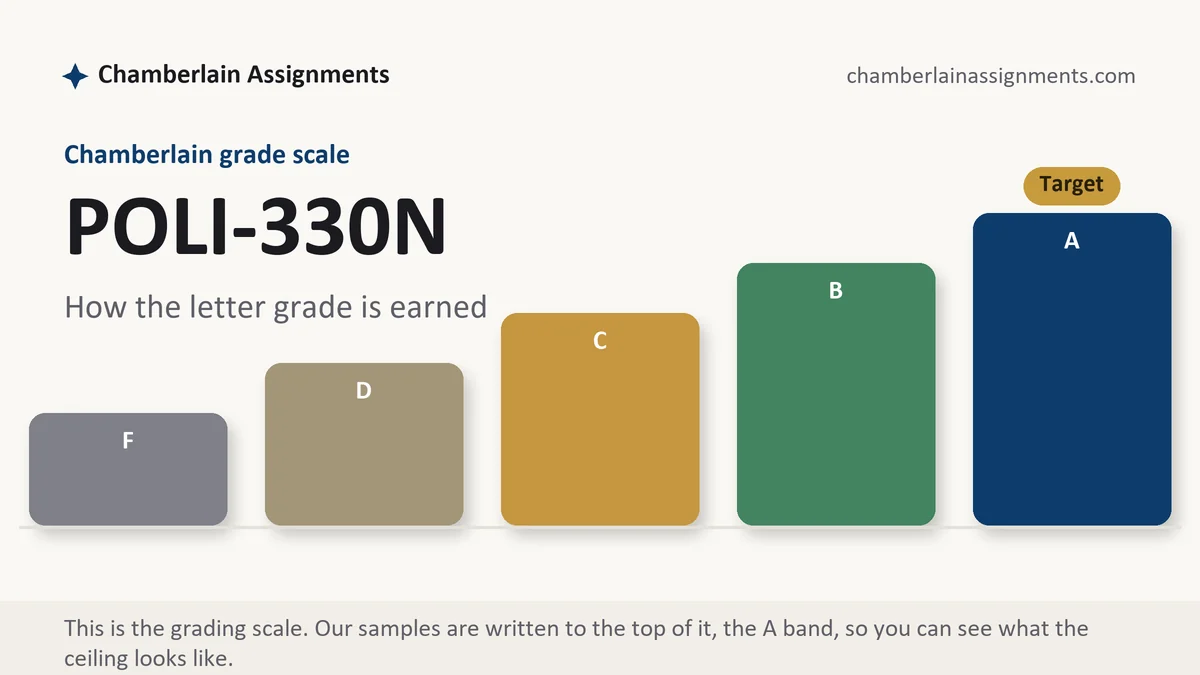
The discipline behind every paper here: the rubric is the outline, each row gets its section, one-shot discussions get the one-shot treatment, and the 76 percent floor is treated as the cliff it is. Send your week's instructions with a request and the sample matches them, revisions included.
POLI-330N questions, answered
My section assigned the issue. Will the sample match?
Send it alongside the prompt and the example is cut to that issue, which matters more on this shelf than on most, because the authority question resolves differently for every subject. An issue sitting with the states produces an entirely different set of alternatives from one sitting nationally, and an example resting on the wrong one answers a question your section never asked.
The assignment is a letter, not a paper. Can you do that?
Yes, and it is a different register worth seeing done. A letter to somebody in office runs shorter, flatter and organized around one request rather than around a thesis. We draft it and you send it; we do not contact any office, agency or officeholder on your behalf, so what leaves your hands leaves under your own name.
Is this the same as the health policy shelves here?
No. Those are built for people who will work inside health systems, and they examine coverage, payment and delivery from the inside. This one is the general course: institutions, participation and the route a proposal travels through them, with whatever public problem you chose acting as an illustration. Send this course's prompt and the sample is built to it.