Send the exact assignment or rubric from your classroom and a custom sample written to it lands in 24 to 48 hours, the first one free. UNIV-103 is Chamberlain’s University Seminar III course. It centers on the third and widest seminar, where a position on conduct is argued and any figure brought into the argument has to survive checking. Searches like "univ 103 week 4 assignment example", "UNIV103 sample paper", and "UNIV-103 week samples" land on this page.
What UNIV-103 is really about
University Seminar III carries four subjects on one credit: chemistry, medical terminology, the conduct expected of a nursing student, and a foundation in probability and statistics. The width shows up in the writing, where a submission frequently has to hold a position about conduct and a quantitative claim in the same short document without either half undermining the other. Disciplined judgment is what earns the marks: a position put plainly, reasons that survive pressure, and any figure treated with the honesty the topic requires. As the last of the three seminars it assumes the sourcing habits built in the second rather than rebuilding them.
The course catches people on what qualifies as reasoning. An opinion with a citation stapled to it is not an argument. An argument is a claim, the standard the claim leans on, and the work of bringing that standard to bear on the particular facts, and losing that middle piece drops the paragraph back to preference, which any grader can identify without special training. Numbers are held to a matching discipline. Foundational probability inside a nursing seminar is largely defensive: knowing what a rate is measured against, seeing that twice a small risk remains a small risk, and declining to write likelihood as though it were certainty.
What UNIV-103’s assessments ask for
The signature piece is a short position response whose parts stay predictable while the scenario does not. Two or three facts that genuinely drive the decision are pulled clear of the ones that are only scenery. A stance arrives in one sentence, worded so that disagreement is possible. Then the standard or professional expectation underneath it, cited as the document it is rather than paraphrased loosely. Then the application, the sentence carrying that standard onto these facts, where the marks concentrate. Then the opposing case at its strongest, answered instead of waved away. Then an action pitched at what a student could genuinely do. Classroom posts run weekly for points. Terminology is marked alongside all of it.
Where students lose points in UNIV-103
Retelling the scenario wastes the most, because the grader wrote it and every summarizing sentence is one taken from a weighted row. Declining to decide comes next, since even-handedness is not a stance and most rubrics carry a row that nothing but a stated position satisfies. Quoting a standard without applying it leaves out the application sentence, and the application sentence held the marks. A statistic hung on the page carrying no base, no window and no citation weakens whatever it was recruited to strengthen. Beating a feeble version of the opposing case advertises that the hard part was skipped. And bending a figure toward your own conclusion, in a course partly about integrity, is a wound you inflicted yourself.
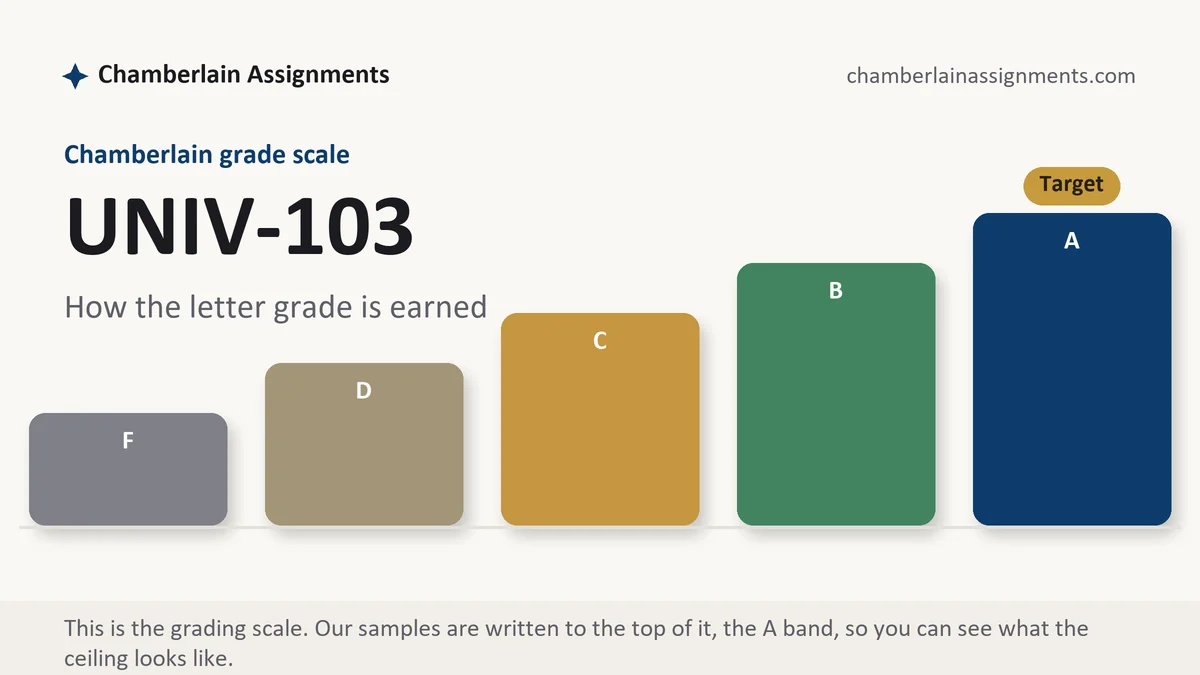
The UNIV-103 drawers
UNIV-103 Week 1 discussion post example
Week 1 typically opens on what professional conduct asks of a student, before any scenario arrives. On request, free, 24-48h.
UNIV-103 Week 2 position response example
Week 2 frequently wants a stance taken in one sentence and defended through the rest of the piece. On request, free, 24-48h.
UNIV-103 Week 3 professional conduct scenario example
Week 3 most often supplies a situation from student life and asks what you would actually do. On request, free, 24-48h.
UNIV-103 Week 4 principle application paragraph example
Week 4 generally turns on the sentence joining a named standard to the facts you were handed. On request, free, 24-48h.
UNIV-103 Week 5 counterargument write-up example
Week 5 often asks for the other side put at full strength and then answered. On request, free, 24-48h.
UNIV-103 Week 6 relative and absolute risk note example
Week 6 usually sets a doubled chance against the absolute figures sitting underneath it. On request, free, 24-48h.
UNIV-103 Week 7 code citation exercise example
Week 7 commonly asks you to quote a code or policy clause and cite it as the document it is. On request, free, 24-48h.
UNIV-103 Week 8 probability interpretation note example
Week 8 in many sections closes on a likelihood read carefully, with what it is relative to said out loud. On request, free, 24-48h.
Your classroom shows something else?
Chamberlain University revises courses; week counts and deliverables shift between terms. Send what your classroom shows and the desk matches it exactly.
Using a UNIV-103 sample the right way
An example pays for itself by showing what a genuine decision looks like at student scale. Read a sample for how little space the position occupies and how much goes to the justification, which reverses the way most sections write it. Read the objection paragraph for an opposing case built at full strength before it is met. Read the ending for an action a reader can picture: the person you would speak to, the thing you would write down, the request you would refuse. Read any figure for the clause admitting what the number does not settle.
How these samples are written
Every sample on this chart is written the way the custom ones are: the rubric decoded row by row, discussion samples sized for posts that cannot be edited after they land, templates filled field by field. Chamberlain revises classrooms; a custom request is always written to the rubric in YOUR course, never from a stale template.
UNIV-103 questions, answered
How does a sample handle a standard it does not fully accept?
It questions how the standard reaches this particular case, which is the reasoning that earns marks, rather than discarding it as inconvenient. The rule is set out accurately, the reason it exists is granted, and then the argument runs that this case sits outside what it was written for, or that two duties are pulling against each other here. Disagreement with no engagement reads as an unread source.
How does a figure get into an argument without being overstated?
With its base and its stretch of time attached, and a following clause saying what it leaves unsettled. The share affected within the group studied is reported, then the note that the figure belongs to that group and may not carry over. Fifteen words of that shuts down the objection graders raise most, which is evidence stretched to fit a conclusion.
What does the example do when every option in the scenario is bad?
It says so plainly and then decides anyway, since deciding under conflict is what the exercise tests. The two duties running into each other are identified, the grounds for putting one first are given, and the piece states what would be done to contain the damage on the side set aside. Reasoning and objection are both answered by that shape.