Send the exact assignment or rubric from your classroom and a custom sample written to it lands in 24 to 48 hours, the first one free. UNIV-201 is Chamberlain’s University Seminar - Foundational Nursing Concepts 1 course. It centers on the first concept seminar, where the shared pattern behind many conditions has to reach the page with its connections named. Searches like "univ 201 week 4 assignment example", "UNIV201 sample paper", and "UNIV-201 week samples" land on this page.
What UNIV-201 is really about
Everything this seminar marks sits on the joins. Its four areas are taught as patterns rather than as illnesses, which is the decision the whole curriculum rests on: oxygenation and perfusion, homeostasis, and health and wellness are each a shape that dozens of separate conditions take turns filling. Because the shape is what transfers and the illness is not, the rows reward a document showing how the pieces act on one another and pay very little for the pieces themselves. The seminar is worth one credit across eight weeks and sits under a load of much larger courses, so all of that has to happen in very few words.
Read the course as an academic one and the marking stops being mysterious. There is no plan of care anywhere in it, no person to manage, and no clinical decision under test. What arrives each week is a small piece of writing, occasionally a drawing with writing beside it, sometimes a contribution to the discussion that stops accepting edits the moment it goes up. Caps are tight. Most weeks land in the hundreds of words rather than the thousands, and the rows are few enough to count. A student who answers at four times the length has not been generous, only off target, and the surplus pages usually turn up in place of the sentences that were worth something.
What UNIV-201’s assessments ask for
Assignments come every week and stay small. The one that repeats asks for a single concept opened up: which elements belong inside it, chosen because they act on each other rather than because they shared a chapter, and then what each one does to the next. Sections differ on format. Some want a figure with an explanation attached and others want the explanation by itself, and the rows behind them are identical either way. A specific case normally has to be run down the same route, to prove the shape still holds once something real fills it. Closing weeks tend to ask what the pattern lets you anticipate. Discussions run weekly and carry points.
Where students lose points in UNIV-201
Four habits account for most of the missing points. Answering with meanings is the first: a document saying what the concept is, then what each element is, then narrating a case, has filled every box except the graded one. Leaving a connection bare is the second, since a line or a clause that puts two things near each other without naming the action between them answers nothing. Third is letting one illness swallow the submission, at which point the transferable shape the rubric was buying has gone. Fourth is length, because a full workup at one credit displaces the very sentences carrying the marks. Posting unrehearsed compounds all four at once. Each is cheap to avoid and expensive to leave in place.
The UNIV-201 drawers
UNIV-201 Week 1 discussion post example
Week 1 typically opens on what a concept is and how it differs from any single condition that displays it. On request, free, 24-48h.
UNIV-201 Week 2 concept relationship write-up example
Week 2 often wants one concept opened up with every action between its elements written into a sentence. On request, free, 24-48h.
UNIV-201 Week 3 feature-based definition example
Week 3 commonly asks which properties a thing must have before it counts as this concept, rather than a borrowed definition. On request, free, 24-48h.
UNIV-201 Week 4 labeled link set example
Week 4 in many sections wants each connection carrying a verb and a direction, so a reader can see which way the influence runs. On request, free, 24-48h.
UNIV-201 Week 5 worked example trace example
Week 5 usually sends one specific situation down the connections you built, to show the pattern holds outside the abstract. On request, free, 24-48h.
UNIV-201 Week 6 prediction statement example
Week 6 frequently asks what the pattern lets you anticipate or watch for, which is the work a concept exists to do. On request, free, 24-48h.
UNIV-201 Week 7 concept versus diagnosis memo example
Week 7 tends to hold the general shape against one named problem and ask what belongs to each. On request, free, 24-48h.
UNIV-201 Week 8 homeostasis explainer example
Week 8 generally closes on balance and on what follows once the system holding it steady runs out of room. On request, free, 24-48h.
Your classroom shows something else?
Chamberlain University revises courses; week counts and deliverables shift between terms. Send what your classroom shows and the desk matches it exactly.
Using a UNIV-201 sample the right way
A finished sample settles the proportions, which is the thing students consistently get wrong. Most drafts arrive as a page of accurate meanings with two lines of analysis welded onto the end, and seeing the reverse is more use than being told about it. The sample keeps its pattern-level sentences and its case-level sentences apart, which is the discipline every later concept course assumes you already have. Look at where the figure stops and the prose starts, and at how few words the whole thing needs. Built to your prompt and your rubric, while what reaches the classroom is written by you.
How these samples are written
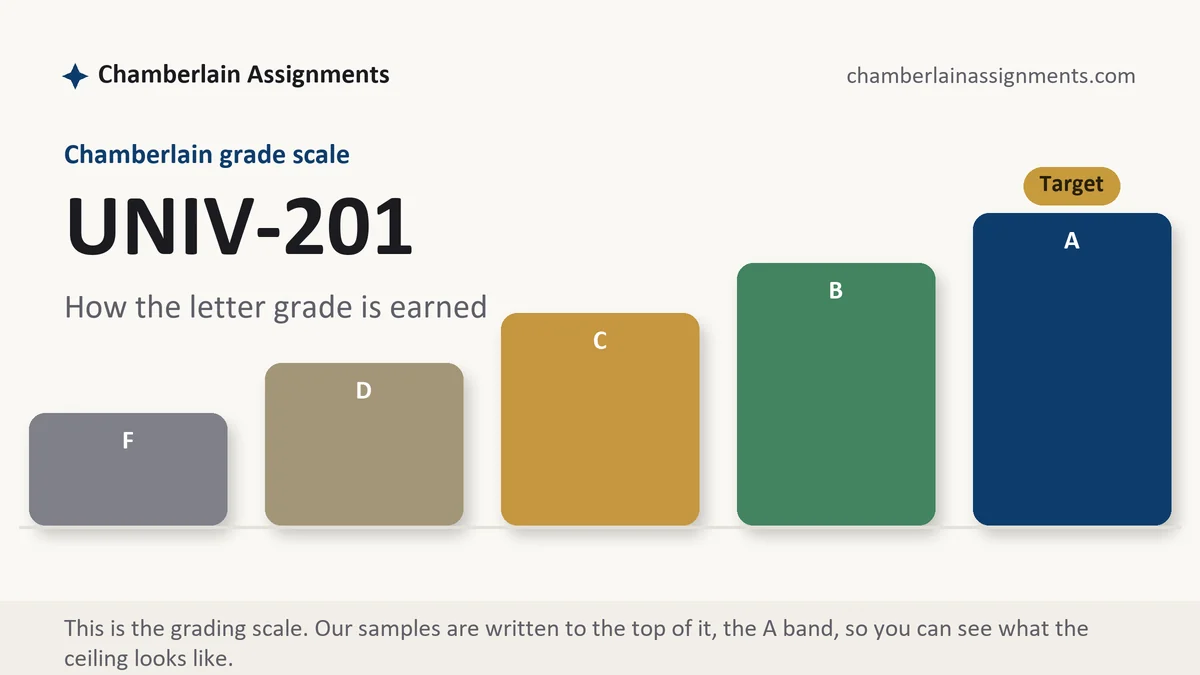
The discipline behind every paper here: the rubric is the outline, each row gets its section, one-shot discussions get the one-shot treatment, and the 76 percent floor is treated as the cliff it is. Send your week's instructions with a request and the sample matches them, revisions included.
UNIV-201 questions, answered
Will one sample fit the other seminars in this sequence?
Not well, and reusing it that way is visible. Each seminar in the run sits at a different point and is marked for a different move: this one for stated connections, the next for ordered reasoning, the 300-level pair for weighing two things and for defending a quantity. Send the code you are actually sitting in and the sample matches that stage.
My week wants a diagram. Does the sample include one?
It includes whatever your prompt names, and the written half comes with it either way, because that is where nearly every row lives. A figure whose connections go unnamed scores below a plain paragraph saying what acts on what. Tell us the format your section requires and both halves arrive matched to it.
Is this marked on nursing knowledge or on writing?
On writing, using nursing material. The rows ask whether a relationship was stated, not whether you can recognize a condition, which is why a submission with nothing wrong in it can still finish mid band. Send the rubric alongside the prompt and the example is aimed at the rows carrying the weight.