Send the exact assignment or rubric from your classroom and a custom sample written to it lands in 24 to 48 hours, the first one free. MSW-525 is Chamberlain’s Trauma Treatment for Children and Adolescents course. It centers on structured treatment with children and adolescents: matching a model to an age, and the work a caregiver is asked to do. Searches like "msw 525 week 4 assignment example", "MSW525 sample paper", and "MSW-525 week samples" land on this page.
What MSW-525 is really about
This is a protocol course. Most of the session sits with structured models built for young people, above all a trauma-focused cognitive behavioral sequence whose components run in a set order: psychoeducation, relaxation, work on feelings, cognitive work, the narrative itself, then sharing that narrative with a caregiver. Several sections add expressive and play-based approaches for children too young to work verbally, and eye movement protocols turn up in the reading. What the classroom keeps testing is fit. A twelve-session manual written for a nine-year-old does not transfer to a fifteen-year-old by being shortened, and saying why is most of the argument a paper has to carry. Sections differ on how many models they cover, never on that requirement.
Just as firmly, the sections treat the child as one client among several in the room. A caregiver runs in a parallel track for most of the model, learning what the reactions mean, practicing responses, and eventually hearing what the child wrote. That adult may be exhausted, may be the reason a referral happened, and may be a foster parent three months into knowing this child at all. Assignments ask you to plan for that person as deliberately as for the young client. Around both sit schools, child welfare workers and sometimes a court, each holding a piece of the picture and none of them able to act alone. Coordination is graded work in this classroom, not background.
What MSW-525’s assessments ask for
Deliverables in most sections read like the paperwork of a real course of treatment. An early paper sets two models against one referral and commits to one, with the evidence for the choice and the population it was tested on. Handouts follow: something a caregiver could read in a waiting room without a glossary, which is harder than it sounds and graded on plain language. The middle weeks build the narrative work, planning how a young client moves toward telling it and what happens if they stall. Later assignments handle the school and the session record, and a closing document sets out how the work ends and what would bring a family back. Most sections also grade a weekly discussion, usually on a point the reading left open.
Where students lose points in MSW-525
Points go first to papers that pick an approach and never defend it, naming a model in the opening line as though the name were the argument. The rubric wants the study, the population it was tested on, and the reason it suits this referral. Second is the plan written for a child with no age. Vocabulary, session length, homework and who keeps the record all change between eight and sixteen, and a plan that would fit either has not planned anything. Third is the caregiver reduced to a signature on a consent form. Fourth is a closing section that stops at the last appointment and says nothing about afterward. Fifth is the caregiver material written at graduate reading level, which rubrics score as a plain language failure.
The MSW-525 drawers
MSW-525 Week 1 discussion post example
Week 1 typically opens on what a manual can and cannot decide for a young client. On request, free, 24-48h.
MSW-525 Week 2 treatment model comparison example
Week 2 often sets two approaches against a single referral and asks for a commitment. On request, free, 24-48h.
MSW-525 Week 3 caregiver handout example
Week 3 in many sections wants a page an adult at home could read without a glossary. On request, free, 24-48h.
MSW-525 Week 4 trauma narrative plan example
Week 4 commonly maps how a child moves toward telling the account, and what happens if that stops. On request, free, 24-48h.
MSW-525 Week 5 play session write-up example
Week 5 frequently covers younger children and the work that happens with very little talking. On request, free, 24-48h.
MSW-525 Week 6 school coordination memo example
Week 6 usually brings in teachers, counselors and case workers already holding pieces of the file. On request, free, 24-48h.
MSW-525 Week 7 session progress review example
Week 7 often asks whether the repeated measures moved and what follows if they did not. On request, free, 24-48h.
MSW-525 Week 8 termination session plan example
Week 8 usually documents the ending: last appointments, the handoff, and what would reopen the case. On request, free, 24-48h.
Your classroom shows something else?
Chamberlain University revises courses; week counts and deliverables shift between terms. Send what your classroom shows and the desk matches it exactly.
Using a MSW-525 sample the right way
Look at how a strong example handles sequence. The components run in an order for a reason, and a sample shows where a writer justifies moving one rather than treating the manual as optional. Watch the caregiver sections in particular, because the register there is different: warmer, shorter sentences, no clinical shorthand. Every young client in these documents is invented and the referral detail is built to match what your prompt describes, so nothing from a real family sits anywhere in the file. Use the shape of the plan and write your own clinical reasoning into it. Sequence and register are the parts that transfer.
How these samples are written
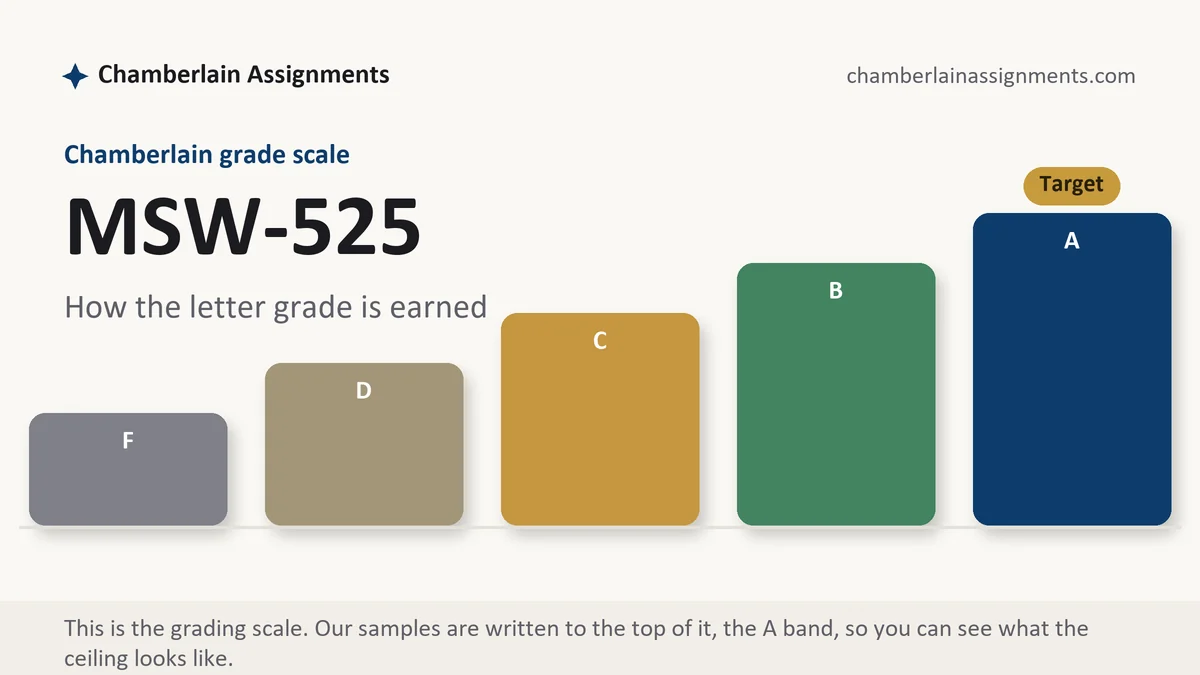
The discipline behind every paper here: the rubric is the outline, each row gets its section, one-shot discussions get the one-shot treatment, and the 76 percent floor is treated as the cliff it is. Send your week's instructions with a request and the sample matches them, revisions included.
MSW-525 questions, answered
My section names a model I have never worked with. Can a sample still be written to it?
Yes, and that is the common request in this course. Send the assignment plus whatever the classroom supplies about the approach, a component list, an article, a manual excerpt, and the sample is written inside that structure rather than a generic one. Where the literature is thin on a specific model, the sample says so and cites what does exist instead of inventing support.
The prompt wants a session-by-session plan. How specific should that get?
Specific enough that another worker could run the session and know when it went wrong. That means a purpose for each meeting, what the child is doing in it, what the caregiver is doing that week, and the marker that says whether to move on. Vague plans read as untested. A sample shows the level of grain that scores, and where a rubric stops requiring it.
My assignment asks for the narrative itself. Can a sample show one?
It can show an invented one written at an age-appropriate reading level, along with the plan that produced it and the notes about pacing around it. What no sample does is draft a narrative for a real young person, because that account belongs to the child and no one else can write it. Send the assignment and the model comes back built on a fictional case.