Send the exact assignment or rubric from your classroom and a custom sample written to it lands in 24 to 48 hours, the first one free. NR 325 is Chamberlain’s Adult Health II course. It centers on patients whose condition moves during a shift, where the marked skill is reading a direction early and acting before the number is obvious. Some program versions carry this course as NR 330; the same drawers apply. Searches like "nr 325 week 4 assignment example", "NR325 sample paper", and "NR 325 week samples" land on this page.
What NR 325 is really about
By the second medical-surgical course the patients stop holding still. The conditions are the ones that declare themselves over hours, and a set of readings taken at eight is not information until it sits beside the set taken at four. That is a genuinely different reading habit from the one built earlier. A blood pressure inside the range on paper can be the most alarming thing on the chart if it has dropped through the afternoon and the heart rate has climbed to meet it. Most of the writing in this course is an argument about direction, and the strongest answers say what they expect to happen next rather than what has happened already.
The other half of the course is about therapies that are dangerous in their own right. A drug that thins the blood, a machine that takes over a kidney, a regimen that suppresses the marrow: each one buys something and charges for it, and the nursing work is largely the collection of that charge. Assignments keep asking the same shape of question. What does this treatment make more likely, what would the first sign of it be, and what stops if you see it. The course also cares about when you speak. A change noticed at the bedside and mentioned three hours later is a change nobody could act on, so written work often has to name the point in the trend where waiting stopped being reasonable.
What NR 325’s assessments ask for
Weekly work generally pairs an acute condition with the therapy used against it. Case assignments arrive with more than one set of observations attached and ask what the sequence shows, which is a different question from what the latest figure means. Laboratory work reappears with results read across days rather than one at a time. Treatment focused assignments ask what you would check before starting something, what you would watch while it runs, and what would make you stop it and call. Some weeks want a handover written for the nurse coming on, which is marked on what you chose to lead with. Discussions frequently open on a patient who deteriorated quietly, and the reply that earns points identifies the reading where the picture had already turned.
Where students lose points in NR 325
The costly answer is the snapshot: one set of numbers interpreted as though nothing preceded it, which reads as a chart being described rather than a patient being followed. Second is the trend noticed and then left alone, where a paper points out that the urine output has fallen for three hours and concludes by continuing to monitor. Third is the therapy written as a definition, with its mechanism explained and no mention of the thing it makes more likely in this person. Beyond those, an escalation with no timing attached, a handover that opens at admission instead of at the change, ranges quoted with no reference to what this patient usually runs, and language soft enough to leave a reader unsure whether you were worried all cost points.
The NR 325 drawers
NR 325 Week 1 discussion post example
Week 1 typically contrasts a patient who is stable with one who looks it. On request, free, 24-48h.
NR 325 Week 2 case study analysis example
Week 2 generally supplies observations from three points in a shift rather than one. On request, free, 24-48h.
NR 325 Week 3 laboratory trend write-up example
Week 3 often asks what a set of results is doing across several days. On request, free, 24-48h.
NR 325 Week 4 cardiac case response example
Week 4 commonly follows a heart failing to keep up with what is asked. On request, free, 24-48h.
NR 325 Week 5 concept map example
Week 5 usually links an acute condition to the risks its own treatment carries. On request, free, 24-48h.
NR 325 Week 6 treatment safety analysis example
Week 6 in many sections examines a therapy whose main danger is itself. On request, free, 24-48h.
NR 325 Week 7 handover report example
Week 7 frequently asks for a change of condition passed on in a minute. On request, free, 24-48h.
NR 325 Week 8 deterioration case paper example
Week 8 tends to follow one patient from the first reading that looked odd. On request, free, 24-48h.
Your classroom shows something else?
Chamberlain University revises courses; week counts and deliverables shift between terms. Send what your classroom shows and the desk matches it exactly.
Using a NR 325 sample the right way
Time is the thing to watch in a finished one. The strong ones put two or three moments side by side early on, so a reader can see the direction before any conclusion is offered, and the conclusion when it arrives is about where things are heading. Watch how the writer attaches a threshold to every parameter being followed and says out loud what would end the waiting. Then rebuild it around the readings your own case gives you, because a trend belongs to one patient and the point at which theirs becomes worrying depends on where they started. Everything else in the document is there to make that point defensible.
How these samples are written
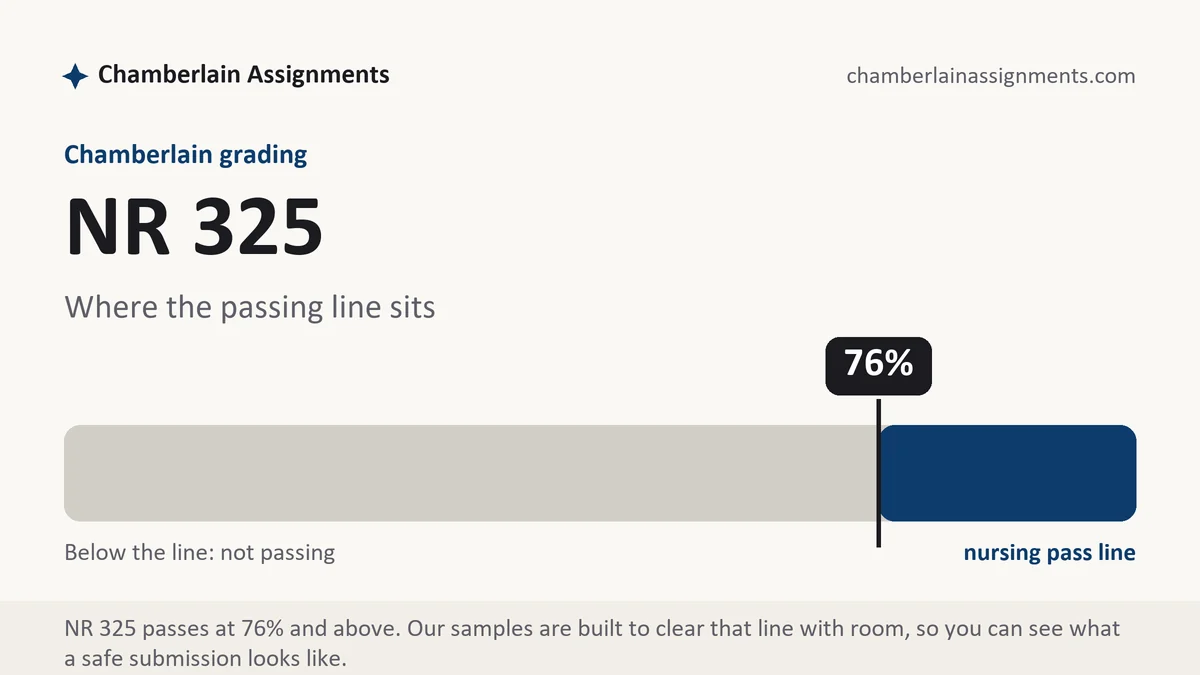
The discipline behind every paper here: the rubric is the outline, each row gets its section, one-shot discussions get the one-shot treatment, and the 76 percent floor is treated as the cliff it is. Send your week's instructions with a request and the sample matches them, revisions included.
NR 325 questions, answered
How do I show a trend when I only have one set of numbers?
Ask for the rest, or say plainly that you cannot. If the case supplies a single reading, name what you would want beside it and by when, which shows the grader you know a value on its own decides very little. Where earlier figures do exist in the prompt, put them in the same sentence so the direction is visible.
What should a handover lead with?
The reason this patient is different from the one on the sheet an hour ago. Open with what changed and what you are worried about, then give the background only as far as it explains the worry. A handover organized as a life history makes the incoming nurse find the important part themselves, and that is where handovers lose marks.
Do I need to name what is wrong with the patient?
You need to name what you are watching and why, which is not the same as settling a diagnosis. Say what the readings are doing, what that pattern is consistent with, and what you would do next if it continues. Undergraduate work is marked on recognition and response, and an answer that skips both to arrive at a label has skipped the assessed part.