Send the exact assignment or rubric from your classroom and a custom sample written to it lands in 24 to 48 hours, the first one free. NR 449 is Chamberlain’s Evidence Based Practice course. It centers on the distance between evidence that already exists and practice that has not changed because of it, and what closes that distance. Searches like "nr 449 week 4 assignment example", "NR449 sample paper", and "NR 449 week samples" land on this page.
What NR 449 is really about
Research produces findings faster than practice absorbs them, and the delay is measured in years rather than months. NR 449 takes that delay as its subject. Somewhere on your unit is a routine that the literature stopped supporting a long time ago, and it survives not because nobody read the study but because reading a study changes nothing on its own. Somebody has to want the change, somebody has to pay for it, a policy has to be rewritten, and the people on nights have to find the new way easier than the old one. The course asks you to look at a persistent practice and explain its persistence.
That framing changes what counts as an answer. A summary of five studies is not a finding in this course; it is the easy half. The graded half asks who currently decides, what the current routine protects, which staff group absorbs the extra work, what the change would cost in time or money, and who could stop it. Barriers get named specifically rather than listed as resistance to change, since that phrase explains nothing and appears in every weak paper. The strongest work in NR 449 usually ends somewhere modest, with one unit, one shift, one measurable behavior and a person who agreed to try it, because a proposal nobody has agreed to is a wish with citations attached.
What NR 449’s assessments ask for
Assignments in many sections move from a problem you can point at to a change somebody could authorize. Early assignments typically want the practice described as it currently runs, in enough detail that a reader who has never been on your unit can picture the sequence and see where it goes wrong. Middle weeks bring the evidence in, and the ask is narrower than it looks: not everything published on the subject, but the studies that speak to this practice in this setting, with their limits stated honestly. Later work asks for the plan, including who has to approve it, how it would be introduced, and what number would tell you six months later whether anything stuck. Discussions early in the week often trade examples of routines that outlived their reasons.
Where students lose points in NR 449
The dominant failure here is the paper that stops at the evidence. It finds good studies, summarizes them accurately, recommends that practice should change, and never says by whom, starting when, or against what objection, which leaves the implementation rows empty no matter how strong the reading was. Second is the barrier section written in abstractions, where staff resistance and lack of buy-in stand in for the actual reasons: the supply is kept on another floor, the form takes four minutes, the night charge nurse was never told. Third is the outcome nobody could measure, usually stated as improved awareness or increased knowledge. Recommendations aimed at everyone, plans with no owner, and evidence chosen because it agreed with you cost points on the same rubric rows.
The NR 449 drawers
NR 449 Week 1 discussion post example
Week 1 usually asks for a routine on your unit that nobody can justify. On request, free, 24-48h.
NR 449 Week 2 practice problem statement example
Week 2 often pins the practice down as it currently runs, step by step. On request, free, 24-48h.
NR 449 Week 3 evidence summary example
Week 3 typically gathers only the studies that speak to that one practice. On request, free, 24-48h.
NR 449 Week 4 stakeholder analysis example
Week 4 commonly asks who would have to agree before anything on the unit changed. On request, free, 24-48h.
NR 449 Week 5 barrier analysis example
Week 5 in many sections names what physically stops the change, not attitudes. On request, free, 24-48h.
NR 449 Week 6 practice change proposal example
Week 6 often wants a plan small enough that one ward could start Monday. On request, free, 24-48h.
NR 449 Week 7 evaluation plan example
Week 7 frequently asks what number would show six months later that it held. On request, free, 24-48h.
NR 449 Week 8 dissemination brief example
Week 8 tends to ask who outside the unit still needs telling, and by whom. On request, free, 24-48h.
Your classroom shows something else?
Chamberlain University revises courses; week counts and deliverables shift between terms. Send what your classroom shows and the desk matches it exactly.
Using a NR 449 sample the right way
Read a sample for the second half rather than the first. Anyone can see how the studies were summarized; what is worth studying is the paragraph where the writer names the person who would have to say yes, the paragraph that costs the change out, and the sentence that says what would be counted afterwards. Then rebuild it around a practice you can actually watch, because the whole argument depends on knowing who does what on which shift, and no sample can know that about your workplace. Any approval, permission or sign-off your site requires stays entirely with you.
How these samples are written
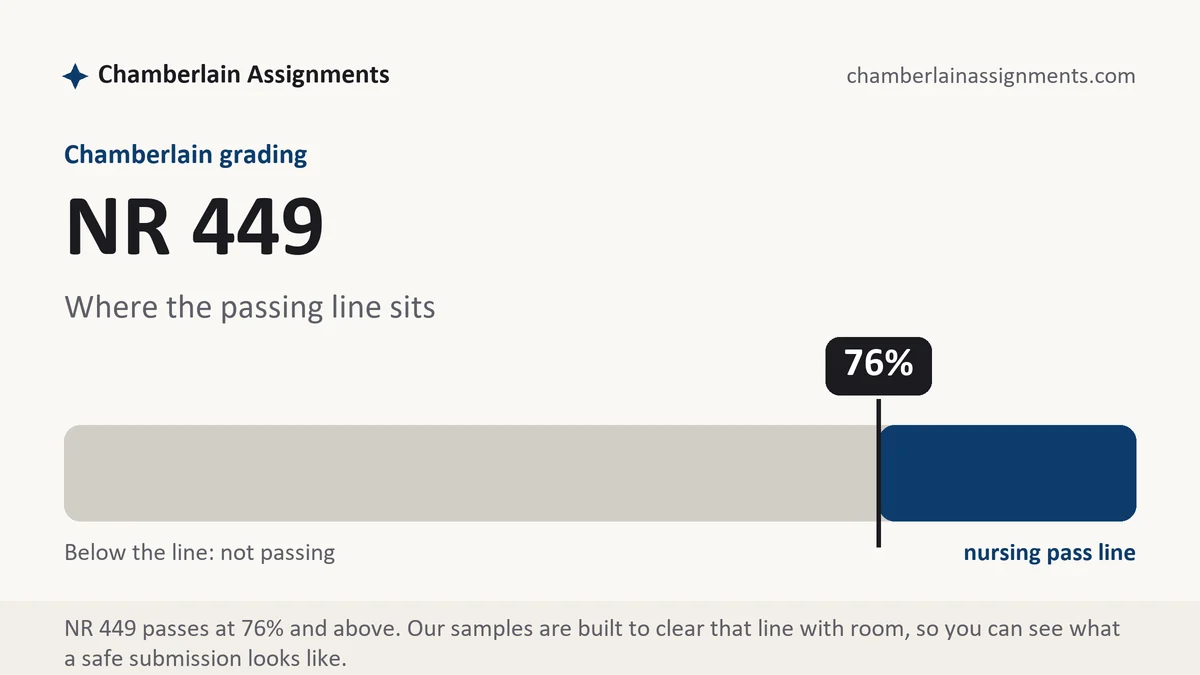
The discipline behind every paper here: the rubric is the outline, each row gets its section, one-shot discussions get the one-shot treatment, and the 76 percent floor is treated as the cliff it is. Send your week's instructions with a request and the sample matches them, revisions included.
NR 449 questions, answered
How is this different from the research course?
The research course teaches the ladder: a question in PICOT form, a search, an appraisal, a synthesis, each one a document. NR 449 assumes that ladder has been climbed and asks the question waiting at the top, which is why nothing changed. Its subject is adoption rather than appraisal, so the deliverables point at people, costs and approvals instead of at study designs.
Can I write about a change my unit already made?
That often works better than a hypothetical one, because you can say what actually happened rather than what should. Describe the practice before, the evidence behind the move, who authorized it, what got in the way, and whether the new routine survived once attention moved elsewhere. A change that quietly reverted is a stronger subject than one that succeeded, since the reasons are visible.
My proposal keeps growing. How small is too small?
Almost nothing is too small in this course. One checklist on one ward, one handover script, one item moved to a cupboard people actually pass: each of those has an owner, a cost and a countable result, which is everything the later rubric rows want. Proposals that cover a whole hospital tend to lose points precisely because nobody in them is answerable.