Send the exact assignment or rubric from your classroom and a custom sample written to it lands in 24 to 48 hours, the first one free. NR 542 is Chamberlain’s Managing Data and Information course. It centers on how a clinical question turns into a query, a report and a figure that holds up when somebody disputes it. Searches like "nr 542 week 4 assignment example", "NR542 sample paper", and "NR 542 week samples" land on this page.
What NR 542 is really about
Reports look objective, which is what makes them dangerous. Behind every rate on a dashboard sit a numerator somebody defined, a denominator somebody chose, a time window and a set of records that were quietly excluded, and each of those was a judgment. This course puts the judgments back on the page. Students who have only ever used reports find the shift uncomfortable, because the work is no longer reading a figure but defending one, and defending it means writing down what you counted and what you left out. The strongest submissions read like an audit trail, where anyone following the description could rebuild the number and land on the same answer.
Storage and structure occupy the other half. Where values live, how tables relate, what a query has to join to answer an ordinary clinical question, and why the answer changes when a field is entered as free text instead of a coded value all belong here. None of this requires becoming a database developer, but it does require knowing enough to say why a request that sounds simple takes a week. Data quality arrives as the practical version of the same subject, since completeness, timeliness and consistency are not abstract virtues but the specific reasons a number was wrong on a specific Tuesday.
What NR 542’s assessments ask for
Assignments in many sections start from a question a manager might ask and make you take it apart. The prompt usually wants the population defined before anything is counted, the fields named, the exclusions justified, and the limits of the answer stated in the same paragraph as the answer itself. Other work supplies a report or a small dataset and asks what it does not support, which is where most of the marks sit. Later assignments often move to design, asking how you would collect something not currently captured and what burden that adds to whoever enters it. Discussions early in the week regularly circle a figure two departments calculate differently, and the useful reply explains why both are defensible.
Where students lose points in NR 542
Marks disappear first into undefined populations. A paper that reports a rate without saying who was included has produced a number nobody can check, and checking is the whole subject of the course. A second loss is confusing what was measured with what was meant, so a count of documented assessments becomes a claim about assessments performed. Third is the quality section written as a list of dimensions with no example of any of them failing. Charts pasted without interpretation, comparisons across periods where the definition changed, conclusions that outrun the sample, and recommendations requiring data the organization does not collect all cost marks. The weakest papers of all present a figure with confidence and never say who would be entitled to disagree with it, which is the one question this course exists to make unavoidable.
The NR 542 drawers
NR 542 Week 1 discussion post example
Week 1 usually asks what a familiar dashboard figure actually counts. On request, free, 24-48h.
NR 542 Week 2 data question brief example
Week 2 typically converts a manager question into a countable definition. On request, free, 24-48h.
NR 542 Week 3 database structure write-up example
Week 3 often explains where values sit and what a query must join. On request, free, 24-48h.
NR 542 Week 4 reporting plan example
Week 4 in many sections plans a report and states its exclusions upfront. On request, free, 24-48h.
NR 542 Week 5 data quality audit example
Week 5 commonly hunts for the fields that make a figure untrustworthy. On request, free, 24-48h.
NR 542 Week 6 dataset analysis example
Week 6 often reports a result and then says what it cannot prove. On request, free, 24-48h.
NR 542 Week 7 collection design brief example
Week 7 typically designs capture for something nobody currently records. On request, free, 24-48h.
NR 542 Week 8 data management paper example
Week 8 usually defends one number from question through to its stated limits. On request, free, 24-48h.
Your classroom shows something else?
Chamberlain University revises courses; week counts and deliverables shift between terms. Send what your classroom shows and the desk matches it exactly.
Using a NR 542 sample the right way
Read a sample for its definitions before you read its findings, because the definitions are what the marking follows. Notice how the writer states the inclusion rule and the window first, then reports, then names what the figure cannot show, and how that order stops the paper from overclaiming. Study the limitations paragraph in particular, since it is usually shorter and more useful than students expect. Then rebuild the argument with a question from your own setting, because a report you have seen argued about produces sharper exclusions than an invented one ever will.
How these samples are written
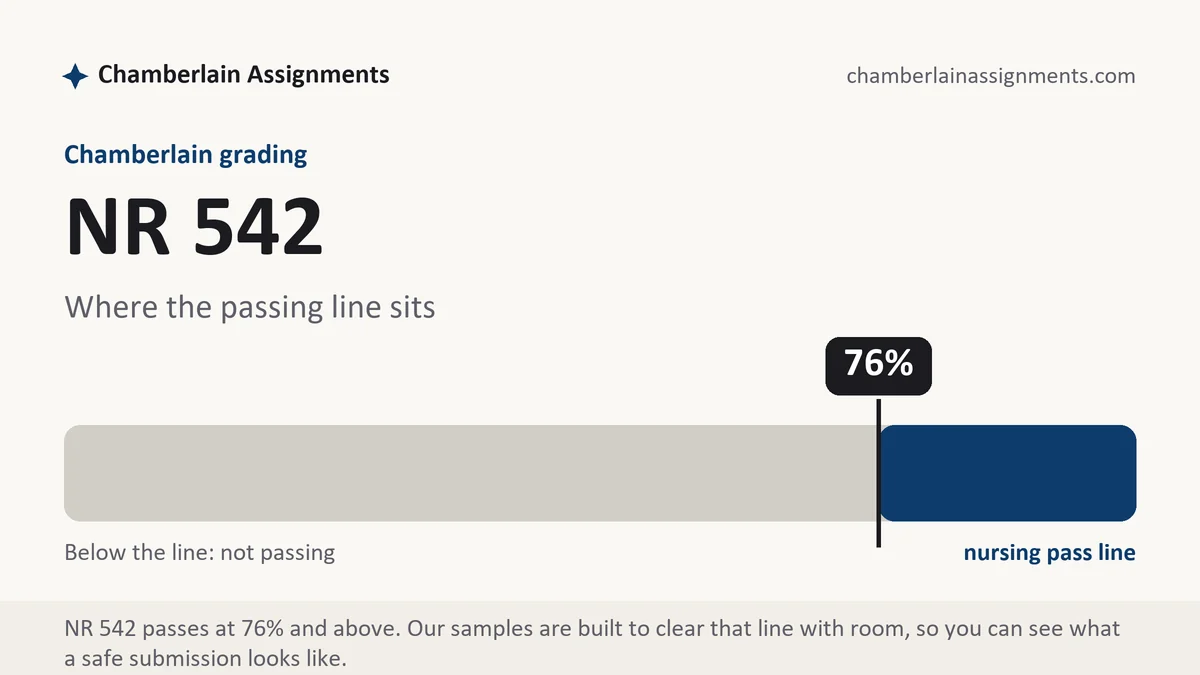
The discipline behind every paper here: the rubric is the outline, each row gets its section, one-shot discussions get the one-shot treatment, and the 76 percent floor is treated as the cliff it is. Send your week's instructions with a request and the sample matches them, revisions included.
NR 542 questions, answered
Do I need SQL for this course?
Rarely at a level that would trouble a beginner. Sections vary, and some show queries so you can see what a join costs, but the graded argument is about definitions and interpretation. If your section does ask for query work, the reasoning still carries most of the weight, since a correct query answering the wrong question earns nothing at all.
Can I use data from my workplace?
Only in a form that carries nothing identifying and nothing internal. Most students describe the kind of report they see, reconstruct the definition question and use published or classroom figures for the numbers. That works because the marking is about how you define, exclude and qualify, not about whose records you had access to.
How do I handle a dataset that is obviously messy?
Say so, specifically, and treat it as findings rather than as an obstacle. Naming the missing fields, the duplicate entries and the values that could not be true, then explaining which conclusions survive anyway, is exactly the reasoning being assessed. A clean analysis of a dirty source with no acknowledgment is the weaker paper every time.