Send the exact assignment or rubric from your classroom and a custom sample written to it lands in 24 to 48 hours, the first one free. NR 577 is Chamberlain’s Primary Care Management of Adolescents and Adults course. It centers on managing adolescents and adults at the point where risk is still becoming disease and the first entries reach the chart. Searches like "nr 577 week 4 assignment example", "NR577 sample paper", and "NR 577 week samples" land on this page.
What NR 577 is really about
This is the part of the lifespan where most of what you do stays invisible for twenty years. The patient is usually well, or has one thing wrong, and the graded question is what to start, what to screen for, and what to say. Both halves of the title bring their own difficulty. Adolescents come with a third party in the room, so consent, confidentiality and who receives a result are clinical decisions made before anything is examined, and they belong in the note. Adults come with a schedule, a job and a budget, which decide whether the plan you wrote gets carried out at all. A plan somebody cannot afford is a plan that did not happen.
The second thing NR 577 teaches is that a decision made at these ages becomes the history everybody else inherits. A diagnosis entered today will be read as settled fact by a clinician forty years from now, which is reason enough to write what the evidence was and what stayed uncertain. Screening arguments work the same way. An interval is a judgment about this person's risk rather than a default, and strong submissions say what raised or lowered it. Behavior is where most of the outcome lives here, so counseling is assessed as an intervention with a method behind it, aimed at one change the patient agreed to rather than at a list of things they should do.
What NR 577’s assessments ask for
Weekly work in many sections is built from ordinary visits. An assignment supplies a young or middle aged patient and asks for a plan carrying the screening that suits their risk, the immunization status checked, the diagnosis started or excluded, and counseling written in words the patient could repeat afterwards. Adolescent assignments generally expect the confidentiality question answered out loud, including what goes into the record and who else can see it. Assignments commonly want cost, working hours and access addressed wherever they decide adherence. Discussions early in the week take one prevention argument and ask you to defend an interval, and points come from testing the risk assumption behind a classmate's number.
Where students lose points in NR 577
The most common loss is the recommendation recited without the patient attached: an interval quoted from a national body with nothing in the note explaining why it fits this person's risk. Second is the plan written for somebody with time and money, handed to a patient holding two jobs, and never adjusted, because a course about working age adults treats access as clinical information. Third is the adolescent visit written as though the young person were a small adult or a large child, with consent and confidentiality left unaddressed. Counseling reduced to advice given, risk factors listed but never scored, a first diagnosis recorded without its evidence, and follow-up with no return trigger cost points as well.
The NR 577 drawers
NR 577 Week 1 discussion post example
Week 1 commonly opens on what a well visit is for when nothing hurts. On request, free, 24-48h.
NR 577 Week 2 adolescent visit note example
Week 2 typically writes a private conversation into a record a parent may read. On request, free, 24-48h.
NR 577 Week 3 preventive care plan example
Week 3 often builds screening around one patient's risk instead of a default schedule. On request, free, 24-48h.
NR 577 Week 4 chronic disease visit note example
Week 4 usually starts treatment for a condition entering the chart for the first time. On request, free, 24-48h.
NR 577 Week 5 counseling write-up example
Week 5 in many sections wants one behavior change the patient has actually agreed to. On request, free, 24-48h.
NR 577 Week 6 risk assessment write-up example
Week 6 generally scores risk before anything at all is recommended or ordered. On request, free, 24-48h.
NR 577 Week 7 management case analysis example
Week 7 frequently follows a working adult whose shifts keep defeating an agreed plan. On request, free, 24-48h.
NR 577 Week 8 synthesis case write-up example
Week 8 tends to close on prevention argued for one person across a decade. On request, free, 24-48h.
Your classroom shows something else?
Chamberlain University revises courses; week counts and deliverables shift between terms. Send what your classroom shows and the desk matches it exactly.
Using a NR 577 sample the right way
Read a sample for how a recommendation gets attached to a person. Watch where the writer states this patient's risk before naming any interval, how a confidentiality decision is recorded inside an adolescent note, and how counseling is written as one agreed change instead of a paragraph of advice. Then build the visit around your own patient, since the risk, the money and the schedule that make a plan realistic all belong to them. What a sample lends you is the habit of justifying prevention for an individual, which holds whatever the recommendations say the year you write.
How these samples are written
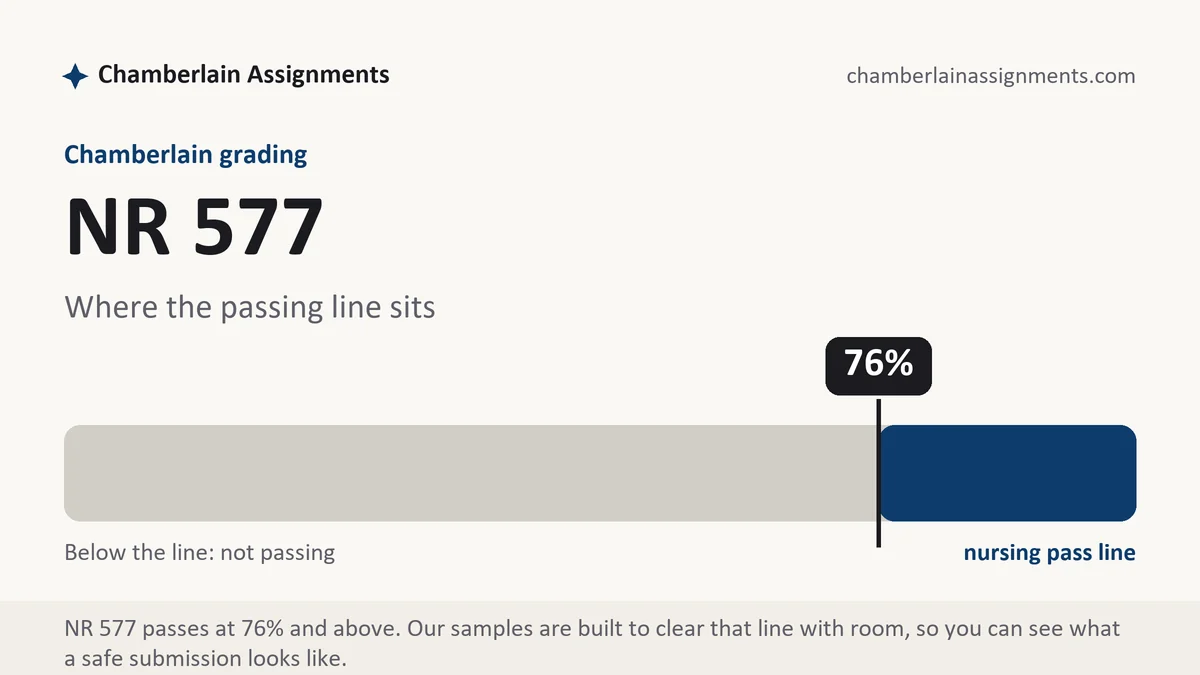
The discipline behind every paper here: the rubric is the outline, each row gets its section, one-shot discussions get the one-shot treatment, and the 76 percent floor is treated as the cliff it is. Send your week's instructions with a request and the sample matches them, revisions included.
NR 577 questions, answered
How do I handle a parent who wants the whole visit reported to them?
Write the decision, not only the outcome. Say what was discussed with the adolescent alone, which state or clinic rules govern that conversation, what you agreed would be shared, and what you documented where. Assignments here are marked on whether the confidentiality question got asked and answered, so leaving it implicit reads as an omission rather than as discretion.
Do I need to name a screening guideline every time?
Cite one where the interval really does come from a published recommendation, then do the part a recommendation cannot do, which is apply it. The mark sits in the sentence connecting that interval to this patient's risk, family history or last result. A citation attached to a claim the source does not actually make costs more than it earns.
My patient already has one chronic condition. Is that in scope?
Yes, and it sits at the center of the course rather than at its edge. At these ages the work is starting treatment, setting a target the patient accepts, and writing what would count as control. Say what you began, why now, what you told them to expect in the first weeks, and when you would change course if the number does not move.